Noise-canceling Headphones
Unfortunately for music lovers, many types of ambient sounds can interfere with or even block the sounds coming through their headphones. If you have ever tried to listen to a CD or MP3 player on a plane, then you know the problem well: The roar of the engines makes it difficult to hear what’s being piped through the speakers — even when those speakers are situated in or on your ear. Fortunately, noise-canceling headphones can provide a more enjoyable listening experience.
Noise-canceling headphones come in either active or passive types. Technically speaking, any type of headphone can provide some passive noise reduction. That’s because the materials of the headphones themselves block out some sound waves, especially those at higher frequencies. The best passive noise-canceling headphones, however, are circum-aural types that are specially constructed to maximize noise-filtering properties. That means they are packed with layers of high-density foam or other sound-absorbing material, which makes them heavier than normal headphones. The tradeoff of all that extra weight is a reduction in noise of about 15 to 20 decibels (dB). But considering jet engines create 75 to 80 dB of noise inside the aircraft cabin, passive models have some serious limitations. That’s where active noise-canceling headphones come in.
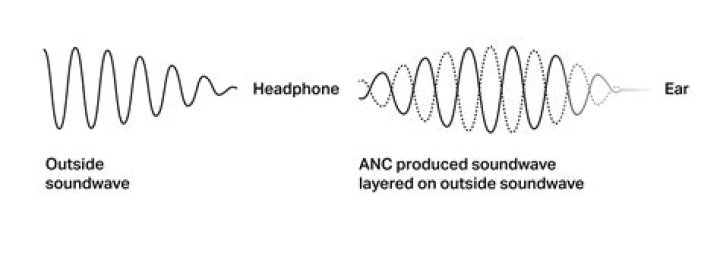
Active noise-canceling headphones can do everything that passive ones can do — their very structure creates a barrier that blocks high-frequency sound waves. They also add an extra level of noise reduction by actively erasing lower-frequency sound waves. How do noise-canceling headphones accomplish this? They actually create their own sound waves that mimic the incoming noise in every respect except one: the headphone’s sound waves are 180 degrees out of phase with the intruding waves.
If you look at the illustration below, you can see how this works. Notice that the two waves — the one coming from the noise-canceling headphone and the one associated with the ambient noise — have the same amplitude and frequency, but their crests and troughs (compressions and rarefactions) are arranged so that the crests (compressions) of one wave line up with the troughs (rarefactions) of the other wave and vice versa. In essence, the two waves cancel each other out, a phenomenon known as destructive interference. The result: the listener can focus on the sounds he wants to hear.
Of course, several components are required to achieve this effect:
- Microphone – A microphone placed inside the ear cup “listens” to external sounds that cannot be blocked passively.
- Noise-canceling circuitry – Electronics, also placed in the ear cup, sense the input from the microphone and generate a “fingerprint” of the noise, noting the frequency and amplitude of the incoming wave. Then they create a new wave that is 180 degrees out of phase with the waves associated with the noise.
- Speaker – The “anti-sound” created by the noise-canceling circuitry is fed into the headphones’ speakers along with the normal audio; the anti-sound erases the noise by destructive interference, but does not affect the desired sound waves in the normal audio.
- Battery – The term “active” refers to the fact that energy must be added to the system to produce the noise-canceling effect. The source of that energy is a rechargeable battery.
Using these components, noise-canceling headphones are able to provide an additional reduction in noise of 20 decibels. That means about 70 percent of ambient noise is effectively blocked, making noise-canceling headphones ideal for airline and train travel, open office environments or any other location with a high level of background noise.
While noise-canceling headphones do a good job distinguishing between the audio a wearer wants to hear and the background noise he or she wants to keep out, some people say that they compromise sound quality by muffling sounds. Users can also experience a change in air pressure, although ports built into the ear cup are meant to vent air trapped behind the speakers.
In spite of these tradeoffs, many people would never go back to normal audio headphones. That’s because noise-canceling headphones do more than reduce noise. They also help alleviate fatigue when traveling, which can result from exposure to low-frequency noise for an extended period of time. You can even use noise-canceling headphones if you don’t want to listen to another audio source but do want to cancel out background noise. And a little bit of quiet can be music to anyone’s ears.
For lots more information on noise-canceling headphones and related topics, check out the links on the next page.
A decibel (dB) is a measure of sound intensity. The dB scale is logarithmic, meaning that a change of 10 dB represents a tenfold change in loudness. So, a sound measuring 30 dB is 10 times louder than a sound measuring 20 dB.
When a headphone is equipped with a small microphone, it is called a headset. Microphones are transducers just like speakers. They change sound waves into electrical signals, while speakers change electrical signals into sound waves.
@yatritrivedi
September 28, 2016, 11:17am EDT
Passive noise reduction, active noise cancellation, sound isolation… The world of headphones has become quite advanced in giving you your own private sound bubble. Here’s how these different technologies work.
Physical Headphone Types
Let’s briefly discuss the different types of headphones out there before we get into noise reduction.
Supra-aural
These are your run-of-the-mill headphones that are padded and sit on your ear. It’s like having a small speaker right next to you, and they’re not too large.
Earbuds
These are the normal earphones that come with your iPod. They’re like tiny speakers that sit right next to your ear canal and are very portable. The sound quality is usually lower and they may not fit correctly because they’re pretty generic.
(Photo: iPhone earbuds by Shanghai Daddy)
Circumaural
Also known as “cans,” these headphones fit around your ear entirely. They create a seal effectively cutting off outside noise. They’re big and bulky, but usually give a much better sound quality because of that. They’re very popular for bands and musicians, and they widely vary in terms of quality and price. Because they create a good seal, they’re pretty good at sound isolation on their own, but you’ll find many that have active noise cancelling, too.
Intra-aural
These are known colloquially as “canalphones” and professionally as “in-ear monitors.” They’re made with an elongated portion that actually goes into your ear canal and uses silicon or rubber caps to create a seal. They’re very portable and offer great sound, and are very good at sound isolation because the seal is made closer to your ear drum. They require frequent cleaning, as you can imagine. While there are cheaper ones available, there are really high-quality, multi-driver ones available for upwards of $300. You can even get custom ear molds made at an audiologist’s or otolaryngologist’s office.
(Photos: Etymotic’s in-ear monitors; Shure earphones with various sleeves by MyLifeStory)
Active Noise Cancelling
Active noise cancelling is arguably the most advanced of noise reduction technology. These types of headphones include some hardware that has its own battery, microphone, and audio processor. They’re often tucked into the headphones themselves, though sometimes they appear as an in-line dongle. It works by taking in ambient sounds via the microphone and adding an inverted sound wave to your audio, effectively cancelling out whatever background noise is obfuscating your music.
The primary issue here is that it doesn’t work for everything, with things like speech remaining unchanged. It works best for consistent sounds in specific registers, like the background noise in airplanes. Different sets of headphones use different technology to accomplish this, with many offering “channels” optimized for specific bands of frequencies. Most don’t work for the upper register at all, hence the speech problem.
SysAdminGeek writer, Aviad, says that they aren’t sufficient to produce silence on their own. He uses earplugs with circumaural noise-cancelling headphones when looking for silence, and if he wants to listen to music, he just turns up the volume. You can also find certain models that can play white noise to help drown out outside sounds in addition to letting you listen to music.
Passive Noise Reduction
Passive noise reducing is the same as “sound isolating.” By creating a seal around your ears or in your ear canals, it attempts to reduce the noise you hear in the first place. This ideally works much better than trying to filter out sound, but in practice, there are problems. The primary issue is creating a proper seal, so many people get custom-mold made for in-ear monitors, or tighten the band on circumaural headphones. The other issue is comfort; many people – including myself – have issues with having tight headphones on or monitors in the ear canal for extended periods of time.
(Photo: ACS Custom ear molds by camflan)
Active vs. Passive
Which method works better? Well, that depends on what your needs are. If you’re looking for something that will drown out a lot of sound and stay fit, the circumaural headphones are probably best. On the other hand, if you want something compact, canalphones are probably for you. I’ve listened to a lot of headphones in my personal quest for the best and I’ve discovered a few things.
- In general, the higher the price tier, the higher the quality. This is especially true for in-ear monitors because you get bonuses like detachable cables, lifetime warranties, and a wider range of caps for your ‘buds.
- Passive noise reduction works well with music. Because the source is closer to your ear drum, you can play it at a lower volume without skimping on quality.
- Quality is very much subjective. It ultimately comes down to your own ears, and your own music. I once passed on a set of really nice Bose cans in favor of some older Shures that made me fall in love with my music collection all over again.
If you’re looking for something that works cheaply, try looking for in-ear headphones with active noise cancelling; the combination should work well for the price. If you consider yourself an audiophile, find what the pros use. There’s a lot out there, and now that you know how they technology works, go listen for yourself.
If you’re a commuter or listen to your music in public, there is no better upgrade you can get than noise cancelling headphones. Many people believe that in order to get better sound quality, they need to spend more, but that’s only half right: you need to also prevent noise that could overpower your music from reaching your ears. Plenty of companies have tried their hand at active noise cancelling (ANC) headphones, and a few have become so good at it that it’s one of the main selling points for their wireless headsets. But how do noise-cancelling headphones work? And why is it so cool?
Editor’s note: this article was updated on August 27, 2020, to include information about noise cancelling technology and dizziness.
Know thy enemy: noise
BBC
To understand how to cancel noise, it’s important to first what sound is. If you try to visualize sound, you probably picture it in the form of a wave like the one pictured above. Though this 2D illustration will definitely come in handy later, it isn’t entirely an accurate depiction of what sound actually is. At least not until you fully understand what it implies. This is where physics kicks in.
Sound as you hear it is really just the compression and decompression of the particles in the medium in it flows through—for our purposes, we’re talking about air. It may be a little easier to picture sound as a 3D ripple through air. Those moving particles lead to very slight changes in air pressure. We call the measured power of these changes in air pressure amplitude. Your ears and brain detect and decipher those changes in pressure as sound. If you were to chart the amplitude, over time you end up with the wave pictured above. The louder the sound, the more extreme the amplitude.
How your headphones cancel outside noise
Your headphones cancel outside noise by using a trick of physics called “anti-phase.” The concept is simple, but very difficult to get right, as you’ll read ahead.
If you were to take two identical waves and place them on top of each other matching up the peaks and troughs, the two waves are said to be “in-phase” which results in an even larger wave (louder sound). But what happens if you delay one of the waves by exactly one half wavelength matching up the the troughs with the peaks of the other like in the picture below?
Constructive and Destructive Interference
The two waves are then said to be “out of phase” and subtract from one another as the positive pressures of one wave are acting against the negative pressures of the other, and vice versa. Think of it as trying to add one and subtract one. You’re just left with zero. This is the basic physics behind active noise canceling. But how is that used in your headphones?
Tiny microphones
The microphone array (shown here as the holes in the side) records the noise around you to calculate how to cancel it
Headphones make use of this by way of tiny microphones on the outside of your headphones. They listen to the ambient noise around you, and then the onboard electronics take it from there. The headphones then create sound that is exactly opposite to that sound wave (the anti-phase) to cancel it out so that all you should hear is the music coming from your headphones—and not anything going on outside.
Of course this is all theoretical. In practice, noise cancellation is hard to do, and far from perfect. Consistent noises like the low hums of jet engines on airplanes are easier for headphones to recognize and cancel when compared to sudden, random sounds like people talking.
While the physics remains the same, some companies are better at active noise cancelling than others. But now that you know how it works, you can pick the pair that’s right for you.
Can noise cancelling headphones cause dizziness?
The Panasonic RZ-S500W made Lily feel disoriented, because of the high-intensity hybrid ANC technology.
Yes, listeners have reported feelings of dizziness and disorientation when using noise cancelling headphones—our very own Lily Katz included. In some cases, headaches and nausea are also present.
According to an interview with the Wall Street Journal, New York ear, nose, and throat doctor Sarah Stackpole explained that noise cancelling technology may transmit extremely low-frequency vibrations that stimulate balance receptors connected to our ears’ stereocilia, or hearing hair cells. What then happens is that these receptors falsely communicate to the brain that the head is moving, despite one’s eyes being fixed. Mixed messages like this can trick the brain into thinking its experiencing motion and thus, dizziness.
One solution to this for moderately affected listeners is to decrease the ANC intensity. This can be done in many headset apps, or it can be changed directly with the headset’s controls. Another solution is to buy a pair of noise cancelling headphones that aren’t at the top of the class. The sub-optimal noise cancelling may be frustrating or disappointing to others who don’t suffer from side effects, but could prove just right for you. The final solution is to forgo active noise cancelling altogether, which isn’t the best option for frequent flyers but may be the most comfortable.
Published May 25, 2020
Share this post
This Amazon commercial bugs the heck out of me. In it, a young boy jumps on a bed, raucously playing an electric guitar while another kid plays drums. Meanwhile, a father relaxes blissfully undisturbed because he’s wearing noise-cancelling headphones. This scene drives me bonkers because, as a headphones expert, I know the truth: That’s not how noise-cancelling headphones work.
It’s a popular misconception that noise-cancelling headphones can block out any sound around you. People purchase them in the hopes of dimming the din of kids at play, loud-talking officemates, the barking dog next door, and airplane engines. The trouble is, active noise cancellation is really effective on only one of those things. (Spoiler: It’s the airplane engine.) The reason has to do with the physics of sound and how noise-cancelling headphones work.
The physics of active noise cancellation
Active noise reduction technology functions primarily by exploiting a principle of physics called phase cancellation. As you probably know, sound travels in waves, moving the air molecules. These waves travel through the air and into your ear canal, where they vibrate your eardrum. However, if a sound wave meets another sound wave that is the exact same in frequency and opposite in amplitude, the two largely negate each other.
Picture the air molecules as a string stretched between two points. If someone were to press down on the string in the direct center, that would disturb the string, causing a ripple. If, as you pressed on the string on one side, someone else were to press on the string from the opposite side at the exact same place with the exact same force, the string would barely move. Although this visual doesn’t precisely communicate how sound waves work, it helps you to picture how a wave, when matched with its opposite in phase, is effectively cancelled out.
Active noise-cancelling headphones use tiny microphones on the inside (and sometimes the outside) of the earcups to process the sound headed toward your ears and immediately play the opposite phase of that sound through the headphone drivers. The opposing forces effectively reduce the air-molecule movement, and you get a reduction in perceptible sound. Again, this description is a simplification, but it’s the basic concept that all ANC headphone designs currently go by.
Generally speaking, this type of active noise cancellation is most effective on lower frequencies of sound, between 50 Hz and 1 kHz. (If you’re curious about what 1 kHz sounds like, watch this video.) This is partly because lower frequencies produce longer waveforms that are easier to line up properly. Also, at higher frequencies, if the waveforms don’t line up just right, you’re more likely to encounter feedback. So most active noise-cancelling headphones have a noticeable dip in usefulness right at the 1 kHz point. This is why ANC is better suited for reducing low, sustained sounds like those of motors and airplane engines, and it’s why such headphones can’t filter out screaming kids. (We’ve talked with researchers who say there are ANC concepts in the works that would do a better job with higher frequencies, but that technology is likely still a few years away.)
What type of headphone should you buy?
For frequent flyers or folks who want to ignore an annoying air conditioner hum, active noise-cancelling headphones are a great option. But what if you want to block out human voices or barking dogs? Well, that’s where passive isolation comes in. Passive isolation is a physical barrier between your ears and the sounds you don’t want to hear. Many of the best—and, usually, the most expensive—noise-cancelling headphones are equipped with earcups and earpads designed to block as much mid- and high-frequency noise as possible while remaining comfortable. So you get the best of both worlds: active and passive noise reduction.
However, if you’re looking to block out only human voices and other higher-frequency sounds, you have other options. A pair of less expensive, passive headphones might serve you just as well. Nearly all closed-back, over-ear headphones—especially those designed for recording—do a solid job of attenuating the sounds of kids playing, workmates chatting, and dogs barking.
The Best Noise-Cancelling Headphones
Whether you prefer over-ear or in-ear noise-cancelling headphones, we have recommendations to help bring peace to your next trip.
My noise-cancelling headphones are my best friend.
They block out the screech of train brakes, the hum of an AC unit, or the roar of a jet engine, reducing otherwise ear-splitting sounds to an almost-pleasant background hum. Even as I write this sentence, I’ve got noise-cancelling headphones blocking out the dulcet tones of my coworkers’ conversations. In this post, let’s take a look at how noise cancellation works.
How do noise-cancelling headphones work?
Technically, all headphones have some sort of capability for passive noise cancellation. If the headphones go all the way over your ears, they physically block out some of the vibrating air that would otherwise be entering your eardrums for your brain to interpret as unwanted noise. Even something as simple as sticking a cotton ball in your ear qualifies as a form of passive noise cancellation.
When we refer to noise-cancelling headphones, typically we’re talking about a technique known as active noise cancellation. Active noise cancellation, frequently abbreviated as ANC, has a number of applications outside of consumer audio. That said, for our purposes, let’s focus on how active noise cancellation is deployed in the context of headphones.
To understand how active noise cancellation works, let’s think about what noise is. The signal that the listener wants to hear is coming from the sound source through the headphones, and the noise is anything coming from outside that might interfere with the listener’s ability to hear the signal.
Keep in mind that at its most basic level, sound is a pressure wave. When we look at a waveform, we’re looking at a representation of the compression and rarefaction of air. If we were to play two identical waves at the same exact time, we’d hear the same thing we’d hear if we played only one, except at a greater amplitude. However, if we were to move one of the waves out of phase by 180 degrees, we would hear nothing! When one signal is played at an inverted phase, the peaks and troughs of the two identical waves cancel each other out. If two signals cancel each other completely, you can say that they phase cancel, or null, with each other. This is an important technique in many other audio engineering applications as well, but we’ll have to revisit that in another blog post.
So, how does this relate to headphones? Well, active noise cancelling headphones could technically be referred to as headsets since they have microphones embedded within them. The onboard mics record the outside noise that’s meant to be cancelled, and then the headphones’ DSP (digital signal processing) chip analyzes the noise, using the manufacturer’s algorithms to predict the most accurate possible representation of the outside noise that the headphones’ mics are picking up. Then, the noise is removed from the signal via phase cancellation as the headphones invert the phase of the noise and add it to the playback, resulting in less outside noise reaching the listener’s ears.
Limitations
Active noise cancellation isn’t perfect. For example, as the unwanted noise increases in frequency, it becomes more difficult to analyze. In practice, this means that active noise cancellation is most effective at removing low-frequency, periodically repeating ambient noises like the hum of an airplane.
Although they might be more comfortable than your studio cans, using noise-cancelling headphones for music production might not necessarily be the best idea. As outlined above, active noise cancellation will alter the input signal, which would be unacceptable for mixing and mastering applications where detailed listening is important.
Cost is another limitation of active noise cancellation for consumer audio. The tiny mics, powerful DSP chips, and proprietary algorithms are quite expensive, especially compared to passive noise cancellation options. If you’re already working in a relatively quiet space, or if you’re looking to use them for studio applications, I would recommend an open-back or semi-open-back pair of headphones instead of circumaural noise-cancelling headphones.
Hopefully, you now have a better understanding of how noise-cancelling headphones work and what applications they might be useful for. Time to sit back and enjoy your music instead of the scream of ablative material coming off the brakes as the train pulls in for your morning commute. Happy nulling!
While traveling on a bus, we often tend to pop our earphones in to listen to some good music and pass the time. Unfortunately, it often happens that the ambient noise is so high that instead of listening to the music, we sometimes hear a strange medley of patchy music and irritating noise. At that moment, our eyes enviously wander to someone who can’t seem to stop bobbing their heads, completely lost in their music. In that instant, we know what advantage they have – noise-canceling headphones! We know the feeling, and it’s alright to be a little jealous.
However, all envy aside, have you ever wondered what’s so special about those particular headphones that make them вЂnoise-canceling’?
Noise-Canceling Headphones
Noise-canceling headphones are a special type of headphones that minimize unwanted ambient sounds entering your ear through active noise control. Their obvious advantage lies in their ability to reduce unwanted noise and enhance the overall listening experience.
Credit” Tomasz Zajda/Fotolia
Listening to music with noise-canceling headphones is a wonderful experience, as they enable you to listen to music without having to increase the volume to uncomfortably high levels (which can negatively affect your ears and hearing). These types of headphones are also used by aircraft crew to listen to vital announcements and other pieces of information with much more clarity in the noise surrounding an aircraft.
How do noise-canceling headphones work?
While listening to music on a pair of noise-canceling headphones, you can immediately sense how awesome they are, as they almost completely block out any unnecessary sound waves from entering your ears. However, if they’re so effective, why can’t regular headphones be noise-canceling in nature?
Passive noise-canceling
Almost every pair of headphones provides some protection against unwanted noise due to the material itself. The basic design and material block out certain sound waves, especially high-pitched ones (shrill, high-frequency sounds). That being said, the best passive noise-canceling headphones are more specially designed; these headphones have multiple layers of high-density foam (or some other noise-absorbing material) packed inside them. They reduce the noise by 15-20 decibels, but on the downside, they are slightly heavier than regular headphones.
Although these headphones do improve your listening experience, when you are inside an airplane cockpit listening to important pieces of information that could affect the lives of hundreds of people, you need something even stronger.
Active noise-canceling
In addition to everything that passive noise-canceling headphones do, active noise-canceling headphones take noise reduction to a different level altogether. Their design is such that not only do they have all the noise-absorbing materials packed inside them, but they also employ a novel technique to compensate for the noise coming in.
They make their own sound waves!
The moment an ambient sound wave (noise from the surroundings) hits this type of noise-canceling headphones, the headphones create their own sound wave that is very similar to the ambient sound waves; the only difference is that the waves the headphones make are 180 degrees out of phase from the ambient sound waves.
In other words, they make sound waves so that the new crests superimpose on the trough of the ambient waves, and the new troughs superimpose on the ambient crests. Check out the figure below for more clarity:
This means that these two вЂoppositely oriented’ waves cause destructive interference and cancel each other out completely. As a result, the listener can clearly hear the sound (e.g., an important message, a music piece) being played on the headphones.
Since these headphones create their own waves, they need an energy source to do so. This is why noise-canceling headphones come with a battery (rechargeable batteries have become quite popular today) that help to create this noise-canceling effect.
While these types of headphones help to hugely improve your music-listening experience, they also play a significant role in the aviation industry and military operations. Furthermore, they are said to reduce fatigue caused by prolonged exposure to low-frequency noise.
With further design tweaks and improvements, noise-canceling headphones will likely become much more inexpensive than they are today. I reckon that for people who can’t seem to live without listening to music on their headphones, getting their first pair of noise-canceling headphones will definitely be a dream come true!
You’re walking down a busy street when your cell phone rings. Do you pick up and shout over the din while straining to listen to your caller, or do you miss the call? If you have a noise-canceling headset, you don’t have to choose. It’s designed to eliminate environmental noise so you can have a conversation at a normal voice level almost anywhere. The mouthpiece of the noise-canceling headset works by detecting only your voice vibrations, which the device picks up through your jaw bone.
Noise-canceling headsets help out in many environments. You can use it in the office when you’re trying to conduct a business call as your co-workers gab away near your desk. It’s a discreet option when you’re on a busy street and don’t want to shout your credit-card number into your cell phone. Now that several states are requiring hands-free cell phones for drivers, headsets also provide a perfect alternative to breaking the law.
But how does your phone know which voice to pick up? In this article, we’ll look at how noise-canceling headsets work.
Issues to consider before you purchase a noise-canceling headset:
- Noise-canceling headsets are typically more expensive than traditional headsets.
- The arm of the mouthpiece can be too short for a person with a large or long face.
- Some users find the “plugged ear” sensation unnerving or at least uncomfortable [source: The Travel Insider].
- The headset is yet another thing to charge (or forget to charge).
- Some people think the headsets make them look silly.
How does the headset know which noise is your voice and what noise to cancel? To answer that, try this: Plug your ears with your fingers so that you can’t hear the noise around you. Now talk. You can still hear yourself, right? Your voice sounds different from the way it sounds when your ears are unblocked, but you can definitely have a conversation with yourself in your head. Whether that’s a good or bad thing is up to you.
How is this possible? Thank your jaw bone. When you speak, you create vibrations that travel through the ear and reach another person’s ear. Regular phones use air conduction hearing, which uses the outer ear to catch sound waves. The sound waves are then transported through the middle and processed in the inner ear. Noise-canceling headsets combine this air technology with bone conduction hearing [source: Anjanappa et al]. The bone conduction method transmits sound vibrations directly to the inner ear along the bone itself. For more on hearing, see How Hearing Works.
The mouthpiece on a noise-canceling headset is actually two microphones — one for air conduction and the other for bone conduction — combined into one. This is called a bi-directional microphone. The microphone sends the signal to a sound processor. The processor then sends the signal across the airwaves so the person on the other end of the call hears your voice. This is similar to the process of voice transmission featured in hearing aids.
Because the sound hasn’t passed through your entire mouth (since your lips also help with speech) when it hits the jaw, bone conduction is slightly lower in sound quality, so the air conduction method of transmission is needed to make your voice clear. The noise-canceling headset uses the bone conduction method only to discern the correct noise to recognize, thus filtering out surrounding noise. This active noise control can be controlled by an on/off switch on headsets [source: Aliph Jawbone].
Noise-canceling headsets help you hear yourself clearly despite the noise around you, but how do you hear who you’re talking to? Read on to find out.
Those who desire inconspicuous headsets should remember to keep their ears clean. Earwax can build up on the earpiece and clog filters on some models. Replacement covers and ear buds are available — for an additional fee [source: The Travel Insider].
All products and services featured are independently selected by Forbes Shopping contributors and editors. When you make a purchase through links on this page, we may earn a commission. Learn more
Whether you’re trying to drown out background noise or just want the highest quality audio experience possible, the best noise-cancelling headphones on the market in 2020 will do the job, and then some.
Noise-cancelling headphones work in two main ways. First, active noise-cancelling technology, which identifies ambient noise around you, then uses what’s called phase cancellation to effectively block your ears from hearing it with additional sound at an inverted frequency. While this technology is quite adept at cancelling low frequency background noise (like the hum of an airplane engine) there are limits to what it can do. That’s where passive noise cancellation comes in — features like rubber tips that fit snugly in your ears or big ear cups that wrap around your ears — which also help reduce noise transmission. The best noise-cancelling headphones in 2020 incorporate both.
Aside from the noise cancelling abilities of your would-be headphones, there are other things to consider: Do you want in-ear buds or do you prefer over-the-ear headphones? The latter typically offer better noise cancellation, but the former are better for certain activities — and often more affordable. As wireless headphones have become increasingly popular, most of the top options in 2020 are already wireless. (But if you want to save a few bucks, you could opt for older wired models.)
You’ll also want to consider overall audio quality. Noise cancellation can be turned off or on but if you’re listening to music especially, you want the audio to be as crisp as possible. To achieve that, err on the side of speaker power — the more you get, the more you’ll enjoy.
Below, I’ve pulled together a short list of some of the best noise-cancelling headphones on the market today. Each of the following headphones were chosen based on their strong user and critics reviews, as well as our own hands-on time with some of the devices.
- Best Noise-Cancelling Headphones Overall:Bose QuietComfort 35 II
- Best Sounding Noise-Cancelling Headphones:Beats by Dr. Dre Studio 3
- Best Cheap Noise-Cancelling Headphones:Mpow H19 IPO
- Best Customizable Noise-Cancelling Headphones:Sennheiser Momentum 3
- Best Noise-Cancelling Earbuds:Apple AirPods Pro
- Best Noise-Cancelling Headphones for Working Out:Sony WF-SP800N
- Best Noise-Cancelling Headphones for Working From Home:Sony Noise Cancelling Headphones WH1000XM3
Nov 2014:
How do noise-cancelling headphones work?
Noise-cancelling headphones are a good choice if you want to listen to music safely in a noisy environment. They cut out the background noise which means you can set your volume to a lower (and safer!) listening level.
Most noise-cancelling headphones (whether worn over-the-ear or in-the-ear) use two different methods to reduce the background noise for the user.
An electronic process known as ‘active noise control’ is used to to cancel the low-frequency portions of noise, like the hum of an aircraft or traffic noise. The headphones are fitted with a tiny external microphone which picks up the ambient noise in the environment. Electronics within the headphones sense the microphone input, create a ‘fingerprint’ of the noise and then create a new wave that is 180 degrees out of phase with the noise waves. This new wave is sent to the headphones where it is played along with the audio track the listener is trying to enjoy. The newly generated sound wave cancels out or erases the unwanted noise, but does not affect the audio track!
To reduce the high-frequency portions of noise, a less technical process called ‘passive noise control’ is used. This is essentially a matter of soundproofing whereby the materials of the headphones themselves block out some of the sound waves.
Together these two processes ensure that background noise is minimised so you don’t have to crank up the volume to try and drown it out! It’s a win-win for you – your music sounds crisp and clear and your ears aren’t being damaged by excessive volumes!
Headphones and earphones have enhanced to a level that it can cut you off from the outside world and can take you deep down into what you are listening to, thanks to noise-cancelation. But how do they work? Let’s break it down and see how it works.
Types Of Noise-Cancelling Headphones
There are two types of noise-cancelling headphones available in the market;
- Passive Noise-Cancelling Headphones
Passive headphones will block out the sound with the help of the sound-canceling “technology” which is within the headphone’s construction and material choice.
- Active Noise-Cancelling Headphones
Active headphones continuously (actively) work to cancel out the sound using sound cancellation, of course, there’s dedicated hardware involved in this process.
How Does Passive Noise-Cancelling Headphones Work?
Passive sound-cancelling headphones are designed to deaden external noise by using materials that are good at muffling the sound. These materials are not fully soundproof i.e these take a passive role in cancelling the noise, hence the name.
Mind you, the passive noise-cancelling varies from product to product, for example, in-ear headphones may use different sound-cancelling materials than over-ear headphones. In general, over-ear headphones come with the best passive cancelling as in-ear headphones can only do so much with their small size and proximity to the eardrum.
Why You Should Prefer Passive Noise-Cancelling Headphones?
- These require power (via cable or batteries) for its mechanism to work, however, this is not the case with passive sound-cancelling headphones.
- Passive sound-cancelling headphones are cheaper (comparatively) and if you want to block soft ambiance noise, passive will work.
How Does Active Noise-Cancelling Headphones Work?
This type of sound-cancelling headphones works by making a constant effort to mute the external sounds. These headphones alter the sounds that are entering your ear and that way only the music from the headphones will be heard and rest all will be muted.
Active noise-cancelling headphone listens to the sound around you, for that, a microphone is required which you will find on all active sound-cancelling headphones. This microphone tracks the noises occurring around you and measures the sound waves that make those sounds.
How does it silence the external sounds? well, the microphone received sounds and evaluated and the hardware a wave that is the direct inverse of what it’s hearing and make the outer sound fall-flat. The peaks and troughs of the sound waves meet one another and cancel each other out giving out a dead silence.
Why You Should Prefer Active Noise-Cancelling Headphones?
- These headphones aren’t cheap, but they do their work. So, if you’re working in noisy areas and regular headphone aren’t good enough to block the external sound, active sound-cancelling headphones are the go to’s.
Some of the best active noise-cancelling headphones you should look at are;
BONUS VIDEO
For the latest tech news , follow TechDipper on Twitter , Facebook , Google+ , Instagram and subscribe to our YouTube channel .
BONUS VIDEO For the fast reports, deep insights & opinion on consumer technology, and more, subscribe to TechDipper on Telegram. You can also follow TechDipper on Twitter, Facebook, Instagram, and subscribe to our YouTube channel.