How to Have a Motivational Seminar
Putting together a seminar workshop can be a daunting prospect, but with the proper planning, it doesn’t have to be difficult. If you work from a seminar-planning template, then you can focus even more on the content of your presentation and conducting the seminar instead of the planning itself.
Planning a Seminar Workshop
There are two main things you need to do initially when planning a seminar workshop:
- Determine the topic of your seminar.
- Pick an appropriate venue.
The topic of your seminar should be one that appeals to your target audience. It should be one that is somewhat novel in order to encourage people to attend, especially if you charge for it. You want people to get value out of attending your workshop and walk away with information that they can immediately put to use.
As for the venue, you’ll want one that is the appropriate size for the number of people you want to attend. If you are planning an intimate seminar for a handful of people, a restaurant may do. However, if you want to draw a larger audience, you may want to consider a hotel banquet or conference room to hold more people.
How Do You Organize a Seminar or Workshop?
Once you have the two biggest hurdles out of the way, it’s time to organize your seminar workshop. Whether it’s just you, or you have a team of people with whom to work, there are several things that need to happen:
- Know your goals and objectives, both for the workshop itself and for the participants.
Set your budget and stick to it as closely as possible. Also, set the price of attendance if it’s a paid event.
Lock in the date, time and location of the seminar workshop.
If you’re serving food at the event, get that squared away.
Make sure the technology you need is available, whether it is standard audio visual, Wi-Fi or something more advanced.
Plan your marketing strategy so you can be sure to reach the attendees you want.
Promote the event with a marketing strategy that includes social media and traditional advertising channels.
Since these are standard things to organize for any seminar workshop, it’s handy to have a seminar-planning checklist that you can run through for any event.
How to Conduct a Seminar
For many people, planning the seminar workshop is the easiest part and more so if you work from a seminar-planning template. Conducting a seminar is often a more stressful undertaking, especially if public speaking isn’t your thing.
When creating the meat of your seminar workshop, know how much time you have and be clear on the learning objectives you want to hit. For each section of your seminar, use a combination of lecture, visual aids and interaction. You want to make the seminar both engaging and informational so that your attendees stay engaged.
If it’s helpful, you can have role plays, frequent question and answer sessions and some breaks to help break up the lecture and get attendees involved. While there’s likely a lot of material you want to cover, you don’t want to overwhelm attendees with statistics and PowerPoint slides.
Tips for Conducting a Seminar
If conducting the seminar makes you nervous, practice in advance. Ask a friend or colleague to participate in practice sessions and provide constructive feedback.
End the seminar with a question and answer session for a specific length of time. If there are more questions than time allows, offer to respond later by email.
With proper planning and practice, your seminar workshop is likely to be a success.
Many of us are currently facing the challenge of turning a workshop that was planned to happen in person, into a virtual one. Whereas many facilitators are incredibly good at leading a group of people in a physical space, virtual facilitation can bring a new set of concerns and questions to the table. The same rules still apply to facilitating any workshop – there needs to be a purpose and goal with everything as well as a carefully planned timeline.
Common challenges with virtual workshop facilitation
1. How to activate people and create a relaxed and trust-filled environment in a digital workshop?
When a group meets in person, it may be a little tricky at first, but usually, discussions start to flourish and people feel more relaxed over time. Brainstorming and post-it exercises take place, alternatives are discussed, and sometimes, even decisions are made. But what happens when the group meets virtually?
If we translate this example into a virtual workshop, many times I hear people say that there is not as much activity. “People do not participate in the same way.” “Nobody is engaged or seems willing to contribute.” I often asks facilitators if they planned the process as well in the digital space as they did in the physical. Do they facilitate the process in the same way that they would do if they were with the group in front of them? Are they asking the same questions and using the same methods and approaches to create engagement?
In virtual workshops, it’s even more important that you make the participants feel safe and secure to start the dialogue. Therefore, don’t oversee the importance of the traditional check-ins. One way to do this is to pose a short question that’s easy to answer from a personal perspective. People need to get warmed up. Also, if you are in a video meeting, make sure you have the same rules for everyone. For example, instruct participants to keep their cameras on or off and when they have the opportunity to speak. With the tools of today, you are still able to make use of your well-earned skills of facilitation.
2. How to manage the tools? Which are the right tools to use?
It’s important, that you as a facilitator feel like you have control and understanding of the tools you are using. As we all know, there are plenty of choices. The combination we tend to favor is any video conferencing tool that you feel comfortable with, like Zoom, Teams or Hangouts, but also a separate digital facilitation platform in addition. In big workshops, when everyone tries to take turns sharing their thoughts and experiences on a video call, it will end up with a lot of participants just staying quiet. It’s a good idea to mix different methods just like you would in a live setting. Which questions are best answered in polls or multiple choice? Is talking more effective for the question at hand or writing? Post ideas, cluster them, and create groups based on them. Vote and prioritize on ideas in real-time.
Make sure to have a script of what happens when and with which tool, and clearly communicate that to participants as well. Test new things and tool combinations beforehand with a colleague or a friend so that you can start the workshop relaxed and with a plan in mind.
3. How to hold people’s focus and attention for the whole virtual workshop?
Maybe you can’t. And that’s why I would never suggest turning a full-day live workshop into a digital one, as is. Instead, it’s better to have a plan based on smaller interventions mixed with shorter synchronous video calls. In general, people tend to have a shorter attention span when it comes to working in a digital environment. It’s also much harder to tell how the energy in the group is. Mix things up with a higher frequency than usual, even during a 1-hour video session.
It’s also valuable to think about what the participants can do beforehand to be able to start effectively when you have shared time online. Can you take some parts of the discussions in smaller teams, or maybe have smaller groups discuss in writing on a facilitation platform based on their own interests?
It’s very important to set clear expectations
You need to facilitate each digital interaction as much as you would if you met face-to-face. What is your meeting culture for online interaction? Maybe you haven’t talked about that.
Leading in the digital space is not the same as leading in the physical. It can definitely have the same purpose and goals, but it still requires some new type of skills and insights on what works and what doesn’t.
If you’d like to explore the world of digital facilitation in more detail, go ahead and download our free eBook: Top 5 tips and tricks for powerful digital facilitation.
Want to start your free Howspace trial? 30 days, no credit card needed.
Conducting a successful workshop requires hours of long planning. If you are someone who has conducted several workshops you must know how having a general template can save many hours and direct all your time, energy, and focus on the content you want to present.
This is a workshop proposal template that will tell you exactly what should be in your planning checklist, what you need to arrange, what should be the interactive workshop activities, how to market your workshop; all in all how to conduct a successful workshop.
When you follow up on this template you will only have to fill it or customize it for future workshops, saving your time and energy.
Workshop goal
This is the first thing you need to clarify: what is exactly what you are trying to achieve from the workshop? For example, if you want to conduct a workshop on health and safety awareness in your company, your goal should be: all employees have a better understanding of health and safety.
Who will attend?
This is to decide who your target participants are and who can benefit from this workshop. For the example mentioned above, all the company employees would be the participants.
How many participants?
This depends very much on your workshop goal(s). For example, if your goal is to raise awareness about some topic, say “career counseling” then you would want many participants like parents, psychologists, teachers, and other professionals to be present.
However if your goal is to find a focused and detailed solution to a problem then fewer participants would be needed, around 10.
The venue of workshop and logistics
In order to pick a suitable venue for your workshop, you need to think of some logistics and the practicality of it. You need a venue big enough to accommodate everyone, the visual equipment, refreshments, and enough space for the facilitator to move about.
Ask yourself how convenient would it be for your participants and would they be able to reach the venue. You also need to think about what visual equipment you would need, how much space would it occupy, what additional devices would it need, and how much would the venue cost.
Consider what would be the seating arrangement, is it u-shaped or in rows? The U-shaped arrangement gives a lot of space for the visual equipment and promises maximum interaction as everyone can see you and you them but, this arrangement is not possible if there are 20 people or more.
You can decide on your seating arrangement by deciding upon the level of formality you want to maintain in the workshop; will the event be very formal or you plan it to be slightly informal.
Selecting the date
Make sure that your workshop date doesn’t clash with a holiday or pre-existing events for the primary people you want in your event. The timing of the workshop should be such that your target participants can make it on time.
Create an agenda
What should happen in your workshop, in what order, and how much time should each activity take? These are the questions you need to answer while making your event’s agenda.
Create a list outlining the 4-5 main points you want to discuss and break them down further. Try to be as specific as possible keeping in mind the total time of the workshop. You need to go as per agenda or else you cannot be able to limit your words and time.
List the visual aids (if you want) related to each of your main points. If someone’s going to provide technical support in carrying out visual aids, this would clear it out to that person.
During your workshop, if you want to distribute any handout or pamphlet or flyer regarding the title, list that too.
List the interactive workshop activities you want to conduct during the session. There can be a single activity or several activities as you go by explaining your main points or after that. These activities should require input or interaction with your participants. Keep in mind they are participants and not the audience.
Market the workshop
Now that you have arranged the venue, decided your target participants, and created a timeline for your workshop, you need those people to mark their calendars for your workshop.
There are several ways you can publicize your event. However you choose to market it, it must contain the title, date, time, address of the venue, facilitator’s name (if it will help), and contact information. You may also add a title or accomplishment of the facilitator (if any)
- Make flyers (digital and printed) and post them in offices, or circulate them via email, or post it on your social networks (Facebook, Instagram, Twitter, etc)
- Post it as an ad in your local newspaper
- Word of the mouth certainly helps a lot. Ask your friends and family to spread the word
- Bulletin
Feedback
Feedback is a gift that you would want. Design a questionnaire to be handed out at the end of the session. It should ask the participants of their opinion on the workshop. This would help you in improving your role as a facilitator and in planning future workshops.
Follow up
Giving feedback to your participants about how their input helped accomplish the workshop goal can go a long way and is a key feature of a successful workshop. They should know how they contributed to the event.
Keep your participants updated about the actions you took after the workshop. This can be done again, by circulating emails to your participants or making a group of them on Facebook.
Workshop planning checklist
- Facilitator available (if it isn’t you)
- Got the venue
- Got participants
- Planned refreshments
- Visual aid equipment
- Presentation (if any) ready
- Agenda ready
- Feedback forms
- Technical support
Role of Facilitator
If you are the workshop facilitator you should know your contribution would be extensive and this role would require you to do the following:
- Read and research about your title and workshop goals
- Lead all activities
- Manage the participants during the event
- Answer follow up questions from participants
Conclusion
Planning a workshop can seem like a hefty task, one where you have so much to plan and do. A workshop planning template like this one can save your planning time by more than 50% so that all that’s left to do is build confidence and collect content to give one impactful workshop. Good luck!
Conducting a successful workshop requires hours of long planning. If you are someone who has conducted several workshops you must know how having a general template can save many hours and direct all your time, energy, and focus on the content you want to present.
This is a workshop proposal template that will tell you exactly what should be in your planning checklist, what you need to arrange, what should be the interactive workshop activities, how to market your workshop; all in all how to conduct a successful workshop.
When you follow up on this template you will only have to fill it or customize it for future workshops, saving your time and energy.
Workshop goal
This is the first thing you need to clarify: what is exactly what you are trying to achieve from the workshop? For example, if you want to conduct a workshop on health and safety awareness in your company, your goal should be: all employees have a better understanding of health and safety.
Who will attend?
This is to decide who your target participants are and who can benefit from this workshop. For the example mentioned above, all the company employees would be the participants.
How many participants?
This depends very much on your workshop goal(s). For example, if your goal is to raise awareness about some topic, say “career counseling” then you would want many participants like parents, psychologists, teachers, and other professionals to be present.
However if your goal is to find a focused and detailed solution to a problem then fewer participants would be needed, around 10.
The venue of workshop and logistics
In order to pick a suitable venue for your workshop, you need to think of some logistics and the practicality of it. You need a venue big enough to accommodate everyone, the visual equipment, refreshments, and enough space for the facilitator to move about.
Ask yourself how convenient would it be for your participants and would they be able to reach the venue. You also need to think about what visual equipment you would need, how much space would it occupy, what additional devices would it need, and how much would the venue cost.
Consider what would be the seating arrangement, is it u-shaped or in rows? The U-shaped arrangement gives a lot of space for the visual equipment and promises maximum interaction as everyone can see you and you them but, this arrangement is not possible if there are 20 people or more.
You can decide on your seating arrangement by deciding upon the level of formality you want to maintain in the workshop; will the event be very formal or you plan it to be slightly informal.
Selecting the date
Make sure that your workshop date doesn’t clash with a holiday or pre-existing events for the primary people you want in your event. The timing of the workshop should be such that your target participants can make it on time.
Create an agenda
What should happen in your workshop, in what order, and how much time should each activity take? These are the questions you need to answer while making your event’s agenda.
Create a list outlining the 4-5 main points you want to discuss and break them down further. Try to be as specific as possible keeping in mind the total time of the workshop. You need to go as per agenda or else you cannot be able to limit your words and time.
List the visual aids (if you want) related to each of your main points. If someone’s going to provide technical support in carrying out visual aids, this would clear it out to that person.
During your workshop, if you want to distribute any handout or pamphlet or flyer regarding the title, list that too.
List the interactive workshop activities you want to conduct during the session. There can be a single activity or several activities as you go by explaining your main points or after that. These activities should require input or interaction with your participants. Keep in mind they are participants and not the audience.
Market the workshop
Now that you have arranged the venue, decided your target participants, and created a timeline for your workshop, you need those people to mark their calendars for your workshop.
There are several ways you can publicize your event. However you choose to market it, it must contain the title, date, time, address of the venue, facilitator’s name (if it will help), and contact information. You may also add a title or accomplishment of the facilitator (if any)
- Make flyers (digital and printed) and post them in offices, or circulate them via email, or post it on your social networks (Facebook, Instagram, Twitter, etc)
- Post it as an ad in your local newspaper
- Word of the mouth certainly helps a lot. Ask your friends and family to spread the word
- Bulletin
Feedback
Feedback is a gift that you would want. Design a questionnaire to be handed out at the end of the session. It should ask the participants of their opinion on the workshop. This would help you in improving your role as a facilitator and in planning future workshops.
Follow up
Giving feedback to your participants about how their input helped accomplish the workshop goal can go a long way and is a key feature of a successful workshop. They should know how they contributed to the event.
Keep your participants updated about the actions you took after the workshop. This can be done again, by circulating emails to your participants or making a group of them on Facebook.
Workshop planning checklist
- Facilitator available (if it isn’t you)
- Got the venue
- Got participants
- Planned refreshments
- Visual aid equipment
- Presentation (if any) ready
- Agenda ready
- Feedback forms
- Technical support
Role of Facilitator
If you are the workshop facilitator you should know your contribution would be extensive and this role would require you to do the following:
- Read and research about your title and workshop goals
- Lead all activities
- Manage the participants during the event
- Answer follow up questions from participants
Conclusion
Planning a workshop can seem like a hefty task, one where you have so much to plan and do. A workshop planning template like this one can save your planning time by more than 50% so that all that’s left to do is build confidence and collect content to give one impactful workshop. Good luck!
Communicating through the digital world has been a prevalent part of our society for some time now. Yet, with self-isolation, the use of video communication is more popular than ever! Platforms like Zoom have become a leading communication tool on the market as they allow people from across the globe to stay connected. While video conferencing is now seen as an essential communication channel, this has set a foundation for the value of online workshops.
At The Acquisition Group, we have always sought to conduct daily workshops with our team members. We believe that workshops enable our team to explore an array of innovative topics that help further enhance their career and personal growth. With video conferencing considered a main mode of communication, our team has begun integrating online workshops into our daily routines. From our experience so far, here are a few tips we suggest you use when conducting your online workshops!
Set Guidelines
Many people have never participated in online workshops before, in which case, it becomes your responsibility to provide a clear understanding of how participants can get involved during the workshop. This can comprise of sharing rules of engagement at the beginning of your workshop. For example, a rule could be that participants should use emoticons in the chat function if they have a question. Setting these guidelines at the start is one of the key elements to fostering a friendly and collaborative workshop environment for your audience.
Keep it Short & Sweet
What is true for an in-person workshop is doubly true for a virtual workshop. According to a study led by Microsoft, the average person has the attention span of 8.25 seconds! So, trying to cram too much information in a workshop can be off-putting for your audience. Instead, keep your messages concise and to the point. Less is always more!
Encourage Involvement
Encouraging engagement is a wonderful way to make your workshop seem less like a lecture and more like an interactive discussion. While directly calling on individuals has become a popular way to keep consistent involvement, sometimes people get nervous about speaking up or find it difficult to jump into a discussion. With this in mind, try to switch things up! If you choose to use a platform like Zoom, they have various features including screen sharing, annotating shared content, polls, and a chat function. You can also split up your participants into video breakout rooms, or send them to a website to have them fill out a Google Doc. By integrating diverse tools, you will boost audience presence and effectively drive more conversations throughout your workshop!
Find a Co-Facilitator
When running an online workshop with a larger audience, it can sometimes be overwhelming for the facilitator. An easy strategy to mitigate this problem is by finding a co-facilitator. This individual can manage aspects of the online workshop such as incoming questions in the chat, coordinating any of the interactive activities planned or providing technical support. With the co-facilitator dedicated to making sure the workshop is running smoothly, the facilitator can completely concentrate on conducting a successful workshop.
Practice
Like any presentation, you must practice in order to feel confident. Try talking in front of a mirror or record yourself conducting your workshop. This is a terrific way to prepare and hone your presentation skills. In addition, take the time to check over the technical components of your workshop. Triple check your slides, visual aids and interactive features. Practice your workshop with a friend over the video conference platform you choose to use. This will be a useful test to ensure everything is functioning properly. Although, be mindful that technical difficulties still may occur. With this in mind, create a backup plan in the event that you do experience any problems. It is always better to be prepared!
Have Some Fun
Lastly, bring some excitement to your online workshop! With the time you have with your audience, it is your goal to bring them together to engage in meaningful discussions. By adding some fun elements and exercises, this creates a more comfortable space for your participants to share their ideas and collaborate with others. No matter what the topic of your workshop may be, there are a plethora of directions you can delve into with making your online workshop fun. So, take this opportunity to elevate your workshop by just having fun with it!
Three Steps to Conducting Requirements Workshops
Whether you are a business analyst, project manager, or software developer, at some point in your career you will most likely be asked to elicit requirements for a new initiative. There are several techniques to accomplish this including interviews, observation, surveys, job shadowing, brainstorming, and requirements workshops to name a few. All of these techniques consist of three basic elements: prepare, conduct, and follow-up. However, they do have differences – you should have an understanding of what they are and how they are best used.
Select which technique to use based on the following factors:
- Project scope and complexity.
- Cost and/or schedule constraints.
- Stakeholder availability and geographic dispersion.
- Team knowledge of the subject matter and overall development process.
My personal favorite technique is the Requirements Workshop. This is a structured meeting with the specific goal of capturing requirements. It is used to define, prioritize and hopefully finalize requirements for the new initiative that you’re working on. Requirements workshops typically last between one and a few days. They should also be a highly focused event that is let by a seasoned facilitator. Some benefits and disadvantages of the requirements workshop are identified in the following table:
Getting the right resources in the same room, at the same time with the proper authority to speak on the subject matter.
If you’re looking for more detailed information about this, and other techniques used by BAs, there’s a great body of knowledge out there that can offer much more insight into what I’ve discussed above. It is called the Business Analysis Body of Knowledge, or BABOK. You can find it on the International Institute of Business Analysis IIBA websitesite
Tips that you may want to remember:
1. Requirements are as good as the sources you use to prepare. Strive to seek meaningful information regarding the subject matter. Some great places to look include: customers, users, internal and external experts/SMEs, industry benchmarks, etc.
2. Get the right resources scheduled for the meeting and get meaningful information to them before the actual session. Do some pre-interviews to gather valuable insight in the subject matter, as well as perspectives that you might not have considered.
3. Don’t forget the cost of conducting the workshops. Work with the project manager to ensure that you have adequately captured the costs. This includes areas such as facilities, time, reproduction, food and so on.
4. One of my biggest pet peeves is when a key resource sends their “designated hitters” to a workshop without giving them the capability to make decisions on their behalf. When this happens, the schedule can be prolonged because these representatives cannot act as the decision makers themselves. Get the word out early that if a key representative sends someone in their stead, they should also send them with the ability to speak for them.
5. Do as much in advance as possible and get information out to the team well ahead of the actual session. This allows team members to clarify any misconceptions, as well as offer a platform of information to work from. In this world there are two types of people: those who can create information from scratch, and those who can only modify information that they have in advance. Assume the people you are dealing with are from the second type.
6. Be careful about scope creep. Many analysts unwittingly add scope to an effort and don’t even realize it. Know the core business objectives and scope, and refrain from adding functionality that is not in the original approved boundaries. If you add scope, there must be additional funding and time to make this happen.
7. Run the workshop professionally and efficiently. Control the flow of the discussions and keep the participants focused on the specific and relevant topics. This means having an agenda beforehand, as well as using visual tools to assist in the discussions. Visual tools can include whiteboards, projectors, templates, etc.
8. Functional decomposition is a great way to organize. When dealing with requirements, it is very difficult to add structure to their organization. Try to get a list of requirements early, then break them down into logical groups at a high level. The intent of decomposition is to break big things down into small things. You can correct and improve the model as you move forward.
9. If you are discussing a scope that is best illustrated using a prototype, then by all means use a prototype. It allows the team to use this as a visual baseline for defining specific functionality. You’re not trying to sell the prototype, simply creating a model that can be altered as needed.
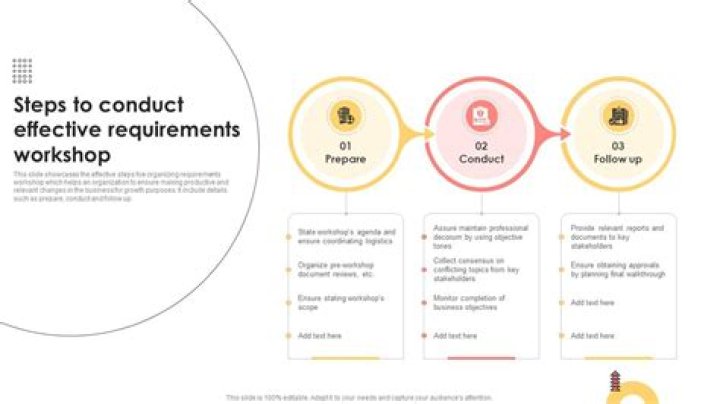
10. Finally, make sure you have a good strategy on tackling the workshop. Below is a representation of the things to consider before, during and after the workshop.
There are many tips, tricks, and techniques to these requirements workshops. What I’ve done in this blog is give you my perspective based on experience. Give them a shot, and build your own list. Good luck!
It’s important for teachers, business leaders, scientists, and other professionals to learn how to conduct a workshop. A successful workshop brings new skills, knowledge and a sense of achievement to the students. The perfect workshop also gives students the ability to regularly connect and understand.
Right Way To Conduct A Workshop
Workshop Preparation
To ensure that your workshop is a valuable experience for everyone, follow these steps to conduct a workshop:
1. Define the Goals
Every workshop must have a goal. Do you need to improve your company’s hiring procedures? Or do you want to teach managers how to be better organizers? Do you need to do some team-building with a newly formed team?
Many workshops are a waste of time because there’s no clear goal kept at the center of the discussion. Without this clear goal, there’s really no point in getting people together.
2. Decide Who Will Attend
Knowing who’s going to attend is linked to your target. For example, if the aim of your workshop is to create a comprehensive solution to a problem, you are likely to want 10 or fewer main participants. If your aim is education-centered, you may be satisfied with a much larger group splitting into smaller groups for discussion.
Make a list of who needs to be there. Try to be as specific as possible, but leave a few openings for last-minute additions.
3. Choose the Right Venue
If you have 10 people, it’s possible that the conference room down the hall will be all perfect. But if you’ve got 50 people you might need to find a location outside that’s large enough.
Think about your workshop’s logistics and practical details when you select the location. Will they all be able to see your visual aids? Will the place support it if you need a certain technology such as teleconferencing? Are there suitable facilities for breakout sessions? Will they all be able to reach the venue? Are you going to have to organize accommodation for people coming from a long-distance? And what are the catering facilities provided by the venue?
4. Make an Agenda
Now that you know your primary goal and who will attend, you can begin to outline how you will achieve the goal of the workshop.
Main Points–Create a list of key points that you want to cover, and then break down every major point into information that you want to convey to your audience.
Visual aids–List the visual aids that you will use for every point if any. If you need technical support, it helps the people who provide it to decide where they need to focus their efforts.
Discussions and activities–Take time to outline precisely which group discussions and activities at which stage in the workshop you will have. How much time are you going to allow for each exercise? Make sure that your events are suitable for the size of the group and ensure that your venue has the facilities (e.g. Meeting rooms) needed to run the sessions.
5. Create A Follow-up Plan
Having an effective follow-up plan is the only way to find out if your workshop has been a success. Develop a survey at the end of the event to provide all participants with plenty of chances to share their views on how well it went. While this may be a little frightening, for the next time it’s the only way to learn –and improve.
Having a plan to communicate the decisions reached during the workshop is also important. Can you send a mass email with the information to everyone? Will you put it on the intranet of your company? People need to know that their hard work has actually led to a decision or action, so keep them informed about what happens after the workshop is over.
How To Involved People During Workshop
Figure out how to add some fun to your event once you have a good advance plan. You know the subjects you want to discuss, but how are you going to make the information fun and unforgettable for your team?
A good workshop is a key to getting everyone involved. When you get up and talk for three hours, you’re just giving a lecture–not making a seminar better. Everyone has to be active.
For each workshop, the development of group exercises is different. Keep in mind the following tips:
- Most people are nervous about talking in a new group or in public. When you organize group activities, keep the size of each team small, allowing people to talk and communicate more easily.
- In each group combine different types of people. For example, if your team includes many departments, don’t place members of the same department in their own group You will learn to look at things from different viewpoints by allowing people to interact with other departments.
- Determine how each group’s ideas will be documented. Will the participants scream at them as you write them down? Or are they going to write down their own ideas and send them to you? This is a small detail that is often ignored, but significant.
- If you have five or fewer teams, spend time encouraging the whole team to discuss that smaller group’s idea. This is a perfect way to narrow down the ideas list and really let the good ones shine.
So, if you are also planning to conduct a workshop, consider these tips to make it successful
Remember, spend as much time creating fun and interesting group exercises as you can. These are likely to keep everyone informed and active.
By Friedrich Sulk
Change can be scary. It’s even scarier when it happens in the workplace, and when automation is involved. No matter how it’s presented, the night before a meeting about automation, someone will drift off to sleep with visions of job-stealing robots dancing in their head.
Managing the change effectively can help. A big step in that direction happens in a Use Case Discovery Workshop. If you’re not familiar, this workshop is a session in which employees from various teams discuss where and how intelligent automation can be applied inside a company. Which business processes are the most manual and error-prone? Which would be easiest or most cost-effective to automate?
Running such a workshop well is critical because it helps leaders create impactful change. It also sets up your company for long-term success with automation. Since the meeting brings together employees at all levels, from assistants to analysts and engineers, automation directives can come from the bottom up — as well as from the top down. A good Use Case Discovery Workshop ensures that all voices are heard, meaning people will find future automation projects less intimidating.
A main goal of the workshop: identifying high-value, easy-to-implement automation opportunities. Following the 10 steps below will give your company a ranked list of use cases, along with their value and difficulty. It’s your company’s first draft of an automation road map.
For more materials, including a worksheet and detailed slide deck, contact [email protected] at Robiquity.
Step 1: Set goals.
The general purpose of the session: find highly specific use cases for intelligent automation inside your company. The use cases should contribute to your broader business goals, and in the end save you time and money.
Some questions to help break this down:
• Which business processes take the longest to complete?
• Are certain tasks extremely error-prone?
• Are your employees repeating some tedious tasks over and over?
• Which processes could be most easily streamlined with technology?
Step 2: Gather the right participants.
By the right participants, we mean subject matter experts in your company who have their hands in business processes daily. Let’s say you invite the manager of the finance department but not rank-and-file workers within it. Later, when you want to automate an accounting function, you may have difficulty with implementation and buy-in.
As you collect participants for the workshop, there could be a dominant personality or top executive involved. Ask that person to stay quiet during discussions. Ideally, you want between 6-20 total participants in a Use Case Discovery Workshop, and you should allow for multiple small groups.
Step 3: Present an overview, and inspire the group to think big.
This is where you lay out goals and objectives, and explain why they’re participating in the workshop. A key here: inspiration. Remind the group that this is a chance to speak up, use their knowledge of the business, and drive real change. Often you can kick this off with a creative, mind-opening type presentation. Encourage people to be ambitious. Most Use Case Discovery Workshops last at least 4 hours, depending on the agenda. Leave plenty of time for in-depth discussions.
Step 4: Split up.
An important facilitation technique: splitting everyone into groups of 3 to 5, so that they’re encouraged to pour out ideas (none too small or offbeat). Small group discussions prompt individual participation and input across the board.
Step 5: Ask questions.
True brainstorming will remove barriers with questions like: “If there were no constraints around…___, what would you do?” Participants should throw out ideas for improvements they’d like to see in the short term, and over time.
Step 6: Tally effort scores.
For each idea or use case, have every person in the group score the difficulty of implementation. This can be broken down by role. For example, technical employees might say that integrating new tools with their current systems will be difficult, while business employees may believe implementation will be easy.
Step 7: Tally value scores.
This is the same exercise, but with a value score at the end. Ask everyone in the group to assess how much the improvement would benefit the organization.
Step 8: Prioritize ideas.
In the end, you’re looking for use cases with the highest value score and lowest effort score.
Step 9: Discuss barriers to implementation.
Have each member break down requirements for implementing a change, based on their role. Will you need a certain level of security for the project to meet compliance? Will you need more or different data? Additional employees? This is a good time to note anything that would be needed to make that idea a reality.
Step 10: Collect data and get to work.
Have each group input all ideas into a Google form or other shareable document for analysis. In a single session, companies frequently come up with between 30-60 use cases, but the sky’s the limit.
By Resolver Modified April 17, 2020
I hope it’s safe to say that Risk Management has gained enough attention over the past few years to have become at least a consideration in most managers’ minds.
I hope that before embarking on every project a PM will conduct a project risk identification with key stakeholders and at least try to estimate which risks are the big ones.
I hope that Sr. Managers encourage risk assessments both within departments and across them, and finally I hope this information gets used to make more informed decisions. So – wearing my optimism hat – there are a lot of people out there conducting risk assessments with a wide range of topics, detail, and experience.
Consider this a layman’s guide to an effective risk assessment. First, a word of caution, I am not an accountant, auditor, or lawyer, in fact I’m a nerdy computer science guy, so this is purely a completely biased (yep, it is) but very effective way I personally have managed upwards of 20 corporate wide risk assessments. Before you dive into the risk assessment there are a couple of basics to get sorted:
- Figure out who should be involved – make sure you have representation from all key stakeholder groups
- Determine what format works for you – interviews, online surveys, workshops…
- Determine what type of results you want out to get out of the session—rankings, discussions, ideas, response plans…
Preparing for the Workshop
- Book a reasonable amount of time to cover the topics
- Determine assessment scales that everyone will understand and get agreement from the two most senior people in the room.
- Make sure they have a both qualitative and quantitative components and do not focus exclusively on financial risk.
- Agree on a language for your risks that will reduce confusion (E.g. don’t put the word “or” in your risks)
Principles of the workshop
- Ensure you get viewpoints from everyone
- Use an effective technique for anonymous voting (i.e. Ballot by Resolver)
- Have one person dedicated to writing everything down (not you, and not one of the participants)
- Sample 90 min Workshop Agenda (30 risks) your group may be faster or slower depending on the # of risks and the depth of discussion.
- After the workshop, share the results and the corresponding actions with participants; this will dramatically improve the process the next time around. Resolver*Ballot Feature: Auto generates PowerPoint and Excel documents to share with others.
- Keep the voting results and use them next time to plot change over time. If you are doing a routine assessment (e.g. every quarter) which risks are changing? Which risks are increasing? Which actions did not get executed on? Resolver*Ballot Feature: Merge multiple files and plot them on a single Heatmap to understand change
By now hopefully you’ve got some ideas on how to run an effective risk assessment, and our software will improve the results with anonymous voting. We’ve helped hundreds of companies, large and small, get great results very efficiently. This includes companies like SONY, WAL-MART, PHILLIPS, HEINZ, DELOITTE, PWC, E&Y and small companies that you’ve never heard of. We’ve even helped the Canadian Government and the United Nations. Oh, and our software doesn’t cost much since it scales to the number of users that you need. So stop reading and buy our software.
If you are looking to learn more about running risk assessment workshops in your organization, feel free to contact us.
For more risk assessment related news and articles, follow us on LinkedIn, Facebook of Twitter.
About the Author
Resolver Protects What Matters®. Over 1,000 of the world’s largest organizations use Resolver’s cloud software to protect their employees, customers, supply chain, brand and shareholders.
Pricing your services as an entrepreneur can be really tough. I cannot tell you what is the best price for your services, because ultimately it is the matter your customers will decide for you. But I can give you some tips based on my experiences to help you figure out your pricing range.
One thing I can recommend you is: differentiate. Differentiating your offer and the value in it is the most important thing in getting a decent price for your time and knowledge. The worst game to get into is a price war. There are only losers in that game.
Some rules of thumb
The basic rule of business is: what comes in must be more than what goes out.
You can charge as much as the customers are willing to pay. And the willingness to pay is related to how they value you as an expert. If you are a nobody, you will be a huge liability for their credibility. They will not be willing to pay a lot, if anything. If you are a known practitioner, you have good references, people recommend you and your work can be seen or read or listened to over the internet – well that significantly lowers the customer risk and they are more likely to pay what you ask for.
Another rule of thumb: I’d also love a Ferrari, but I’m aware of my current shortcomings in the finance department to purchase one. I’m not going to get a Ferrari for the price of a Volkswagen no matter how much I go and peg for one. There’s no need for you to sell your Ferrari services for the price of a Volkswagen service. If someone cannot afford to pay, then they need to settle for someone else’s services. Same goes vice versa.
And finally: If the customer budget is less than your price, do not give a discount. That will make the customer think you tried to fool them into paying more than it was worth. They will get very upset! You lower your price to meet the customer budget by modifying your offer. In other words, you include less.
What all goes into a price
- The time spent on the workshop (is it 4 hours, 5 hours, 8 hours?)
- The travel time required (if the rest of my day goes into traveling for the workshop, I’m not able to sell that time to anyone else)
- The time spent in putting the workshop together
- The presentation material
- Planning the group activities (what, how, how much time can be spent on each including discussion)
- Planning the schedule for the workshop (I hate workshops that are poorly managed and lack efficient time spent)
- Printing any handouts etc
- The time spent on familiarizing myself with the material customer has provided me with
- The time spent on documenting the outcome after the workshop (this I sometimes bill as a separate service)
- My experience and skills in regards to the topic and the way I lead the workshops and pursue to inspire the participants. I’ve studied, practiced and learned for 14 years now. It’s worth something.
As you can see, it’s not just about the actual workshop. And it’s not also the hours you spend on putting the workshop together. You must value your skills, experience and wisdom in relation to the topic. If you have something special, it’s going to be worth more because there are less competition.
Scalability
I pay a lot of attention to being able to use the same framework of a service for as many customers as possible. I call this productizing my services. It makes my services more scalable and is therefore better for the business. If you think how much time is spent on putting together a workshop, you realize you will never have ROI on your workshop unless you build a framework you can easily copy for a numerous of occasions.
My advice is to only offer workshops or trainings on topics that you can resell. But do pay attention to the value add. Many of my customers are willing to pay more when the training or workshop is tailored for their specific situation, to their unique need. There’s a difference between a bulk service and a solid framework that can be tailored for each of your customers.
Be specific in your service offer
I’ve noticed some people tend not to plan what the offer entails when they write a service offer for the customer. They just throw some ideas on the offer and stamp a price over it. And when the time comes to deliver, they realize they need to spend a lot more on putting the service together they originally thought of and now the price is too low. But you cannot raise the price as deal is the deal, so you end up with an unprofitable job.
I conceptualize the content and the outcome of the workshop when I make the offer. I literally open another word document and write my notes on the skeleton of an agenda I put on the actual offer for the customer. I want to make sure I have it covered and I am able to give a rightful price for the content. And when the customer makes the purchase decision and we set a date for the service, it is so much easier then to fill in the blanks.
In the order document I use bullet points and subheadings to give customer enough detail about the content.
Pricing my workshop
So let’s wrap this up:
I used Toggl app to calculate how much actual time went into tailoring my knowledge into a 6 hour workshop for a customer:
- 9 h 8 minutes for putting the slides and material together
- 30 minutes for rehearsing the notes
- The workshop itself takes 6,5 hours of my time.
- It is a nearly 2 hour drive away, so that eats another 4 hours.
- After the workshop I will document all the materials, compile the data into a comprehensive summary and add my professional recommendations along. That takes another day, so that’s additional 8 hours.
That’s total of 28 hours of work for one workshop.
Calculate that with whatever price / hour you think you are worth or you should get. When you decide on your hourly price, remember to include all the costs you bring to your business and then add some as a margin. Depending on your expertise and the industry you represent, there are the general price levels for these types of services. You need to figure out from the customer’s perspective are you considered to be more valuable, equally valuable or less valuable than the alternatives.
Do note, the 28 hours is the mechanical time. Your expertise and value add must be covered in your price / hour. I always recommend thinking how risky is it for the customer to buy from you. The less you are known and recommended, the more risk trusting your word will be. And this directly impacts their willingness to pay for your services.
Student workshops are a great way to teach students new, specific skills through rigorous, interactive training. Most workshops are around 2 hours long, but they can even go on all afternoon or all day. It is usually conducted by a specialist instructor and provides opportunities for students to practice the skill that is being taught. Hence, workshops are a fantastic way to teach students in an interactive manner.
If you have never conducted a student workshop before, but are interested in conducting one, then look no further, Here’s how you can do it:
Choose the Objective
Every workshop should have a specific objective. In other words, it is a learning goal, or what you want students to learn from the workshop. Some great student workshop ideas for intermediate students are:
- Key exam preparation skills
- How to manage stress before exams
- Introduction to using PowerPoint
- How to effectively use solved past papers
- How to give excellent presentations
Find an Instructor
To conduct the workshop, there should be a well-informed instructor. You can choose to call in a specialist from outside the school, or have a skilled teacher conduct the session. For example, the computer science teacher may be able to conduct a student workshop for PowerPoint, and a senior level intermediate teacher for the Federal Board can conduct one regarding “effectively using the previous five-year Federal Board solved past papers”. The instructor should be confident, energetic, and able to deliver the knowledge in an interactive way.
Establish Teaching Points
A student workshop should teach specific points that students can actually take away. Overloading students with a bunch of theoretical knowledge of the topic will not be effective. Therefore, it is important to establish specific teaching points. This way, students will actually take away meaningful knowledge from the workshop. For example, teaching points for the “How to Effectively Use Solved Past Papers” workshop may be:
- Why are solved past papers useful?
- How to study the paper pattern
- How to understand marks allocation
- Solving the past papers
- Evaluating your answers
These 5 points are concise, yet they will provide rich knowledge that students will actually be able to implement in their exam preparation.
Plan Student Activities
Student workshops must be interactive. This will keep the students engaged and interested. Moreover, it will help them learn practical skills and commit the information to their memory. Unlike lectures, workshops should give students the opportunity to practice skills that they are learning.
Hence, there should be some activities planned for the duration of the workshop. The types of activities will depend on the topic and objective of the workshop. Some good ideas of activities are:
- Question and answer session
- Practice time
- Group discussions
- Group competitions for learned skills
- Quick games
Create Teaching Plan
Aside from the activities, a student workshop should consist of rich teaching aids. Rather than relying only on an oral lecture, the instructor should incorporate strong teaching aids to support the lecture. Some good aids include:
- PowerPoint presentation
- Visual aids
- Related videos
- Diagrams
- Props
Using a variety of methods will keep students engaged and help them follow along. Especially if the workshop will be longer than 2 hours, it is important to use a wide range of teaching aids to keep students interested and attentive.
With these steps, you should be able to conduct a successful and effective workshop for your intermediate students. By the end of the workshop, the students should have learned skills that they can actually implement in their daily lives, professional lives, or student lives and exam preparation. In other words, the objective should be met.
To define the success of a medical workshop from the trainees’ perspective, where a medical workshop is a scientific event with the aim of presenting updated knowledge and to teach medical skills to the participants. In surgical specialties, it contributes to the development and maintenance of surgical skills.
Methods
Medline was searched for the previous 4 months to identify articles with combinations of the keywords ‘workshops’, ‘training’, ‘simulators’, and ‘virtual reality’. Further articles were obtained by manually searching the reference lists of identified papers. We also obtained information and critical aspects of view from other trainees.
Results
Based on 30 articles from the Medline search, and mostly from the trainees’ perspective, we present the basic characteristics of a successful workshop. The objective of the workshop, appropriate faculty members and presenters, highly motivated participants, the use of simulators and evaluation sheets, the venue and the registration fees all have a major role in the success of a workshop.
Conclusions
A successful workshop is that from which trainees have grasped most of the knowledge and skills imparted to them, with a positive progression reflected on their learning curve. Workshops are a current necessity and all efforts should be made to achieve the desired result from the trainees’ perspective.
Previous article in issue
Next article in issue
Digital Transformation, Data Science, Big Data Analytics evangelist.
Find experts and specialist service providers.
Search Service Providers
Digital disruption is really fast. The change it brings is sweeping the business landscape at such a furious pace that old ways of thinking are not relevant today.
Organizations are under tremendous pressure to improve the way they leverage data to make the right decisions and improve services for your customers.
At the heart of every business is its customer. The very purpose of the business is to get a customer and keep them for a lifetime. Yet how many businesses truly align their entire organization around the customer and the customer’s experience with their business?
We all know the industry examples of AirBnB disrupting hotels, Uber disrupting taxis, Netflix in the media and the list goes on.
So how do you achieve this great level of digital transformation?
Well, the best way is to call all business and IT stakeholders and conduct a workshop to ascertain where you stand as of now and then decide where you want to go.
- Assess the digital maturity of your organization and study the competition is going right to find out where you are today
- Educate the C suites and senior management on digital concepts & cross-industry opportunities to see where you want to be
- Elaborate with examples how leaders and competitors are using digital to advance themselves
- Understand the customer journey with all the customer touch points of your business, their needs
- Brainstorm & Identify the opportunities to fill the gaps with digital technologies
- Design a simple Framework on where to start and what to do next
- Discuss the examples of similar industry customer’s Digital Business Transformation and how they began their process
- Formulate a fully-fledged digital strategy that covers all aspects of innovation
- Prioritize the solutions based on quick wins, impact on the business, investments required and risk associated with them
- Assign the accountability of who will execute the plan
- Put governance in place for right KPI measurements
Here are major takeaways from the digital workshop:
- Opportunities to increase productivity by enterprise-wide data sharing and collaboration
- Ways to deliver operational efficiencies with real-time data analytics
- How to innovate and grow with advanced analytics to uncover new markets
- Surefire ways to provide an exceptional customer experience
If you do this right with proper metrics to track, the digital transformation of your organization will be smooth.
Digital Transformation, Data Science, Big Data Analytics evangelist.
How to Conduct a Workshop
Workshops provide a forum for individuals and groups to explore areas of mutual interest or concern – skills, problems, or possibilities. And often the expectation is that you, as the manager, will lead and conduct the workshop, thus providing another opportunity for you to demonstrate your leadership and group skills – if you do it well. Here are some considerations to help you prepare for that next opportunity…
1. Do the hard yards early – get prepared.
Preparation is essential. If you are not prepared, postpone the workshop until you are. Preliminary considerations should focus on:
- Timing – the topic must be relevant to the period and participants’ needs.
- Establishing outcomes – fuzziness upfront will create problems later.
- Deciding on essential knowledge and skills – pre-workshop training may be required to ensure effective participation on the day.
- Identifying possible attendees – wall flowers are merely excess baggage.
- Developing materials to suit the audience – even the best materials will fail with the wrong audience.
- Liaising with any other providers – they’ll be expecting to hear from you.
- Inviting participants, disseminating an agenda, arranging facilities, and providing directions if necessary.
2. Plan the format.
Sequence activities to help achieve your desired outcomes. Adult learning techniques should guide the approaches you use (Kolb, for example, advocated a balance between activity, reflection, theory building, and consideration of any practical application). Ideally, the workshop should commence with an icebreaker to help the group relax, establish rapport, and help focus attention on the aim of the workshop. Plan to scatter energisers (short, sharp exercises or activities) throughout the session to help refocus attention on the tasks at hand.
3. Arrive early.
You must be the first person to arrive at the venue. Check all equipment. Arrange seating to suit the purpose of the first session – e.g. theatre style, U-shape, or round tables. Greet people as they arrive. Direct people to refreshments. Introduce people to one another and generally make them feel welcome. The work done now will make your task much easier later. Housekeeping issues may be dealt with here rather than at the start of the workshop.
4. Start on time.
Never penalise those who arrive on time by waiting for stragglers. If a senior executive does not want to get things under way, you do it. Act and sound authoritative, but warm. Use an icebreaker, if necessary. Introduce yourself and ensure everyone knows each other’s name, job, special skills, and what they want to get out of the workshop. Make the objectives of the program clear. Display them where they can be seen clearly. Review the agenda so people are aware of how you are aiming to achieve your objectives. Establish ground rules.
5. Remain relaxed.
Adopt the attitude that there is nothing that can happen in the workshop that you can’t handle. Your nonverbal and verbal responses will contribute substantially to the climate of the workshop. Be guided by these suggestions:
- If things don’t go according to plan, there’s no need to apologise. Move on.
- If you don’t have an answer to a question, ask others. And if they don’t have the answer, offer to get back to them later.
- Keep away from jargon. Paradigms, parameters, and other management mumbo-jumbo are a turn-off for many participants.
- Use visuals wherever possible; they’re much more effective than verbal instructions.
- Make sure all material and language you use are culturally neutral. The need for cultural sensitivity cannot be overemphasised.
- Repeat or rephrase questions that are not heard by everyone in the audience.
- The attention span of most adults is about seven minutes, so vary your pace and presentation techniques accordingly.
- Cater for the anticipated ‘slow time’ after lunch. High activity will beat a video or lecture at these times.
Finally, remember that the word ‘facilitator’, with a Latin derivation, means ‘one who makes things easy’.
6. End on time – with the right message.
Stick to your committed finishing time. Begin the wrap-up about thirty minutes before then. Provide a summary of accomplishments. Invite others’ input. Evaluate the workshop by distributing a short survey or use a less formal approach like handing out small cards and inviting a positive comment on one side and an improvement suggestion on the other. Thank participants and outline further follow-up.
7. Review the workshop.
Use the planned outcomes, the feedback provided, and your own impressions to evaluate the success or otherwise of the workshop. Decide on your next step. Act promptly and program further meetings if required.
8. Observe other workshop facilitators.
All presenters have their own unique styles. Watch other people conduct workshops and you will learn much. And by ‘borrowing’ ideas you can add to your repertoire of skills.
If you interested in learning more about these types of skills or are seeking further training in a particular area you can contact us on 1800 998 500, email us at [email protected] or visit our website.
How to Write a Resume for Master of Public Administration
A successful resume workshop should explain the different types of resumes with specific examples. It should also discuss how to include the most important elements that highlight a job candidate’s qualifications and accomplishments.
Provide Visual Aids and Handouts
Make sure you have all your materials before beginning the session. If you have access to the right technology, create a presentation using a program like PowerPoint so your audience can follow along as you speak. If not, utilize your local print shop to create visual aids on poster board. Remember that your presentation or visual aids should only contain highlights of your session, not every detail. Handouts covering important points allow the audience to take something home. Finally, print out sample resumes: one using chronological organization, one using functional organization and one using a combination of the two.
Describe the Sections
During the presentation, start with the basics. The University of California, Davis’ Internship and Career Center lists three essential sections in addition to the heading: education, experience and skills. Define each section and teach the audience what to include. For example, the education section highlights a candidate’s degrees and academic accomplishments, such as making the dean’s list or a high GPA. The work experience section shows the candidate’s job history and career accomplishments, such as high sales numbers or leading a project. It is important to emphasize accomplishments, not just job duties. The skills section points out job-related skills that might not show up anywhere else, such as proficiency with computer programs or languages spoken. Candidates should structure the resumes to highlight their best qualifications. Other sections, such as professional organizations, may also be included.
Explain Chronological Versus Functional
Describe different organizational patterns and their benefits. The UC Davis’ career center points out three possibilities — chronological, functional and a combination of the two. The chronological structure works best for those who are continuing their careers and whose previous experience is their best selling point, such as someone moving from management at one company to management at a different company. It lists the candidate’s experience in order from most recent to least recent. The functional structure is ideal for those beginning new careers, such as recent college graduates, who want to show that they have the necessary skills and talent even if they lack relevant job experience. It is organized by skill set. Others prefer to combine the two approaches to show that while they are changing career paths, they do have relevant work experience. This approach emphasizes skills but still contains a chronological employment history including accomplishments at each position.
Give Formatting Tips
Provide your audience with general formatting tips. The University of South Carolina reminds users to avoid generic templates and to use 10- or 12-point Times New Roman or Arial fonts. You can also explain how to use underlining, bold, italics and bullets to highlight important points. The resume should have plenty of white space and appeal to the eye. The UC Davis career center says resumes should not be more than one page long, for someone without much experience, and never longer than two pages. Your audience should hold their resumes at arm’s length to see their works’ visual impact. Remind them to use action verbs to give their work panache. For example, they should say “I directed” an activity instead of “I was the director.” Finally, recommend they use 20-pound resume paper for physical copies and the correct type of file for online submissions. Reserve time at the end of the workshop for a question-and-answer session.
Developing a marketing strategy? Conduct a marketing workshop.
- kevink
- marketing, marketing strategy, strategy
On a regular basis I get asked to help companies develop a marketing plan. Some are for a new company, others for a new product. My first question typically is “have you got a marketing strategy and is your management in alignment with it?”
If not, you may be setting yourself up for failure. For those that need support, I typically recommend conducting strategy workshop. The purpose of which is to collect key data points, align management team objectives, and determine next steps for building a go-to-market plan. Attendees should be varied members of your management team (ie sales, marketing, finance, operations).
Although the workshop can be conducted in a single day, additional research will be needed if you want to obtain additional insight and confirm strategic direction. This may include conversations with internal and external resources (ie customers, partners, target customers) and analysis using available tools.
The strategy workshop will provide you with the basic framework used to develop a marketing plan. The marketing plan will then focus on implementation.
Below are the basic elements to resolve in a workshop:
Market Segmentation
Begin with identifying your customers’ needs and consequently determine the best way to meet them. Keep in mind that it is almost impossible for a company to satisfy every unique need. Instead, it is more efficient to allocate resources to target specific customer groups. Because a customers’ needs vary, marketers must identify common needs within similar groups of customers and recognize distinctive needs between different groups of customers. Part one of the workshop should be to
- Identify or align on market segments based on revenue potential and market size
- Profile your ideal customer (size, location, capabilities) and identify target accounts by name
- Build personas to identify who has the buying power in your target company base
- Set market priorities to give focus under limited resources
Company and Product Positioning
Identify what you do best, what your target market wants, and why customers buy from you. Then craft a core set of messages that allows your company to quickly be differentiated. Areas to be discussed should include who you are, what you represent and want to represent, your expertise and what you offer the market).
Separate from the company is the positioning of the product portfolio itself. Key features, benefits, product naming, ordering details, roadmap, technical and promotional details, and other data needed to develop product and web collateral.
Market Analysis
Success depends on knowing your business inside and out. To do this, you should plan to conduct a SWOT analysis to:
- Identify methods to address weaknesses and threats, and to take advantage of strengths & opportunities
- Identify a top competitor list and identify their differentiating characteristics
- Barriers to entry in this market
- Trends in the marketplace, affects on the economic outlook, available financing
Establish Sales and Marketing Goals
These goals should reflect what you think your firm can accomplish through marketing in the coming years:
- Revenue forecasts
- The amount of new business vs. old or repeat business
- Estimate average deal size, and order/sales cycle
- Outline a strategy for attracting and keeping customers to identify and anticipate change
- Identify marketing goals based on resources and ability to meet forecasts
Sales Channel and Partners
Much of the marketing plan and budget will depend upon the channels in which you will sell. The type of sales tools, the size of the campaign, and the methods to retain customers all depend on determining the right mix of marketing and sales programs. Questions to address:
- What are the short and long term plans for recruiting sales and distribution channels?
- What price structure is being offered to these levels?
- Do you have a list of potential partners and distributors to target by industry type and by name
A few additional points
Keep in mind that marketing strategies can vary in length and style based on your company. In general though, you should have a few additional items on your mind before kicking off a marketing plan:
- What is your marketing budget (ie a percentage of exiting or future sales?)
- How will your spend be allocated and tracked (print material, web development, promotion, etc)
- What is your timing for a soft launch (internal and select customers) and hard launch (public promotion)
- How will you measure success or failure? Leads, revenue, conversions, gross sales?
So what comes next?
Review the final results of your strategy and engage with your management team to assure agreement of the strategy. Then, move into implementation of your strategy using the information you have collected to develop a marketing plan.
Need help building a strategy or plan? Consult an expert who has worked in your area of expertise, who can pull information out using interview techniques and who has the network of vendors and tool providers to assembly reliable information.
September 02, 2016
The idea of a whole class of students quietly writing, revising, peer conferencing, and working on writing that they care about is an image that I dreamt about for years.
I admit that although I started doing reading workshop with my classes over twelve years ago, it took me another nine years to get up the courage to try writing workshop. Something about the lack of control, I guess.
But over the past few years, I have conducted many successful writing workshops. I also made many mistakes with my classes, but I have learned from those errors.
Here are my tips for conducting a successful writing workshop with your classes.
- Start with mentor texts.
Whether your students will be writing descriptive essays, creative poems, or research papers on the history of World War II, you should always start with mentor texts. Find some good examples of what you are hoping that students will achieve in the workshop, and then spend some time analyzing them as a class. Make sure that they know what you are looking for, and that they can put those expectations into words.
- Spend at least a day prewriting.
Never ever start a writing workshop by instructing students to start an essay. It will be the least productive day you will ever experience and probably the death of the whole workshop. Instead, start with some kind of low-pressure prewriting. This could be a brainstorm list, a freewrite , or a creative writing prompt .
- Go over the process and then give them a grade for the process.
Make sure that students know what you mean when you say draft, revision, peer conference, teacher conference, and editing, and then give them a grade for what they accomplish before the end of the workshop. In my experience, students who complete all of the required steps end up with the best essays (shocking, I know). I usually count the process grade as 50 percent of the final draft grade.
- Make a process checklist and update it constantly.
Rather than requiring students to turn in evidence of their process at the end of the workshop, just make a spreadsheet and check it off as they go. At the beginning of each new class, remind students about what they have left to accomplish. As they complete any new steps during class, check them off on the chart. But be picky—make sure that they are truly revising and not just adding a few commas, for example.
- Check in constantly.
I am all for grading whenever you get a few minutes in the school day, but writing workshop is not that time. Instead, you should be reading drafts, checking student progress, and monitoring peer conferences from near or far. It can be exhausting, but in my experience, students need that pressure to stay on task. It also makes it easier to assign a final grade when you have an idea of progress students have made towards the goals.
- Model any new expectations.
If your students are new to revision or peer conferences, do some together as a class. Project some examples of true revision on the board, or hold a whole-class conference. If you can do this on a piece that you have written yourself, it will be even more authentic and impactful.
- Don’t collect anything but the final draft.
The first year that I did writing workshop with my classes, I made the mistake of collecting everything at the end—draft, revisions, edits, peer conference notes, all of it. Truthfully, if you have been checking in with students and reading their drafts all along, you will probably have a pretty good idea of what their final grade will be too.
Writing workshops take some preparation and they definitely don’t run themselves, but when you see the quality of writing that your students produce as a result of them, you won’t regret the decision to take a risk and try something new.
Need ideas to get your students excited about creative writing? Check out this resource with ten fun creative writing exercises, forty writing prompts for longer assignments, thirty nine suggestions for poems, non-fiction essays, and short stories to extend the discussion, and ready-to-go slides for each exercise and set of follow-up question.
Christina Gil was a high-school English teacher for sixteen years, but she recently left the classroom to follow a dream and move with her family to an ecovillage in rural Missouri. She believes that teaching creative writing helps students excel on standardized tests, that deeply analyzing and unpacking a poem is a fabulous way to spend an hour or so, and that Shakespeare is always better with sound effects. When she is not hauling water to her tiny home, she can be found homeschooling her two kids or meeting with her neighbors about the best way to run their village.
Teaching a workshop is not only a great way to bring in some extra income for your studio.
Workshops also give you the opportunity to meet new people in the art world, gain exposure for your art business, beef up your contact list, stimulate your own creativity, improve your public speaking skills . and the list of benefits goes on.
But, you’ve never hosted a workshop before. So how do you actually go about setting up and teaching one?
Whether you’re wondering what lessons to demonstrate or how many students you should have in each class, we’ve rounded up eight tips for teaching your first artist workshop, so your students leave feeling satisfied and ready to sign up for more.
Teach Actual Techniques
Listen to this less than desirable workshop experience from watercolor artist Angela Fehr:
“Although I didn’t know it at the time, I had chosen a teacher who was more concerned with encouraging students’ creativity than actually teaching us how to paint. From that class, I learned not to waste my time with cheap supplies, and to paint from light to dark as a rule, but I was still pretty much uninstructed where actual techniques were concerned.”
Long story short: you don’t want your students feeling this way. You want workshop participants to go home feeling empowered with the new skills they gained and confident to apply them in their own work. A fun way to do this? Angela suggests having students create cheat sheets to help recall different techniques they’ve learned.
Complete a Full Piece
Don’t stop at techniques, either. Have students finish an entire piece so they feel more accomplished. Having the finished artwork with them when they go home will also give them a wonderful opportunity to discuss your workshop with friends and advertise your expertise to other potential students.
Plan and Practice
Now that you have the bulk of the teaching material nailed down, focus on the two big P’s—planning and practice—because winging it probably won’t cut it.
As for the planning, sketch out the most important lessons to teach and gather the right supplies. When you get ready to practice, call a friend to walk through demonstrations with, time yourself, and write down whatever you feel is necessary. While it may take some work up front, your preparation will pay off in the long run.
Cover Your Costs
Knowing what to charge for workshops can be a real pickle. To help, take a look at Art Biz Coach Alyson Stanfield’s post on what other artists are getting paid for teaching workshops, and try researching similar workshop costs in your area.
Just don’t forget to include the cost of supplies for each student in the fee, or else that cost will be left for you to cover. And, if you want to give more people the chance to attend your workshop, consider offering a payment plan for those who may not be able to afford the workshop costs all at once.
What’s next?
Promote Like a Pro
Once you have your workshop planned and ready to go, promotion is key! This means hitting up fans on social media, your blog, newsletters, online groups, at art fairs, and any other outlet you can think of to spread the word.
Erase any fears students may have of signing up by clearly stating the experience level needed for the class. Some artists have success with enrollment numbers by casting a wide net with workshops open to all skill levels, and others teach more advanced techniques that attract professionals from all over the country.
Keep the Class Size Small
Know your limits. This includes knowing how many people you can instruct at once. You want to be able to have one-on-one time to answer questions and provide guidance, where students aren’t begging for your attention.
This may mean starting off with as little as two or three students and seeing what you can handle. If smaller classes are more comfortable with your teaching style, you can offer multiple workshop sessions each month to accommodate more students.
Leave Time to Recharge
Another tip? Determine how long you want your workshop to last. Depending on the lesson, workshops can range from a few hours to half a day, or more.
If the class spans multiple hours, don’t forget to allow for rest, water, and snack breaks as needed. One great idea is to let students walk around the room and generate conversation about everyone’s progress.
Don’t Forget to Have Fun
Finally, keep your workshop lighthearted and relaxed. While you want students to walk away with newfound knowledge and skills, this should be a fun experience! Having the right amount of excitement will make students want to come back for more, instead of treating it like a chore.
Go forth and teach!
Of course, you want teaching your first artist workshop to be a success. To make the process less daunting, keep in mind what you would want to get out of the workshop if you were the student. Aim for creating an inviting atmosphere where pupils can learn real techniques with one-on-one guidance. Follow this advice and help make artist workshops a thriving venture for your art business.