Bullying and harassment by neighbours is common but there’s little information on how to deal with it. Laws are weak and often authorities are reluctant to become involved.
Neighbours from Hell in Britain is a community for people dealing with neighbours from hell. They have a forum and have recently published the results of a poll on “What is your worst Neighbour from Hell problem?”
Neighbours From Hell in Britain Survey: if you have a Neighbour From Hell in Britain please fill in the survey at
Hedgeline campaigns for effective legislative control of problem hedges of all species in residential areas of the UK. Hedgeline draws on the experience of thousands of members to provide advice and information for hedge victims.
News and links
May 2005: leylandii becomes subject to anti-social behaviour laws:
October 2003: UK government targets bullying neighbours,
December 2002: Cupressocyparis Leylandii to be subject to law in the UK: local councils are to be granted new powers to deal with the curse of the Leylandii:
Long-term harassment by neighbour ends in murder – article in the Evening Times.
One person’s response to the nightly nuisance of noisy neighbours:
Bully OnLine is a gold mine of insight and information on bullying which identifies the different types of harassment and bullying, and exposes the main perpetrator, the serial bully. Everyone knows at least one person in their life with the profile of the serial bully. Click here to see . who has this behaviour profile in your life? Maybe this describes your neighbour to a T?
Have a look through this web site to recognise the bullies and bullying in your life . start with Am I being bullied? then move on to What is bullying? To find out what you can do about bullying, click Action to tackle bullying. Have a look at the profile of the serial bully which is common to sociopathic managers, harassers, stalkers, rapists, violent partners, bullying neighbours from hell, abusers, paedophiles, even serial killers of the organized kind.
If bullying and harassment have caused injury to your health, commonly diagnosed as “stress”, see the page on injury to health and the one on the psychiatric injury of trauma, a collection of symptoms congruent with the diagnostic criteria for Post Traumatic Stress Disorder, or PTSD.
Children Being Bullied
Listen to what your child is saying about the bullies and keep an eye on the situation. It may all blow over.In the meantime, arm your children with strategies to deal with the actions the bullies are taking, such as trying to ignore minor things, asking the bully to stop, and telling an adult.
If a child is being picked on frequently, you could try walking with them to school, supervising play areas or speaking to the parents of the bully or bullies and trying to resolve the issues amicably.
In very serious cases, or examples where there have been actual physical violence, it might be possible as a last resort to take out a restraining order, making the parents and the bullies stay away from your child. If the situation has become that serious or dangerous, it’s advisable to involve the police, get some information on your legal options, and consult a lawyer. Thankfully, it’s rare for childhood bullying to need that sort of intervention.
What’s Considered Bullying?
If you’re being subjected to any form of unwanted behaviour from a neighbour, it can be described as bullying. It could take the form of constant harassment, physical or verbal abuse. Name calling or teasing constantly can be bullying if they upset you or cause you any distress. Some bullies may choose to simply ‘blank’ you or spread rumours about you. Serious cases may even involve threatening or anti-social behaviour.
In some cases, neighbourhood bullies can be so subtle and their actions can become so regular that their behaviour can be overlooked. That doesn’t make it right. Long term, bullying can cause mental and physical health problems, and affect your well-being.
What to Do if You’re Being Bullied
Kill them with kindness. If the bully sees you as a threat, try befriending them, even if you don’t want to. If you turn the tables and act as if you’re willing to be friendly, you could get a positive response. Try a friendly ‘hello’ or offer to help them with something. This might not work, but is worth trying as a first course of action.
Try being assertive, too. Use assertive body language, stand straight, don’t avoid eye contact, and confront them with statements like, “I’ve noticed that you seem to be trying to bully me and I would like you to stop.”
If all else fails, or the bullying becomes serious or physical, involve the authorities.
If there’s a discrimination element (you’re being bullied because of your race, gender, disability, sexuality or religion), contact your local authority who may be able to take action. Some local authorities have Safer Neighbourhood Teams who work with communities to identify and address local concerns.
In some cases, a local authority can apply for a court order against the perpetrator, banning them from carrying out anti-social behaviour, nuisance or threats against you or your household, and even evict them if they carry on.
You may be able to take out a civil injunction against the bully. Take advice from a solicitor about your options and what you need to do if that’s the case. Find out more about the Proection from Harassment Act here.
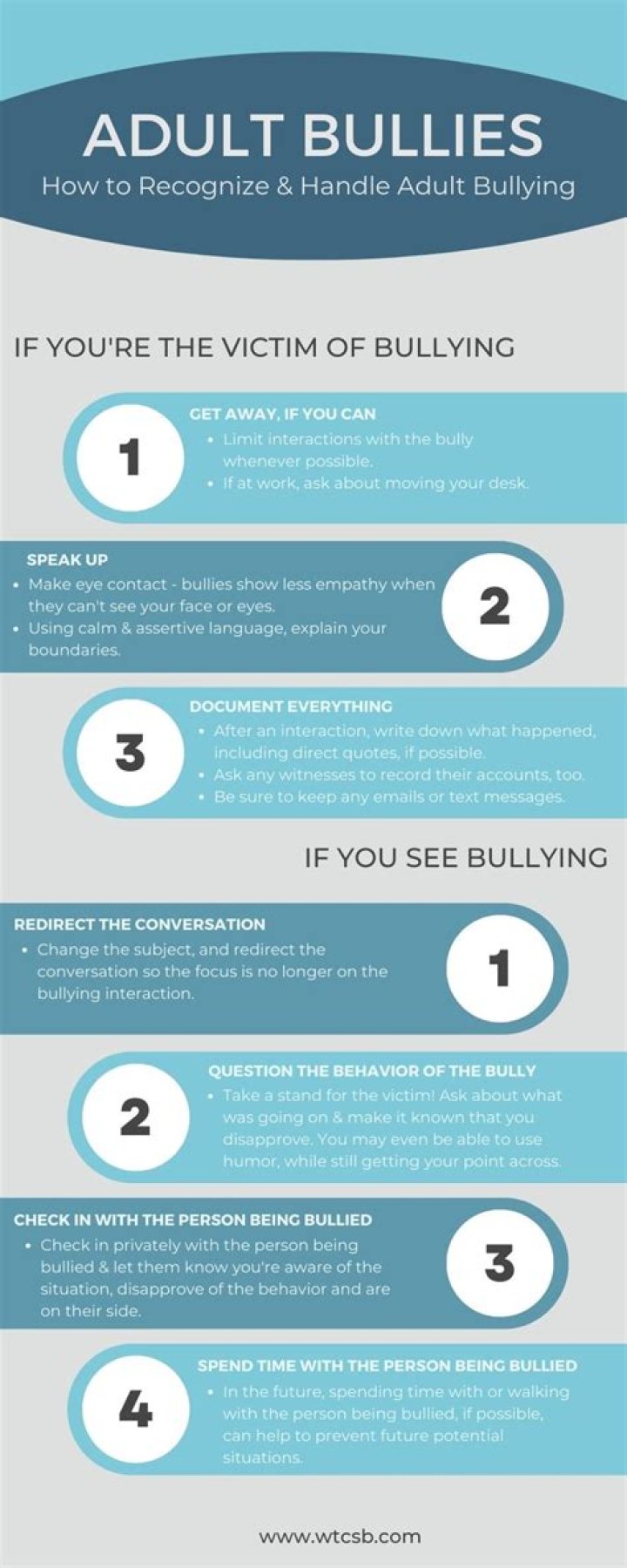
From bulldozer bosses to pushy neighbors, bullying continues long beyond the playground years. Here’s how to recognize a full-blown, fully-grown bully – and what to do about it.
When you hear the world “bully,” what comes to mind — a pre-teen ruffian who’s constantly picking on the neighborhood wimp?
Actually, bullying lasts well into adulthood — and instead of the playground, the abuse is most likely to occur in the workplace. A recent survey of American workers found that more than 41 percent of them had experienced some form of bullying at work in the past year; 13 percent of them were bullied on a weekly basis. “Often, adult bullying occurs between bosses and employees,” explains Irina Firstein, LCSW, a relationship counselor in New York City.
Want to boost your brain capacities? Take Total Brain’s Mental Health and Fitness Assessment!
But that’s not all: Many adults find themselves emotionally tormented by fellow employees, nasty neighbors, aggressive friends, and even their spouse, says Firstein.
No matter who’s doing the antagonizing, the effects of bullying can be extremely damaging psychologically. Here’s what you should know about adult bullies.
How to Spot a Grownup Bully
A recent Iowa State University study found that childhood bullies may very well grow into adult bullies. Of the participants, those with a history of childhood bullying were six times more likely to get in a fight and two and a half times more likely to threaten someone than those without a bullying past.
“Adult bullies tend to be opinionated, judgmental, and coercive,” says Katherine Krefft, PhD, a practicing psychologist in Buzzards Bay, Mass. “If a person repeatedly makes you feel intimidated or humiliated, you are probably dealing with a bully.”
These people tend to:
- Abuse a position of power.
- Repeatedly give undeserved criticism.
- Use verbal or physical abuse.
- Have excessive and unrealistic expectations.
- Repeat insults or threats.
- Abuse the rights and dignity of others.
The Toll Bullying Takes on the Victim
“Repeated bullying — whether it occurs between bosses and employees, between spouses, or in any adult relationship — is a form of traumatic stress that is toxic to one’s emotional health,” says Firstein. In fact, the effects of bullying have been linked to post-traumatic stress disorder (PTSD), a trauma-induced anxiety disorder.
In addition, bullying victims may experience:
- Anxiety and depression
- Loss of self-confidence or self-esteem
- Fearfulness
- Financial losses from missed work
- Sleep disturbance
- Aches and pains
- Digestive disturbances
How to Put an End to the Abuse
The worst thing you can do if you’re being bullied? Ignore it.
“The reason child bullies grow up to be adult bullies is because the behavior is repeated and reinforced,” warns Krefft. If not confronted, a bully will likely continue his antagonizing ways.
Here’s what you can do:
- Recognize that being bullied is something no one deserves.
- Document the bullying behavior as well as you can.
- Try to have witnesses to support you.
- Seek help from an appropriate authority.
Never try to retaliate directly, says Krefft. The proper authority will depend on the situation: If at work, your employee handbook or HR department may identify the right person in your workplace to talk to. If you have been physically threatened or attacked, you may want to go to the police.
Could You Be the Bully?
What if you’re the browbeater? In a national survey on bullying, 6 percent of adults admitted to picking on others.
If you’re constantly taunting others, enjoying other people’s discomfort, have trouble controlling destructive behavior, take out your anger on others, or have threatened other people, you could have a bullying problem. Other warnings signs include frequent lying and fighting.
Whether you are the bully or the bullied, it is important to recognize it and take steps to stop it. If not, it could continue on a destructive path, affecting the emotional health of everyone it touches.
- How to Deal With Nuisance Neighbors
- How to Deal With a Bullying Brother
- How to Handle Abusive Family Members
- How to Deal with a Harassing Neighbor
- How to Get Over Your Wife Cheating on You
Whether it’s your starter home or the dream home you plan to stay in forever, you want your house to be a peaceful refuge where you can retreat at the end of the day. A bully neighbor can rob you of that relaxing feeling and turn your neighborhood into a nightmare. Figuring out how to deal with neighbors who are bullies depends largely on the behaviors you’re seeing and the resources available in your neighborhood.
Document Everything
As soon as you realize you’re dealing with bully neighbors, start documenting all interactions. Write down the dates and times of all incidents involving the neighbor. Take photos or videos of the problems the neighbors cause. If you involve the police, keep a copy of the police report, and document the date and time the police are called. This documentation can be useful if the situation escalates to criminal charges or any type of litigation.
Stay Calm
It’s easy to get caught up in the emotions of the situation, but keeping a cool head helps you make the best decisions. It may also prevent escalation of the situation. Avoid the temptation to retaliate, to call your neighbor names or to lash out in response to something your neighbor does or says. If you lose your composure, the bully has the upper hand and enjoys knowing he pushed your buttons.
Try Talking it Out
In some cases, it’s best to keep your distance from a bullying neighbor. In other situations, expressing your feelings can help improve the relationship. Avoid emotional accusations, ultimatums and blaming your neighbor for the situation. Instead, bring it up directly, and explain exactly what the problem is. Be assertive without acting like a bully yourself. Have the discussion on the sidewalk or on the property line instead of going onto your neighbor’s property where he has the upper hand. Focus on working together to solve the situation.
Get Help From the Homeowners Association
If you live in a neighborhood governed by a homeowners association, contact the group for help in dealing with the bullying problem. If the neighborhood conflict relates to a neighbor violating a neighborhood covenant, the association may be more likely to take action.
You may also find some power in banding together with other neighbors. Perhaps you’re not the only one who has dealt with the bullying behaviors. If you stand up against the bully as a group, it’s more difficult for the neighbor to continue the bullying activity. Having another neighbor witness communication you have with the neighbor can also keep the situation under control and give you more evidence if the situation escalates.
Consider Mediation
If you can’t work out the situation by communicating directly with your neighbor, consider help from a mediator. A third party may be able to help resolve conflicts that are causing the bullying situation. For the best results, look for a mediator with experience in disputes between neighbors.
Call the Police
Bullying behaviors that put you in immediate danger or break laws warrant a call to the police. Your local police department can’t act as a mediator or choose sides in the situation. However, the police can protect you if your neighbor turns violent, damages your property or threatens you in a way that makes you feel unsafe. Your local police department may also be able to suggest local resources for mediating the situation.
Pursue Legal Action
When you’ve exhausted your options, it’s worth considering legal action against your bully neighbor. You may need to get a restraining order or press charges if your neighbor continually harasses you. You may be able to sue your neighbor if you decide to sell your house and she intentionally tries to stop the sale. Keep in mind you need evidence of your neighbor’s behavior when you pursue legal action, so your documentation is very important. Discuss the situation with your lawyer if you’re ready to take legal action. Your lawyer can advise you on potential legal options.
Australia
Welcome to neighboursfromhell.com.au – If you have a Neighbour From Hell (NFH) and you want to know what you can do to regain some sanity and peace in your life this website offers suggestions and links on how to manage your problem and how to avoid making things worse than they already are. Neighboursfromhell.com.au was created in 2011 as the result of a long running NFH problem we had/have which has lead us to becoming all too familiar with what to do (and what not to do) when dealing with a provocative, unco-operative, angry neighbour.
If your neighbour causes you to feel intimidated and under siege in your own home or when you go outside your house then yes you are living next door to the Neighbour From Hell and you need to take steps to manage the situation and regain your life.
It often starts with some simple thing, a reasonable request, like sharing the cost of a new fence or asking them to stop their dog from barking 24/7, maybe you just smiled at them one day and they decided that you ‘needed to be taught a lesson’. Whatever the case when it comes to the Neighbour From Hell it usually doesn’t take much and suddenly you find yourself the victim of bullying, harassment, intimidation, loud noise, and general antisocial behaviour visited upon you by an irrational and unreasonable neighbour.
If you have come here looking for methods of revenge you have come to the wrong place, that is not what we are about and it is probably you who is (or is about to become) the NFH. Revenge is not the answer when it comes to the NFH but that does not mean that you can’t have a laugh along the way (in fact we recommend it) because there is no shortage of amusement to be had in figuring out the inner workings of the mind of the NFH. Being reasonable and reasoned, quietly and persistently standing up for your right to peacefully enjoy your life and ignoring the often infantile provocations of the NFH will quite often be enough to ‘do their heads in’ and ‘mess with them’.
The last thing you want to do is provide fuel for the NFH and their madness but neither do you want to be driven out of your own home so getting them to shift focus away from you and still getting what you want is the key to managing the situation well. It may take time and patience (lots of patience) but the possibilities exist that you can have a NFH and still manage to live a happy and healthy existence. It is important to note here that an attitude of compromise is going to go a long way towards getting peace, you shouldn’t expect to get everything you want but neither should they.
It is quite probable that your NFH has, for various reasons, not fully matured and not developed a compleat adult skill set. They often just behave like the school yard bully, the spoilt brat or the class clown (or all these things) that they were when they were growing up. If you are going to gain the high ground you will need to be the growenup (we consider the high ground is a relatively peaceful existence free of annoyance, intimidation and aggravation) you who will need to be patient, determined, thorough and mature, it is you who will need to be the grownup.
If you consider that for the NFH you are the oxygen that fuels their fire so if you starve them of that fuel they will hopefully look elsewhere for their supply. Try not to mimic their behaviour i.e. don’t get involved in noise wars (they turn up their volume so you turn up yours) or shouting matches over the fence – he said she said or ‘you’re an idiot’, ‘no I’m not, you are’ – these reactions are a ‘race to the bottom’, they go nowhere, wastes precious time and in the long run they make things worse, walk away there are better methods with better outcomes. We are not suggesting that you let them walk all over you, there are ways to fight back but you need to be smart not reactive. When it comes to the NFH you need to be the adult because they probably won’t be. You are better off being well informed and methodical and leaving the agro to them. The web site has lots of info but a good place to start is how to Manage the situation.
We have not arrived at making this web site without having gained considerable experience with the NFH; ‘the whole nine yards’ as they say, fence disputes, planning complaints to council, threats and assaults and the subsequent court cases and AVO’s, and seemingly endless and ongoing childish provocations, so in the content of this web site we will try to cover the various legal methods you have at your disposal to quiet the beast next door and in the process we will explore some of issues that make the NFH what he or she is.
We are not offering legal advice, we are merely wanting to impart some of the information and experience that we have gained since late 2004 when our own neighbour from hell saga started. We hope that we can save you some of the distress and mistakes that we made in our journey so far. So try to relax and not become obsessed with the situation there are steps you can take to deal with the situation and as the NFH in Britain site reminds you constantly YOU ARE NOT ALONE.
We all hope that our neighbours are going to be friendly and reasonable, but unfortunately some people just aren’t easy to get along with. While being tolerant is the key, there can be a point where tolerance is no longer an option and you really have to start dealing with any problems you’re having.
First Steps in Neighbour Disputes
1. A Gentle Request
2. A Letter or Note
3. Mediation/Involving Other People
You should be able to find your local service through your local council website or helpline.
4. Keep a Record of Everything
Make a note of every incident that bothers you – noise, mess, anti-social behaviour, and anything you think that should be included. Photographs, video, anything that proves your case will be useful – but be careful taking pictures of people as this could inflame the situation if you’re caught! If you write any letters, keep copies.
5. Environmental Health
You need to ask them if they will get involved on your behalf, and what you need to do to start action – all councils have slightly different ways of approaching the issue but they will all have some guidelines.
6. Legal Help with Problem Neighbours
It might also be worthwhile trying to get a fixed fee legal appointment with a local solicitor, to see if they can help you by writing a letter to your neighbour. This is a last resort though – legal letters do have a way of inflaming already tense situations. Don’t start legal action unless you really have exhausted all other options.
Since last month I am renting my friend’s house. I am living here with 2 well-behaved dogs who only bark when somebody knocks on the door and they only do it for about 2 seconds. I am living here on my own and have no TV, no stereo. I am a quiet person and all my activities are pretty quiet, such as reading and gardening. I am also not working currently. I live in a terraced house.
Now my problem: My neighbour has complained to the estate agents, who used to deal with this house before I moved in, that my dogs are barking and that I am on the phone late in the evenings and early mornings. As I said, my dogs are very quiet and I am not seeing it through rose-tinted dog-owner glasses 🙂 as I have been living next to a barking dog in the past and that was hell. Anyway, I was shocked, also because she did not come over and talked to me first. I am a friendly and approachable person and happy to listen to her complaint, as I just want to live in peace. Yesterday, at 10pm my partner arrived (he lives 100 miles away) and she banged against the wall straight away.
I have knocked at her door many times to have a nice talk, but although I know she is at home, she is not opening the door. Recently I have also noticed that she is talking with the other neighbours about me and I am now afraid that my neighbourly relations will be all ruinied by her. I have also a very deep and long scratch at my car, but of course I can only guess who had done it and have no proof. The neighbourhood seems very nice, apart from this lady next door.
I have been on websites, but they all just give advise for people, who have noisy neighbours, but not about neighbours who are bullies as such.
One thing that also makes me wonder is, that when my friend, her husband and their dog used to live in this house, there actually was noise here, albeit normal everyday noise and now it is much quieter than before. Before me, there used to live a single guy here for 6 months who was noisier too and there were no complaints. I keep wondering whether I am an easy target for her, but why?
I also regret, that I tried to talk to her, because the other neighbour saw me knocking on her door, and she could tell them whatever she likes.
Sorry for this long post, I am simply desperate and want to live in peace, that’s all.
@ Michael: You seem to lack compassion and objectivity. Dogs can bark for even only 1 second, a simple dark “wuff” and that’s it. I think the fact that I am asking for advice and am being honest, as well as about the noise levels, etc. should have encouraged you to post a constructive comment rather than this rude post.
I don’t know how to deal with the cruelty and “meanness” of my neighbours in the apartment block where I live.
My neigbour and I have 1 year old babies. In August when they were 9 months old we fell out when she tried to give my baby junk food like ice cream and chips. I told her it was fine to give this to her own child but I didn’t want mine eating those foods.
Since then she hasn’t spoken to me and she never greets me in the corridor or the lift. However she constantly sends her children to my apartment to borrow, nappies (daipers), food and other things for the baby, on a weekly basis. She never thanks me for these small favours , she still won’t speak to me. This person has lived in the building for 12 years and is “powerful” in the residents association. We have lived here for 2 years.
Recently, despite these constant small favours, I have discovered that the woman is telling her 6 year old that I am a really bad person. The other little kids in the block told me this. I have been getting on really well with all the little kids in my block. I taught another neigbour’s child to make muffins and gave her them on a plate to take home. I have never received the plate back.
In addition the residents association tried to stop another neighbour from doing some work (an extension to his terrace) I was the only one who didn’t object and this has also created bad feeling.
I feel that I am surrounded by mean selfish people and I am sure that this neighbour is talking about me behind my back creating bad feeling. When we first arrived 2 years ago she introduced herself and proceded to complain about all of the other neighbours.
This morning we had a huge row because my family has 2 parking spaces and so does hers. Due to space problems she has started to park in one of my spaces. We cannot talk about it because they run away from us and avoid conversation. To get their attention this morning my husband blocked her in with his car. She screamed and shouted so much that all of the neighbours came down to the car park and she threatened to call the police.
I just want to have a cordial polite relationship with my neighbours.
Since last month I am renting my friend’s house. I am living here with 2 well-behaved dogs who only bark when somebody knocks on the door and they only do it for about 2 seconds. I am living here on my own and have no TV, no stereo. I am a quiet person and all my activities are pretty quiet, such as reading and gardening. I am also not working currently. I live in a terraced house.
Now my problem: My neighbour has complained to the estate agents, who used to deal with this house before I moved in, that my dogs are barking and that I am on the phone late in the evenings and early mornings. As I said, my dogs are very quiet and I am not seeing it through rose-tinted dog-owner glasses 🙂 as I have been living next to a barking dog in the past and that was hell. Anyway, I was shocked, also because she did not come over and talked to me first. I am a friendly and approachable person and happy to listen to her complaint, as I just want to live in peace. Yesterday, at 10pm my partner arrived (he lives 100 miles away) and she banged against the wall straight away.
I have knocked at her door many times to have a nice talk, but although I know she is at home, she is not opening the door. Recently I have also noticed that she is talking with the other neighbours about me and I am now afraid that my neighbourly relations will be all ruinied by her. I have also a very deep and long scratch at my car, but of course I can only guess who had done it and have no proof. The neighbourhood seems very nice, apart from this lady next door.
I have been on websites, but they all just give advise for people, who have noisy neighbours, but not about neighbours who are bullies as such.
One thing that also makes me wonder is, that when my friend, her husband and their dog used to live in this house, there actually was noise here, albeit normal everyday noise and now it is much quieter than before. Before me, there used to live a single guy here for 6 months who was noisier too and there were no complaints. I keep wondering whether I am an easy target for her, but why?
I also regret, that I tried to talk to her, because the other neighbour saw me knocking on her door, and she could tell them whatever she likes.
Sorry for this long post, I am simply desperate and want to live in peace, that’s all.
@ Michael: You seem to lack compassion and objectivity. Dogs can bark for even only 1 second, a simple dark “wuff” and that’s it. I think the fact that I am asking for advice and am being honest, as well as about the noise levels, etc. should have encouraged you to post a constructive comment rather than this rude post.
Hi. I hope I am posting this in the right place. I’m having a horrible time. I’m on my own with a boy and a girl, my girl has special needs and although she is almost eight she is more like a three or four year old. My next door neighbour really has it in for me. She’s a single mum with a girl in the year above my son at school. I have always tried to be a good neighbour, and get on well with all my other neighbours. But this one neighbour has had it in for me from the start – I had problems with the previous tenant of that flat. When she moved out, a friend of hers moved in. Previous neighbour had been slandering me left right and centre, spread some appalling rumours about me.
I gave the new neighbour the benefit of the doubt, and I know I have always been a good neighbour myself! She used to send her daughter round to play with my son. Then. accusations of me spying on her from my garden, with my back to her house, using a mirror! Months later she “forgot” about my “spying” because she wanted to spread some nasty, untrue gossip about another genuinely nice ex neighbour, so spoke to me to spread the gossip. At the time I was just grateful for hostilities to end, for whatever reason!
So she started sending her daughter to our house again, to play with my son. Then one day her daughter said that she wasn’t allowed to play with my son in school, even though they shared a playground. (My son at that time had been having problems with a couple of other boys, who I think were picking on him, and were also friends with neighbours daughter) Her daughter insisted that was the truth so I phoned the school as I thought it was silly as they were playing together in my house. Neighbour accuses me of complaining to the school about her daughter! I spoke to the head mistress, she phoned neighbour to explain, but to no avail.
Since then I have had all kinds of accusations, she has turned up with her sister, shouting abuse at me in front of my children, accusing me of being a “peeping tom” (funny how she had sent her daughter round to play at a peeping toms house before that school based incident!!) and recently things have got worse.
Two weeks ago my daughter was off sick, so with me on the school run. We went to the paper shop on the way home, for a treat. Then neighbour walks in. My daughter said “There’s jo***” which I ignored. But she said it again, in her innocence. This time I said “yes (and my daughters name)”. Next thing I know she pushed me, very deliberately. All on CCTV. I told the police and they said I could press charges for assault and she would be arrested if so, but I would have to commit to going to court. That would be an extra stress for me, though housing association have said they may put an injunction on her, which I am hoping comes soon, but I have no idea how long that might take.
She is still harrassing me, as I don’t think she realizes I have logged the assault with the police (they won’t have a word with her or anything, it’s all or nothing. )
She came up behind me when I was talking with someone last week, and slapped me HARD on the back, twice, saying “See you later wagbo”
Almost every day she is shouting more or less the same thing at me. And it’s not just her, I have actually tried to shorten this believe it or not! Her mother,sister, brother (all in a different house) plus of course her good friend my previous neighbour, have at different times been abusive to me, plus I have been told of really nasty lies that have been spread about me, from them, resulting in some people who don’t know me giving me a wide berth. Sorry this has been long. What advice can anyone give? I’d be grateful, thanks. xx
THE bully taunts his neighbour every time he hears movement from her house.
- 00:01, 18 OCT 2012
Dear Coleen,
I am a single 47-year-old woman and I live on my own. My neighbour has been bullying and taunting me since he moved in last March.
Any slight movement I make in my house, he claps his hands, says, ‘yeehaa’ and laughs. I know it sounds silly, but it’s got to the point where I don’t go out, can’t clean my house, go without food for days and I haven’t paid my bills.
All I do is sleep on my sofa 24/7, as I’ve realised if I don’t make any movement, the taunting is less.
The more I report him to the police, the more aggressive he gets, so I’ve stopped calling them.
Each time he shouts at me, another one of our neighbours will back him up and tell the police he’s not been shouting. Both of them are ex-junkies so they always back each other up.
I feel like there’s no way out for me. The only reason he bullies me is because I told him I wasn’t interested in him, and he knows I live on my own. What can I do to stop this torture?
Coleen says..
Firstly, you must not give up reporting him to the police – that’s what he’s counting on.
He’s harassing you and it’s extremely intimidating. What you must also do is write and record everything that happens so you can demonstrate to the police how serious the intimidation is.
If you’re in rented accommodation you should also tell your landlord or local authority – they can provide additional support and if this guy lives in the same building, they can also issue a warning.
This sounds really hard to do, but you must also try to put on a front that you’re not bothered. Bullies thrive on getting a reaction and once they spot a weakness they’ve got you. Let him shout and if he makes a remark when you’re walking to the shops, ignore him.
I don’t think you should be forced out of where you live, but if you’re in council housing, you could speak to them about getting moved.
And don’t try to cope with this alone. Try to have work colleagues, friends and family over so you feel you’ve got back-up.
Finally, try not to let him turn this into an all-out war because he’s not worth it.
The most important thing is not to let him intimidate you into not reporting his behaviour – if he keeps up this harassment, the police will have to do something.
I know he has the support of this one neighbour, but maybe you could enlist the support of some other people in your neighbourhood. Good luck.
g&l images / Getty Images
One of the biggest blessings of living in a community is having good neighbors—people you enjoy being around and are there when you need them. However, the opposite is true of bad neighbors who can make your life miserable. The bad ones can make you think of calling a realtor and putting your house up for sale.
If you have neighbors who are rude or show a lack of consideration for you and the other people on your street, you might be tempted to react with rude behavior of your own. While this may bring you momentary satisfaction, it could have long-range damaging effects.
Here are some ways to deal with bad neighbors in ways that don’t diminish your own integrity, cause you to do something desperate, or make you appear rude:
Introduce Yourself
If you haven’t met the neighbor, try introducing yourself, shaking hands, and chatting for a few minutes. Listen to what they have to say and show sincere interest in them. Sometimes this simple act will help diminish animosity in the future. If it doesn’t, at least you’ve taken the high road and done a good deed.
Offer an Invitation
If you have a neighbor who constantly complains about your parties, invite them to your next backyard barbecue. Whether they choose to attend or not, they’re not as likely to complain when they could have been there enjoying the fun.
Help with the Upkeep
Does your neighbor have an overgrown lawn, shutters with peeling paint, or siding that needs to be power washed? You might assume that they’re neglectful, but there might be a bigger problem that you’re not aware of. The family may be dealing with sickness, or their lawnmower broke down and they can’t afford a new one.
Offer to help with whatever the problem is in a respectful, non-condemning manner. Perhaps you can mow their lawn for them or offer your power sprayer if they don’t have one. This lets them know you care about the appearance of the neighborhood, and you’re on their side. If they get upset about your kindness, that becomes their problem, not yours.
Handle Issues at the Base
If there are other issues that need to be addressed, try to handle them by addressing them with the neighbor involved. Calling the police on the family next door will only build animosity and will probably drive a permanent wedge between you.
You’ll be better off letting your neighbor know that you have to get up at the crack of dawn, so you would appreciate turning down the music after 10:00 PM. Be reasonable about this, or you’ll find more resistance to your request. In other words, don’t ask them to be church-mouse quiet after 7:00 PM.
Avoid Gossiping About the Neighbors
No matter how bad your relationship is with the people next door, gossiping about them with the lady across the street won’t help. In fact, it will most likely make the problem worse. If you think your neighbor is weird but harmless, keep your opinion to yourself. However, if there is something more serious that directly affects you, go straight to your neighbor you have the issue with and discuss it.
Be Nice to the Children
If you live on a cul-de-sac in a family neighborhood, you probably have children playing outside, and they can get quite noisy. Get to know their parents and show kindness to the little ones. If you are nice to them, they are much more likely to be respectful when you ask them to stop squealing so loud.
Take an extra step of friendship to soften the times when you ask them to tone down the noise. If you enjoy babysitting, offer to watch the children once in a while so the parents can have a night to themselves. If you like baking, consider making a few extras for the neighborhood children. As these kids grow up, you’ll reap the rewards of seeing this kindness pay off.
Don’t Blame the Pets
One of the things that can turn an otherwise good neighbor into a nuisance is when their pets aren’t tended to. For example, your neighbor’s dog may leave droppings in your yard, or their cat may get out and dig in your garden. Remember that the animals are doing what comes naturally. It’s the owners who need to show responsibility.
If you have an ongoing issue with the neighbor’s pet, show empathy toward the owner. You might say, “I know how frustrating it can be when you run out of plastic bags to pick up after the dog.” One way to deal with this is to save plastic bags, and when you have enough for several days, bring them to the owners. If they were clueless about the issue, you have let them know without coming across as judgmental.
A cat digging in your garden is a little more complicated to deal with. You might ask your neighbor if she’s aware of the city ordinances about animals being allowed to run loose and add that you’d hate for the animal control department to pick them up. If you live near a preserve or forest, you might also mention that wild animals can harm a domestic cat that doesn’t have the instincts to protect itself. If your neighbor doesn’t act, go to your local garden center and ask for a product with a scent that repels animals without hurting them.
Know Your Boundaries
Your neighbor might want to erect a fence, but you’re pretty sure he’s encroached on your property. The best time to handle this is before a dime has been spent and the work has begun. As soon as you know he’s thinking about it, ask if he needs help on determining where his property ends and yours begins.
If you disagree on property lines, get together with your surveys and walk it out together. That way, you’ll both see the same thing, and you’ll be able to come up with a solution together.
Write a Letter
If you are unable to speak to your neighbor for any reason, write a letter in a non-accusatory tone. Be clear about the issue and offer to help come to an agreement. Try to make it seem as though this is a problem that both of you want to solve. For example, if the neighbor has planted a tree with branches that hang over your yard, offer to trim that part of the tree. Yes, it’s more work on your part, but it’s probably worth the effort to prevent hard feelings the neighbor will have if you expect more effort on his part.
Contact the Association or Codes Department
There may be a situation that you can’t handle on your own, and you need backup support. If the problem with the neighbor persists, even after you’ve tried to resolve it personally, let your neighborhood association or city codes department know that there might be an issue in the neighborhood. Most of the organizations will send a letter to the homeowner without mentioning who contacted them. However, be prepared to defend yourself if the neighbor finds out it was you.
Establishing a Good Relationship with the Neighbors
Each of the scenarios listed above can work if done with the right intent and spirit. A good relationship with your neighbors can make your home life so much more pleasant.
However, there are some people who refuse to be reasonable. If you make an attempt to work with difficult neighbors, and they become belligerent, don’t put yourself in a dangerous position. You have several choices. You can learn to live with the bad behavior, call the authorities, or move. Just remember that moving doesn’t guarantee you won’t have a bad neighbor because the new community might have someone who is much worse than what you’re dealing with now.
Bullying frequently happens out of school and is often a source of trouble between neighbours and divides roughly 50:50 into school bullies and serious problems with local children.
If these children are pupils at the same school as your child then it’s sensible to warn the school that trouble at home could spill over into school.
Schools can act over bullying on the way to and from school. In 2004 the Department for Education (DfE) issued guidance to schools reminding them they can take action on bullying on the journey to and from school so if bullying is carried out by pupils in school uniform then it’s worth a complaint to the head teacher asking for action to be taken in accordance with the guidance. Read the DfE guidance here.
Schools won’t normally take action over incidents at weekends or during the school holidays.
If your child feels unsafe you could get him/her an attack alarm. These often look like keyrings and cost about £5. The noise they make when activated should scare an attacker off and attract the attention of passers-by.
Involve the police over violence. Making a complaint to the police about intimidation, physical attacks or threats is the best thing to do if the bullies are over the age of criminal responsibility (10) in England and Wales.
The police may be prepared to visit the bullies’ homes to warn them off but it’s unlikely that further action will follow unless there has been an assault with independent witnesses or a long campaign of harassment. If you do this then you are also likely to have contact from Victim Support offering help. You can try the police for pupils aged under 10 but you may not be successful.
Suggest that your child takes a different route to and from school if possible, and perhaps walks with other pupils, there’s safety in numbers. Bullying on the school bus is covered in that section of our advice to parents.
Bullying by neighbours’ children
Bullying by neighbours’ children is a very tricky problem that can escalate into a long term dispute. Bullying UK gets numerous complaints at the start of every school holiday.
Some parents have said they intend to move home to get away from the problem. Younger children can be desperately upset at being excluded from games and ‘the gang’ so that they have to spend their free time indoors or even away from their home.
Inviting pupils from school home regularly is a good idea because then if your younger child has problems locally they will still have playmates.
Tactics to try to resolve problems If you’ve had words with a neighbour over an incident wait until things cool down and say that you are sorry that you’ve had a difference of opinion.
Written by: Freddie Silver
Written on: July 14, 2020
Comstock Images/Comstock/Getty Images
Robert Frost wrote, “Good fences make good neighbours.” This means that to maintain amicable relationships with our neighbours, you need to respect other people’s privacy and keep a healthy distance. When disagreements occur, they may quickly escalate to action and revenge.
Neighbour harassment might be caused by people who are desperately seeking new friendships that are not mutual or when an offence has been taken and vengeance is sought.
Examine your own behaviour to determine whether you said or did something that may have triggered the harassment. Do not seek out your neighbour to borrow anything or initiate any conversations if the harassment stems from overly friendly neighbours who do not respect your privacy.
Cease any unreasonable behaviours you or other members of your family might have been doing. For example, if your teenagers have been playing very loud music late at night that disturbs your neighbours’ sleep, your teen must refrain from doing so.
- Robert Frost wrote, “Good fences make good neighbours.”
- Do not seek out your neighbour to borrow anything or initiate any conversations if the harassment stems from overly friendly neighbours who do not respect your privacy.
Discuss the situation face to face with the neighbour. Do not raise your voice or express your anger. State your feelings calmly and explain to your neighbour why his behaviour is a harassment. For example, if he has been ringing your doorbell very early every morning to demand you move your car because he believes it is blocking his driveway, point out to him where the property line is and show him how you are within your rights to park there. If, however, you are blocking his driveway, you will have to find an alternate place to park your car.
Elicit support for your point of view from the authorities if necessary. Check your municipal bylaws to ensure you are within your rights if the harassment is caused by a dispute over property rights. Inform the neighbour that you will have to resort to calling the police if the harassment continues.
- Discuss the situation face to face with the neighbour.
- Inform the neighbour that you will have to resort to calling the police if the harassment continues.
Ask other neighbours whether they are experiencing similar problems with the same neighbour. Gather signatures on a petition as a last resort if you feel it will help the neighbour realise his complaints are invalid.
Try a little loving kindness if the harassment consists of the neighbour complaining about your behaviour. Bring the neighbour a home-baked cake or merely try some friendly conversation. Choose a time when the neighbour is not angry and try to connect on a personal level; your neighbour’s anger might be stemming from loneliness.
Try avoiding the neighbour as much as possible until emotions calm down. Leave for work a bit earlier than usual, if possible, to avoid having to confront the neighbour every morning if that is when the harassment usually occurs. Do not answer back if the neighbour screams unreasonable comments at you. Childish behaviour often can be corrected by responding in an appropriate way. Do not stoop to his level and scream back; this will only continue the unpleasantness.
- Ask other neighbours whether they are experiencing similar problems with the same neighbour.
- Do not answer back if the neighbour screams unreasonable comments at you.
Consult a lawyer and get her to send a warning letter to the harassing neighbour. Follow up with court action if the situation escalates; the courts may issue a “cease and desist order” that may cause the neighbour to finally realise he must stop his problematic behaviour.
Put your house up for sale and move if none of the suggestions bring about improvement in the situation. Unreasonable neighbours can ruin the enjoyment and sanctity of your home, and moving may, unfortunately, be the only possible way to avoid the unpleasantness.
More Articles
Deal with a difficult sister-in-law while keeping your own sanity →
Deny a father visitation rights →
Write a cease & desist letter for slander →
Who has never dealt with a noisy neighbour? Loud music, high heels that hit the floor in the middle of your dreams, til-the-morning parties on a Tuesday night. Well, it’s happened to me and it’s probably happening to you, too, if you are here. Keep reading to find out how to deal with noisy neighbours, once and for all.
First of all, keep calm. You have a number of non-legal and legal options available to you so that you can enjoy peace and tranquillity in your own Spotahome home.
Let them know through the Walls
Most people think that the noise they make in their homes remain within their walls and ceiling. I made this mistake once too. I lived in a two storey house in north London and with my flatmates had a few parties. We thought the walls were thick enough to hold the loud screaming and noise. They didn’t. Our neighbours, a lovely family from Greece, knocked on the wall to let us know we were making too much noice. We turned out the music and the matter was solved.
Talk to them
The best way to deal with a noisy neighbour is to talk to them and, while keeping super calm, explain why their music, screaming baby, dog or heels are driving you mental. Initiate the conversation telling them that what they are doing (parties, playing the drums, wild loud sex) is cool with you, but tell them that the time of the day to do such things isn’t really cool with you. Make sure to choose the right moment though. You probably want to stop that party right now, but put your earplugs in and go to bed instead, you’d have better chances at solving the matter with a calm conversation once the music and alcohol are over.
99% of the times, a quick, nice chat solves the problem. Even if the kids downstairs look like they don’t give a damn, they will probably feel mortified once you tell them you can’t sleep at night. Most likely, they do not know that the walls are so thin that you could hear everything happening in their homes. You can even try and get out the real Italian inside you and resolve this matter in full Italian style: wine. Yes, seriously, go to the offender‘s door with a bottle of wine/beer, cheese or a cake and rest your present in their hands to set the tone of the conversation as the beginning of a new friendship rather than the start of a war. You might even find out they are actually amazing neighbours after all!
If you are unlucky and you get someone who doesn’t want to hear reason, take the high road and simply ask them to give you notice before their next big party – if you fancy, you can even joke to get invited too. If you set some peaceful rules, you can maybe also request that loud music and extreme noise end around midnight or 1 am.
Talk to the Landlord
If you get one of the 1% a$^holes as a neighbour, then I suggest taking step number 2: talk to their landlord. In the UK, tenants normally have a clause in their Tenancy Agreement prohibiting them from actions and/or behaviours that cause a nuisance to their neighbours. Talk to their landlord and explain the situation. The risk of losing their homes normally scares the loud tenants and often solves the matter.
Contact the Local Council
If talking to your neighbour and your neighbour’s landlord doesn’t sort anything, don’t despair – you can still make a complaint to your local authority.
The Noise Act 1996 states that your local council must investigate any noise that is deemed to be a ‘nuisance’. If your neighbour’s noise is deemed a nuisance, then the Council can issue an Abatement Notice which can involve that the noise must stop completely or is only permitted during certain hours of the day. If your neighbour fails to comply, they can be fined up to £5,000.
In other circumstances, your local authority may suggest you attend mediation along with your neighbour. During this process, a third, independent party will help you and your neighbour to stipulate an agreement to resolve the issue.
Get your solicitor involved
One thing is sure. Any letter sent by a lawyer is a scary letter. If this letter states that if they do not cease in their noisy activities, they could face eviction, I bet they would stop the party right away. It’s the power of law, innit?
If even this fails, that you can take legal action against your neighbour through the court. You should ask for advice from your Solicitor about the process and the attached costs.
Move away
Yes, I know. No one really wants to move because of somebody else, but sometimes we have to do it for our own sake. You want to go home and be able to say home sweet home, right? So maybe moving somewhere else will help give you peace of mind (and ears).
In fact, if you are struggling with your noisy neighbours and you tried all of these steps but nothing really worked, we are here to help your house search with some of the best properties in London.
Need more advice about renting, neighbours’ and settling in a new home? Check out our brand new tenant tips’ collection.
Read more about moving away, house-sharing and other useful tips here:
About Sabrina Bertazzo
Sabrina is a dreamer, a rebel and a storyteller. In other words, she is a traveller, a writer and a photographer. And she’s also so obsessed with stationery that she launched her own brand.
Comments
I am a Landlord
About the Spotahome Blog
Welcome to the Spotahome Blog, the go-to resource for current and potential tenants living or moving to one of the cities where Spotahome is present.
Contact
We love working with travel bloggers and we want YOU on board. Interested in writing for Spotahome? We’re looking for bloggers who can write about living as a local in one of our cities using list type articles or even making videos. Please get in touch at [email protected] and share with us your portfolio or blog. We only accept long-term contributors, not one-off guest posts.
B ullying is a ‘term’ we often hear, read cases about and spot out in news and articles.
Whilst, Bullying is an ‘act’ we might not be that familiar with.
And, Bullying is an ‘experience’ we might not be able to talk about that easily.
Since we are young most of have the privilege of having parents or guardians who can at least make us aware of this subject i.e. bullying. Awareness about such a situation helps guide us towards a path where we can try to avoid and deal with bullying. That being said, this does not mean that everyone can avoid it and rather most of the people experience bullying at least once in their life.
Bullying is not something which we can characterize as a set of actions. It has a lot of diversified divisions and types. Cyber bullying, office bullying, school bullying are just a few common types which we are particularly aware of. Bullying can happen anywhere and in any situation.
Bullying is an experience which is not similar for everyone simple joke or leg pulling for one might cause real negative affect on the mental health of the other. This states the part that not everyone has a similar temperament and hence the act of bullying does not qualify as ‘bullying’ by looking at the intensity of it but by rather the intensity by which it affected the victim.
Anyone can get caught up in such a situation in their lives and dealing with it can be hard. In such cases below are a few ways which can be implemented to help ourselves or our loved ones in case they are being bullied-
1. Addressing The Issue Rather Than Ignoring- Ignoring is not a choice you should make. Continuing to ignore such acts which hurt you physically and mentally can make the offender more bold in his/her actions.
2. Having A Proper Confrontation- Rushing into a decision is never really a good idea. Think the situation through and then try to solve it logically and harmlessly. Tit for tat is not something you do in every situation. If you think of taking revenge it can backfire. In such situation confront the person and talk through your way by giving of a subtle warning and standing up for yourself. Never give them a chance to downplay you by avoiding the confrontation part and skipping the inevitable.
3. Discussing With Elder And Loved Ones- You are not supposed to go through everything alone. Talking and getting advice from an elder can help you evaluate the situation. Asking for help if you feel like it in case you feel mental anxiety is necessary. Knowing that others support you will help your self-esteem and make you feel better about your decisions and yourself.
4. Take Major Action When Necessary- Bullying is an oppressive act which stem from harmful mindset. Dealing with such issue can be extremely harmful for you mental and physical health. In many cases the act can go far from what one can handle on their own and with confrontation. In such cases do not let anything get you down and promptly take the matter to a superior or association. Taking help from law and order is a choice you must make when things feel out of control.
5. Getting Professional Help- Bullying leads to shaken mental health and is a traumatic experience. Getting help from a psychologist or therapist during such times to gain your confidence and harmony in your life back is quite a rational decision. Working on your mental mindset about yourself and about life in general after such experience is a positive step toward positive mindset and health lifestyle choices.
Find a BUDDY to share all your problems with (even anonymously, if you want) on the FeelJoy Mobile App available for all Android users.
In an ideal world, nobody would ever experience problems with their neighbours or those who live in close proximity to them. But we don’t live in an ideal world – and it’s unfortunately the case that problematic neighbours can spoil your enjoyment of your home. There’s no one size fits all approach to the problem of noisy, rude or harassing neighbours: it can depend on how long the problem has been persisting for, for example, and also on the severity of the problem and how much it is affecting you. This article will explore what your options are in the event of a dispute with neighbours and point out some of the ways in which you can tackle these issues and move on with your life.
Be polite and friendly
Before escalating any issues to a higher authority, it’s worth first of all trying to be friendly with your neighbours. Sometimes, they may not be aware that a problem exists – and by letting them know politely and in a friendly manner, they will perhaps be more likely to solve the problem without having to go to a stressful or costly dispute resolution process.
If you can, try to speak in person initially. If you send a text message or similar, your meaning may be misinterpreted. By speaking in person, you’ll be able to show through your body language and tone of voice that you’re conciliatory and happy to work together in a friendly way. If this does not work, however, sending a written message next time may be better. If the issue proceeds to court or similar in future months, this could end up acting as crucial evidence.
Speak to the council
If you continue to experience problems with your neighbours, the next thing to do could be to get an external body such as the council involved. This is particularly sensible in cases which involve noise or some other sort of environmental issue or hazard, as this tends to fall under the council’s remit more often than not. It’s important to note, however, that council staff may not be able to get to you right away. If you are reporting a noise issue which takes place during a party on a Saturday evening, for example, you might not get a reply until later in the week.
Remember, if your neighbours are harassing you or causing other legal problems, it is important to report this straight to the police. If they are committing a criminal offence, it is important that the problem is placed on record rather than swept under the carpet. In the long term, it is this sort of evidence and record that will help you achieve a satisfactory conclusion.
Are you a leaseholder?
If you live in a block of flats, it’s likely that you may own the leasehold to the flat in which you live. In that case, there is most likely a property management company or a freeholder involved somewhere up the chain who may be able to help you negotiate with the problem neighbour and come to a resolution. It may also be worth checking the lease governing the relationship between the management company and the leaseholders. If this explicitly forbids the nuisance behaviour of your neighbour, you may be able to take them to court ultimately for breach of contract.
If you do go for this option, it could be worth investigating whether or not any other tenants have problems with this neighbour in particular. If they do, you may be able to develop a stronger case by speaking to one another and sharing information about the way that the neighbour is allegedly behaving. If the case does eventually come before some sort of authority, you are likely to find that your case is much more robust given that different individuals can verify the same problem.
Move on
In some extreme cases, however, people who are having problems with their neighbours and cannot solve them via any other means end up deciding that the most appropriate thing to do is to move house – and move on. This is a drastic option, and in the specific case of disputes with neighbours, it is only one to consider if you have exhausted every other avenue and have found that you have no other recourse.
Some people, however, feel trapped when considering this option – especially if their house is selling in a quiet market, and in which they may not even be able to get a buyer. They may also be aware that they have to fill out a property information form in which they declare whether or not there are any problems with the neighbours. In this case, opting for a cash buyer could be the most sensible option, as it will mean the issues involved with an open market sale are unlikely to rear their heads.
Getting involved in a dispute with a neighbour is something that very few people relish the thought of doing – especially when the chances of winning a case are not guaranteed to be high. However, if you are suffering from harassment, noise, environmental hazards or something else altogether, it’s never worth suffering in silence. Instead, why not opt for one of the solutions outlined above? Whether you try a low-level solution in the first instance such as being polite and friendly or you decide to escalate the issue to a higher authority such as the freeholder, the council or the police, there are lots of options open to you as a resident. Don’t forget though, if the problem becomes too much to handle, the nuclear option of selling up and moving on is always available.
Learn more about how National Property Trade can help you and your loved ones sell your property if you need to – in as little as seven days. Check out the information here.
Note
If you are in fear of your own or your family’s safety or have been the victim of physical assault or threats of physical assault
Call The Police NOW
The following information is for New South Wales residents.
For residents of other states check with the Police in your state or your Lawyer for information regarding stalking and harassment.
There are laws in every state that deal with Threatening behaviour, Stalking, Harassment and Intimidation see the Links below
Our NFH Stalking Story
Our NFH stalked us for some time before he actually physically assaulted one of us which resulted in him being charged and an AVO being issued. We didn’t realise that when he turned up at all hours of the day and night to drive around the boundary very very slowly , or when he would stand opposite our house and stare in the window, he was actually committing the crime of stalking, we rang the police on one occasion when he was holding up his hand and pretending to shoot at us and we described the generally creepy behaviour, the officer told us that it would be his word against ours, he failed to mention the possibility of stalking, harassment AVO’s, threat to kill etc. We knew that what he was doing wasn’t right but we hoped that he would get sick of it and stop, so we tried to ignore him as much as possible, we still kept a detailed diary of his behaviour and every incident was noted, but eventually he escalated to physical contact. In hindsight we should have rung the police on every occasion to report him, and made sure to get the officers name and asked for an event number (receipt of the call/report). If we had been better informed we may have been able to act sooner to obtain an AVO for stalking & harassment rather than after a physical assault.
The following information is:
? State of New South Wales through the NSW Police Force
Stalking is a crime.? Under the Crime (Domestic and Personal Violence) Act 2007, stalking includes the following of a person about or the watching or frequenting of the vicinity of, or an approach to a person?s place of residence, business or work or any place that a person frequents for the purposes of any activity.
Stalking involves a persistent course of conduct or actions by a person which are intended to maintain contact with, or exercise power and control over another person.? These actions cause distress, loss of control, fear or harassment to another person and occur more than once.?
Stalking can involve threats or sexual innuendo and the stalker generally tries to intimidate or induce fear in the person they are stalking.? The person being stalked may only realise they are being stalked once they identify a pattern of strange or suspicious incidents occurring, such as:?
- phone calls
- text messages
- messages left on social networking sites (My Space, Face book)
- notes left on their car
- flowers left at their home
- an awareness that they are being followed
- being continually stared at by another person.
The person being stalked often develops a sense of loss of control over their lives and is forced into changing their life routine and behaviours.
Stalking is committed when a person:?
- Intentionally and persistently
- Without legitimate reason
- Engages in a course of conduct directed at another specific person
- Against their will
- This causes the other person to develop fear, or to believe that harm would come to them
Simply this means that whatever intentional actions the stalker takes to put you in fear can be considered stalking when it occurs more than once and against your will.??
Victims of Stalking
Anyone can be a victim of stalking.? People who engage in stalking behaviour can be a former intimate partner, acquaintance, stranger, relative, spouse, etc.?
If you are a victim of stalking you need to understand that you are not responsible for the behaviour of the stalker (known as the offender) and that you should not be blamed in any way.? Read through the information contained here and make a report to the police so that they may initiate an investigation.?
The Australian Bureau of Statistics Personal Safety Survey 2005, released in 2006, identified that ?men and women who had experienced violence during the last 12 months were more likely than those who had not experienced violence, to have also experienced stalking or harassment during this time. (ABS Personal Safety Survey 2005)? This means if you have recently left an abusive relationship that you may be at risk of being stalked and you need to know what to do if this occurs.?
You may be a victim of stalking if someone is:?
- Repeatedly following or spying on you
- Repeatedly calling your home and/or work
- Repeatedly sending you unwanted emails, letters, faxes, text messages, etc.
- Leaving unwanted gifts or items for you
- Vandalising or damaging your property
- Threatening you or someone close to you
- Repeatedly showing up for no legitimate reason at places you go to, eg. the gym, dinner with friends, shopping, movies
Stalking is a crime.? It needs to be reported to the police so they may assist in preventing the stalker from committing a more serious crime such as assault, sexual assault, domestic homicide, or cyber theft of identity.
Recording incidents of stalking
It is important for you to document all incidents of possible stalking and to report them to the police.? Your local Domestic Violence Liaison Officer (DVLO) is available to help you and if they are unavailable, then any police officer at a station can take the report.?
If you think you are being stalked it is essential that you keep a diary of incidents including the date, time, what happened, names of any witnesses, etc.? If someone is intimidating you through technology then you need to keep any emails, letters, faxes, SMS messages sent to you.?
Do not delete or erase emails and text messages as these may be used as evidence.? Keep copies of everything so you can provide police with full details about how you are being stalked.? Save any packages or gifts that you receive from the stalker.? Handle these carefully in case they can be used to obtain forensic evidence.?
Even if you do not want to pursue charges at this stage, it is important that you record all incidents in case you change your mind in the future.? Documenting every incident will assist the police in making a stronger case.?
Important Fact
Stalking often involves a long term pattern of events which is why each and every incident you experience must be recorded and reported to police.? One incident on its own may not appear to be associated with stalking, so each incident has to be recorded and reported so that police can identify if there is a pattern occurring.? Make a record of every incident of stalking, no matter how many there are.?
A good way to document incidents of stalking would be to download and print this stalking incident log PDF.
People who are being bullied can feel really distressed and it can have a serious impact on their life and health. In very serious cases bullying could lead to self harming, or even suicidal thoughts. Often other people don’t realise the effect that bullying has when it goes on day in day out. You may be wondering how you can help someone who is experiencing bullying.
Bullying can be so upsetting and cause such distress that people may need to seek help from a doctor. Bullying can sometimes lead to self harm or eating disorders, particularly if the bullying is focused is relentless. In some cases bullying can also lead to suicidal thoughts.
There are usually quite a lot of pointers that someone is being bullied and if you see or hear any of them you’re in a good position to help.
How to tell if someone is being bullied
- Is anyone in your class or workplace taking a lot of time off, getting to school or work late, trying to avoid being in situations like the toilets, communal areas or changing rooms?
- Do you hear someone calling them names, not loudly, but so that they will overhear?
- Are rumours being spread about them, in person or online?
- Are they being left out of things socially?
- Are they spending breaks on their own?
If so then you already know someone who is being bullied. You might be worried that if you do something about it, the bully might pick on you next but there are lots of things you can do to help.
What you should do to help someone being bullied
- If you are at school, let a teacher know what you suspect
- If you are in a workplace, maybe let your colleague know that you are there for them
- Go with the person being bullied and back up what they say to the teacher
- Tell the person being bullied that you’ll can help them to tell their parents
- Tell your parents or an adult you trust
- Agree with your friends that you will all make it clear to the person doing the bullying that you don’t like what they’re doing
- Keep a diary of what you see going on so that you can give a reliable account of what has been happening
If you tell a teacher what has happened then the bully shouldn’t find out that you’ve done that. The teacher should be able to quietly alert other teachers and keep an eye on the situation so that the bully is caught red handed and has only themselves to blame.
If the bullying is at work, you may be able to take the person to the side and let them know that you are there to support them. If it is possible, ensure they are not left along during breaks and show solidarity. We do appreciate if the bullying is from management, it can be really hard to tackle this but you can show them our advice on workplace bullying so they can feel empowered to get some help.
This page was updated on January 2020
“We are hoping for a peaceful resolution of the situation on the India-China border,” US Secretary of State Mike Pompeo said
Mike Pompeo said China is “engaged in bullying of its neighbours”
Hoping for a peaceful resolution of the situation on the India-China border, US Secretary of State Mike Pompeo on Wednesday asserted that the Communist Party of China is engaged in a “clear and intensive intensifying pattern of bullying” its neighbours from the Taiwan Strait to the Himalayas. That bullying is also evident in the South China Sea, he told reporters at the Foggy Bottom headquarters of the State Department.
“We are hoping for a peaceful resolution of the situation on the India-China border. From the Taiwan Strait to the Himalayas and beyond, the Chinese Communist Party is engaged in a clear and intensive intensifying pattern of bullying its neighbours,” Mr Pompeo said.
“Last week, the US imposed sanctions and visa restrictions on Chinese individuals and entities responsible for the CPC”s imperialism and doing things such as unlawful energy surveillance activities in the economic zones of our ally the Philippines and other countries,” he said.
The US, he said, also remains concerned about the activities of more than 300 Chinese flag vessels near the Galapagos which are almost certainly engaged in illegal fishing. The Galapagos Islands is a volcanic archipelago in the Pacific Ocean. It is a province of Ecuador.
“In light of this maritime lawlessness, it is no surprise that Beijing’s candidate in the international tribunal for the law of the sea election last week received more abstentions than any other candidate,” he said.
China is the most flagrant violator of the Law of the Sea convention and nations all across the world are registering their disapproval, the top US diplomat said.
“We are also concerned about the Chinese actions… in light of the General Secretary (President Xi Jinping’s) recent calls on Tibetan Buddhism and fight split. We continue to call upon Beijing to enter into a dialogue with the Dalai Lama or his representatives without preconditions to reach a settlement,” Mr Pompeo said.
Next week, Mr Pompeo is scheduled to have a series of virtual meetings with his counterparts from Association of Southeast Asian Nations (ASEAN) and Indo-Pacific countries.
In addition to bilateral and regional issues, Mr Pompeo said that he will also raise how the Trump administration is restoring reciprocity to the US-China relationship. “For years, the Chinese Communist Party has imposed significant barriers on American diplomats working inside the PRC (People’s Republic of China).
“Specifically the Chinese Communist Party has implemented a system of opaque approval process which is designed to prevent American diplomats from conducting regular business, attending events, securing meetings, and connecting with the Chinese people, especially on university campuses and via the press and social media,” Mr Pompeo said.
The US Secretary of State said that the State Department has established a mechanism requiring approval for senior Chinese diplomats in the US to visit university campuses and to meet with the local government officials.
“Cultural events with groups larger than 50 people hosted by the Chinese embassy and consular outside our missions will also require our approval. Additionally, we are taking further steps to ensure that all official PRC embassy and consular social media accounts are properly identified as the Chinese government accounts,” he added.
Peter Dazeley/The Image Bank/Getty Images
- Prevention and Coping
- Impact
Most people picture bullying as a face-to-face conflict. They envision bullies pushing, shoving and possibly hitting others. Maybe they even imagine a child being called names and made fun of. But there is another more subtle form of bullying called relational aggression.
With this type of bullying, kids often socially reject, exclude or ostracize other children. This type of bullying becomes more and more evident as kids get into middle school and junior high. It is even commonplace in the workplace. Dealing with this type of bullying can be a challenge for kids.
How to Help Your Child Cope With Being Shunned at School
Being excluded causes a lot of pain, especially at a time when peer relationships are so important. Not only do socially rejected kids suffer emotionally, but they also can suffer academically. And if a child grows into an adult feeling worthless, rejected or less valued than others, this can cause all sorts of issues.
Although you cannot prevent your child from being ostracized, there are things you can do to help her if it does happen. Here are seven ways you can help your child cope with being excluded at school.
Validate Your Child’s Feelings
When your child opens up about her experiences, make sure she feels safe sharing with you. Avoid overreacting or calling those excluding your child names. Also, do not shame your child for being ostracized. Refrain from saying that she should be different somehow or that she should try harder to be liked. Instead, focus on listening and empathizing with how she is feeling. Communicate that no one deserves to be excluded and emphasize that she has a lot to offer the world.
Also, be sure your child can identify the difference between unkind behavior and bullying. Sometimes when kids are excluded, it’s not intentionally meant to harm them. And even though it hurts to be left out, it does happen. Help your child determine if the kids at school were making a deliberate effort to exclude her or if she was just left off the guest list. Regardless of which situation your child experienced, do not minimize her hurt feelings. Both experiences are painful and need to be dealt with.
Discuss What Is Controllable and What Isn’t
For instance, the stress that she has no control over what other people say or do. But she can control how she responds. Work with her to come up with ideas on how to handle the situation and overcome bullying. The goal is that she would not feel helpless but instead feel empowered with different options.
Also, be sure your child does not embrace victim-thinking. Yes, what she experienced is unfair and painful, but it does not mean that she has to remain a victim of this behavior. Empower your child to move beyond this situation so that it does not define who she is.
Give Advice, But Do Not Fix Things
Resist the urge to take over the situation, no matter how much you want to. Do not call the parents of the kids excluding your child, but instead let her decide how she wants to handle the situation. Show her that you trust her decisions. Doing so will go a long way in rebuilding self-esteem. It also helps to build assertiveness, autonomy, and strength.
Your role as a parent is to be there for back up should she need it. Guide her in how to overcome the situation but do not take over. Your child needs your support, your listening ear, and your empathy, but she also needs to be empowered too. Let her know you have her back, but that you also believe in her abilities to address this situation.
Seek Out Other Friendships
Healthy friendships are one of the best ways to prevent bullying. Having at least one friend will give a child a sense of belonging, which can go a long way in erasing the impact of being rejected at school. Look for ways you can help your child develop friendships.
Encourage her to make friends at school, at church, on her sports teams, and in other activities. Remind her that the people excluding her are not the only potential friends out there. Instead of focusing on what they are doing to her, she should take control of the situation and look for ways to invite new people into her life. She will feel a lot better about her situation if she makes some new friends.
Encourage Participation in Outside Activities
When your children are involved in outside activities, whether it’s sports, yearbook staff, a church group or a reading club, they have an opportunity to make new friends. They also are building self-confidence. Outside activities also give kids the opportunity to release tension, develop creativity and blow off steam. Do not underestimate the importance of getting your kids involved in activities outside of school.
What’s more, when kids are busy with activities, they are able to be around peers and socialize. The need for social media also decreases because they have face-to-face contact with others. Additionally, there is a lesser risk of cyberbullying and other unhealthy online behaviors because their free time is more productive.
Improve Your Child’s Social Skills
Many times, when a child is ostracized it’s the result of other kids being mean. But sometimes kids are excluded because they are lacking proper social skills. This does not mean your child is to blame for being excluded. The bullies and mean girls are still responsible for their choices.
But you can help prevent future incidents by helping your child hone her social skills. Also, help your child develop the traits needed to cope with bullying. By doing so, you also will be instilling healthy habits and traits that will benefit your child indefinitely.
Consider Outside Help
Being socially rejected can affect your child in a number of ways including negatively impacting self-esteem. As a result, it is a good idea to get outside help. A pediatrician or a counselor can assess your tween or teen for depression as well as screen for thoughts of suicide. Even if your child appears fine to you, it never hurts to get a second opinion.
If you are having suicidal thoughts, contact the National Suicide Prevention Lifeline at 1-800-273-8255 for support and assistance from a trained counselor. If you or a loved one are in immediate danger, call 911.
It also helps your child to have someone to talk to besides a parent. Outside counselors can be more objective and less emotionally involved. As a result, they may be able to offer tips and suggestions that you did not consider. Counseling also can empower your child to take back the control in her life.
A Word From Verywell
Remember, being rejected feels lousy. In fact, some research says it hurts as much as physical injury. So be careful not to minimize how your child is feeling. Listen and empathize with what she has to say. You don’t want to be flippant and make the situation worse.
Instead, offer patience, encouragement and unconditional love. With a little help and guidance from you, your child can learn and grow from this situation and come away feeling empowered.
Right now, with internet being a common medium to gain information, people are becoming more and more used to the world of cyber. So, there is always an instant growth in the field of cyber bullying. Such stages mainly take place among the high school and middle school students. It will include the proper use of the information technology like cell phones, computers or even social media websites. The main aim of this bullying is mainly to harass, threaten, annoy or even humiliate another person in question. There are multiple times when you might be charged with the cyber bullying crime. If you have been charged like that, then you are always asked to get hands on the cyberbullying lawyer to get some help in this matter.
Some examples to understand cyber bullying:
Cyber bullying will not have to be any sort of threat of any physical violence. But, it can actually affect the person through verbal electronic posting or even any sort of transmission of any image. This image might allege or depicts that the victim has committed some form of humiliating act. Exposing any sensitive information online or through texting which the victim doesn’t want to reveal will always be considered to be type of cyber bullying in this regard.
- If you are associated with this field of cyber bullying for the first time, then some examples might always be sorted out as the best help you could have asked for. Posting any kind of offensive or embarrassing videos of anyone can be considered as bullying.
- On the other hand, threatening someone by texting or email is also considered as bullying. Hacking right into someone’s social media site and then posting embarrassing or derogatory messages will be marked as bullying as well.
- Moreover, transmitting personal, offensive or even confidential information about anyone online or through cell phone can also be marked as cyber bullying types for sure in here.
Head towards the possible charges:
Just after learning about the ideas of cyber bullying, you have to learn more about the possible charges placed against such cases. If you are looking to know more about the possible charges associated with cyber bullying, then be sure to get along with Lawyer for Cyber Bullying for the same.
- Any person who will commit any form of cyber bullying crime by using any electronic device can be will charged with specific crime of cyber bullying in some states.
- They can further be charged with some of the general offenses including criminal harassment, civil rights violations, terroristic threats and even domestic violence like internet stalking.
- Any victim of such issue can pursue civil remedies like invasion of privacy, suit for defamation, intentional or even negligent infliction of the emotional distress.
During such instances, a civil lawyer with proper experience in defamation defense, First amendment Cases or Personal Injury Actions might be hold essential for the said accused.
Do you think this cyber bullying to be a crime?
There is always one considerable debate in the Cyberbullying Law area as to whether the field of cyber bullying can be considered to be a crime or not. Even if it is, then you should know if whether it might be codified or not. Some of the states will have certain instances of the field of cyber bullying a crime, but one popular conflict is still arising in here with the First Amendment rights. It arises mainly with the legislation that will restrict fee speech, mainly if the language of the law is vague or just open to some interpretations.
In case the harassing behavior will lead targeted victim to commit suicide or ensure extreme emotional turmoil or even lose the current status of employment, then the behavior of the offender is likely to be considered as criminal offense, to say the least.
More about cyber bullying:
Any offender under the age of 18 will be charged in juvenile court in case the issue seems to be a severe one. For other offenders above the age group of 18, most of the states will cube bullying law will treat offence as misdemeanour. No matter whatever the case might be, cyber bullying is the last thing to be associated with.