Want a thick, luscious beard? Go from bald to bushy with this barber’s advice
It’s a question for the ages: how long does it take to grow a beard? The answer, unfortunately, depends largely on genetics. For those boasting with follicle coverage as patchy as the mobile signal at your parents’ house, amassing impressive facial hair can be a bit of a slog.
It shouldn’t be – in theory, if you want to grow a beard, you just ‘grow a beard’, right?
As Luke Davies, barber at Ruffians, points out, it’s not quite that simple. “I used to grow my beard long but it was never strong on the sides,” he says. “The chin and moustache were always the strongest points.”
Like it or not, it takes patience to cultivate a full, soft, healthy beard, so you need to be committed. Follow our beard growth tips, push past the difficult two-week stage, and by week six you’ll have facial fuzz you can be proud of.
Think of it like a training plan for your face – one we’ve mapped out for you below, no PT required…
How to Grow a Beard
First of all, you’ll need to lay the groundwork. If you’re happy wet shaving every day, Davies suggests taking a run up and shaving every day for a week before you start growing your beard, to stimulate the hair follicles.
Then, choose a time when the straggly stage of your beard’s growth coincides with a holiday from work, so that you can ride out the homeless Ian Beale phase away from the eyes of your colleagues.
Use a facial scrub to clean the skin underneath and remove dead cells (which will help prevent beard dandruff) and continue to use it weekly, even once your beard has started getting thick.
Growing a Beard: Patchy Growth
Before you reach for the razor, take a moment to reflect. Are you still within the parameters of the notoriously patchy first month? If so, have patience. Beard hairs grow thick and wild, and given half a chance, they’ll soon gloss over the areas where coverage might be a little lacking.
Still set on a trim? It isn’t generally recommended, but Davies says if you’re having trouble with patchy growth, try shaving that particular area against the grain. “If you do that, it’s likely that the hairs will grow back thicker because of the angle you cut it at.”
There’s nothing wrong with using different razor grades on different parts of your face to help even things out. “A colleague of mine gets his beard trimmed to different lengths all the time because different areas need different lengths,” he says. “Persevere and other hair will overlap the weak ones but bear in mind it’s better to have that done professionally.”
Growing a Beard: The Shape
Consider which beard styles flatter the shape of your face. You need to complement rather than mirror your features: if you have an oblong noggin – think Peter Crouch – an extended goatee will only emphasise that. It’s better suited to a wide, square face: think Frank Lampard.
A good beard will help to make your face more symmetrical, which in turn will make you appear better looking. In order to do that, the beard should help create an oval shape. Generally speaking, if your face is on the square side, growing your beard longer (like Jason Momoa) will help balance that out. Similarly, if you have a narrow face, a bushy beard will help create an oval.
“Again, speak to a barber about this,” says Davies. “They can advise you on how best to get the shape you’re after.”
Growing a Beard: The Skin Underneath
Just because you can’t see it anymore, growing a beard doesn’t mean you should neglect the skin underneath. In fact, the healthier your skin, the better your beard will look, says Davies.
“Use a facial scrub for when your beard is shorter to scrub the skin,” he explains. “As it gets longer, get your fingertips in between the hairs to get to the skin in the shower. Then brush it when you get out of the shower and towel dry it.”
And if your beard starts to become uncomfortable, Davies urges you not to scratch the itch. Instead, condition your bristles with beard oil, balm or cream. Not only will you keep flyaway hairs in slick formation, but when the time comes to shave it all off, doing so will be almost effortless. Almost.
Don’t fancy splashing cash on posh tinctures? Consider raiding your kitchen cupboards instead. “Use argan or coconut oil on it overnight to soften it as the hairs come through and eventually you’ll get to a stage where it becomes more comfortable.”
Growing a Beard: Maintenance
After a rather intense few years where the men of Britain looked like they were auditioning for ‘Hagrid: The College Years’, Davies says that “shorter, well-kept beards are becoming more popular.” That’s good news for those who can’t grow thick beards but it will require more maintenance.
It will take between four and six weeks before your beard has really kicked in, so keep going for at least a month. “Maintain the beard, jawline and top lip every two weeks,” he says. “Ideally, you should seek professional help to do this, but in the meantime, make sure you brush it daily.”
And if you don’t want to seek professional help, use a beard trimmer with a guard on it to ensure an even finish when you trim it, taking extra care around the mouth and moustache. In particular, comb your moustache hair down over your lip and use a pair of scissors to trim it back. And remember, you can always cut it shorter, so start with a longer grade and work down.
Keeping your neck and cheek lines neat will mark the difference between ‘overslept all week and forgot to shave’ and ‘I’m growing a serious beard’.
Follow these 7 tips for good-looking facial hair.
At some point, every man has looked in the mirror and thought, “What would I look like with a beard?” Whether it happens out of genuine curiosity or from shaving fatigue, it’s a rite of passage. For some men, that first attempt opens up a lifetime of beard enthusiasm and they rarely, if ever, see their clean shaven mug again. Others are underwhelmed by their attempt, whether they notice patchy growth or just don’t like how they look. But if you want to really grow a beard, you have to actually commit.
Everyone can grow a beard, but to really get the most from your whiskers, you need a plan, man. Think about it like starting a new exercise program: you have an idea of where you want to end up, you have steps to get you there, you commit to the process, and most of all, you’re patient. You don’t become a gold medalist overnight and nor do you wake up with a flowing Jason Momoa beard.
With the right strategy, a glorious beard is within your grasp. But remember: not all beards are created equal and the first step of any great beard is to manage expectations and work with what you have.
Here’s how you can grow a beard with the right steps to achieving the best look.
Know Your Facial Hair If You’re Going to Grow a Beard
Understanding your facial hair is the first step in both managing expectations and formulating a solid plan. You don’t have to have been bearded before to know what your facial hair is like. If you shave every day, you already understand how far down your neck your whiskers grow and what direction they grow in. If you’ve let yourself have a few days of stubble, you may already know whether the hair on your face comes in patchy or full, not to mention how quickly it grows. These are all things to consider when you’re planning a beard. Patchy hair, for instance, may mean you need to go for a longer beard and thick, fast growing hair could mean you’re in for more regular trimming.
Consider Your Face Shape When Growing a Beard
Just like assessing your whiskers, you need to take a good, long look at your face. If beards are good for one thing, it’s enhancing or changing the shape of your face. Take a step back and consider the overall shape: if it’s round, a beard could make it look longer and leaner (by trimming the sides short and leaving length on the chin); if it’s an oval, it could make it look wider and more angular (by doing the opposite – leaving the sides longer); and if it’s square, it can soften the harsher angles (by trimming rounded angles). Generally speaking, a beard should work to make your face as close to an oval as possible, but beards can also make jawlines look more angular and defined. Turn your head slightly to each side to see if you’re going to want to trim your beard with sharp angles in mind.
Shave Your Face Before Growing a Beard
It seems counterintuitive, but shaving could help grow a beard, at least at first. Many barbers recommend giving yourself a good, close shave to stimulate the hair follicles and possibly cut down on the amount of ingrown hairs you get once the hair starts to grow out. It’s also a way to prep skin to make sure your facial hair can grow out smoothly and without as much itch. Right out of the shower, apply a pre-shave oil and massage it into your skin to help the hairs stand up for easier shaving (it will also lubricate the skin to help cut down on razor burn). Then apply a thick shaving cream in a circular motion to create an even layer. Using a new blade on whatever kind of razor you prefer, begin shaving with the grain (the direction your hair grows). Don’t rush through it—make sure you’re taking smooth, even strokes to minimize nicks and cuts. Finish by rinsing off the cream and applying a moisturizing, alcohol-free lotion to calm and hydrate your skin.
Facial hair, like scalp hair, grows in stages — and understanding it may help you maximize your beard-growing potential.
A full beard can take 2 to 4 months to grow, as facial hair tends to grow between 0.3 and 0.5 millimeters (mm) every 24 hours. This works out to between one third and one half an inch per month.
Many factors can affect the growth of your beard, but there are some lifestyle strategies you can try to enhance your beard growth. Read on to learn more about what influences beard growth and if it can be influenced.
Once you stop shaving, you can expect facial hair to grow in stages. Hair may grow fuller and faster in certain areas, especially at first. Be patient, though, as this is a normal growth pattern for most guys.
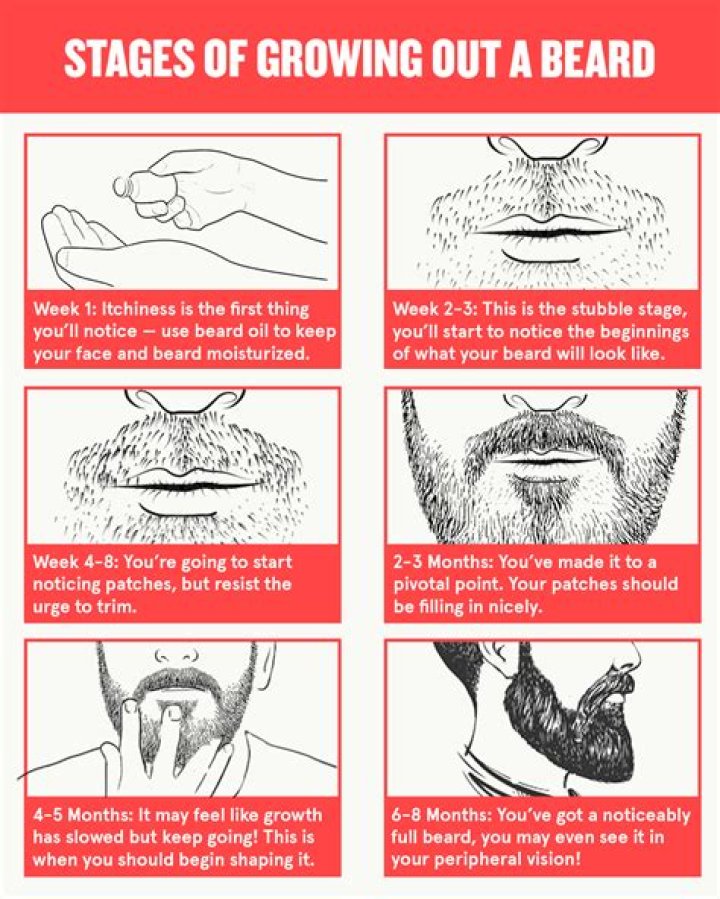
- Stage 1. This stage lasts approximately 7 days. The amount of stubble at the end of the week should give you an idea of how quickly or slowly your beard will grow.
- Stage 2. This stage covers the next 2 weeks. You’ll definitely see a pattern of hair growth that will let you know if any patchiness can be expected.
- Stage 3. This one takes another 2 weeks, at the end of which you should have significant beard growth. If you still aren’t sporting much facial hair by this time, a full beard may not be in your future.
- Stage 4. You’re well into your second month of beard growth. It will likely be time to see a barber about trimming it (if you want that groomed look) and defining the shape you want.
- Stage 5. From 2 months on, you should see slower beard growth. Now you can decide if you want to commit to the look and upkeep of a full beard.
Your ethnicity, age, genetics, and hormones — not to mention various medical conditions — can all affect whether your beard comes in faster or slower, or in all the places you desire.
If your beard seems to be taking a long time to grow in, one of the following factors may be at play.
You may remember guys in high school who seemed to have a full beard before they got their driver’s license. They’re the exception, not the rule.
Typically, full beard growth is possible starting at around age 18, but for many men, that time may not arrive until they’re 30. So, if you’re not getting the beard growth you want, it may be because it’s not your time.
Ethnicity
Certain ethnic groups tend to be more hirsute than others. Chinese men, for example, generally have less facial hair than white men, and men of Mediterranean descent generally have thicker beards.
Genetics
Beyond your ethnic origins, your direct family traits have much to do with whether you can grow a full beard. Likewise, your genetics also determine the texture of your hair, your likelihood of going bald, and so forth.
For clues about your beard’s future, look to your male relatives. While there’s no guarantee that a dad with a full beard will have a son who can pull off the same thing, hair patterns do tend to be hereditary.
Hormones
Low levels of testosterone can make it more difficult to grow a beard. Talk with your doctor about taking supplements or trying testosterone therapy to help combat low testosterone.
All products featured on GQ are independently selected by our editors. However, when you buy something through our retail links, we may earn an affiliate commission.
Here are all of the tips, tricks, and products that will make your beard fuller, softer, healthier, and more flattering. If you’re a first-time beard grower or a 20-year veteran of the game, there’s always room for growth. (Figuratively, and literally.) And even if you’re sticking with a shorter style, these same rules apply.
Make a plan
Before you decide to grow a beard—even if it’s short—it’s important to know which beard styles flatter your face shape. The general rule of thumb is to allow the beard to soften any extremities, and pull everything closer to a central, more oval place. Think of it this way: if you have a longer, more oblong face, you don’t want to magnify the fact with a long, narrow beard. Visually, it’s going to be the first thing everyone associates. Instead, you should widen your face and plan for fuller sides but trim things up under the chin. The opposite can be said for a square, wide face. Soften the jaw with trimmed-up sides and a fuller patch under the chin.
Be patient
The biggest obstacle between you and a good beard is time. The beard you’re capable of growing might be way bigger and fuller than you anticipate, simply because you haven’t ever grown it past the patchy first-month. Beards aren’t reserved for guys with A+ stubble. Lucky for all of us, beard hairs grow out thick and scraggly, and they fill in those patches after a while. So, keep on the path. Follow the next tip in those early weeks so that it looks like a defined beard, even in its shorter stages, and soon you’ll wake up and realize that you crossed the threshold.
Shave the perimeter
There’s one major difference between lazily letting your beard grow and actually taking charge of the growth and style: The neck and cheek lines. You have to maintain them, as they give your beard its intentional shape, even in the first few weeks. Your cheek line will be determined by how full your whiskers grow there. Rely on your own intuition, but if you need help with fuller cheek fuzz, pick up a beard-stenciling tool that helps draw neat lines.
As for your neckline, there’s one easy way to do this: Take two fingers and lay them above your Adam’s apple. Trim an imaginary “U” shape from behind both ears and jaws, and meet in the middle at this point on your neck. Shave everything below this line. This is your neckline, and you have officially defined your beard as such, and not just “5 days of not shaving”.
Waiting for a beard to grow in can feel a lot like watching grass grow. This may be frustrating if you’re trying to grow a full beard.
The younger you are, the longer it may take you to hit your beard goals. Men’s facial hair starts coming in during puberty. Many men will sport the beginnings of a mustache and a few sprigs of chin hair years before the rest of their beard starts to surface.
Some men see their full beard come in when they’re as young as 18 or 19. Others may continue to have sparse areas of growth until their mid-to-late 20s or even later.
Some men may never achieve the beard of their dreams. Genetics and hormones play a large role in determining how quickly and fully your beard will ultimately grow. Health and lifestyle habits can also play a part.
Facial hair growth is largely propelled by testosterone, a hormone. Testosterone levels can vary. For men between 19 and 38, the normal range is 264 to 916 nanograms per deciliter (ng/dL). This represents about the 3rd through 98th percentile for testosterone.
Having low testosterone can negatively affect beard growth. For men with clinically low testosterone, taking supplements under a doctor’s supervision may help increase beard growth. If your testosterone is within the normal range, taking supplements will most likely not help.
You can also be genetically predetermined for a scant beard, even if your testosterone is normal. This is largely due to genetic variations, ethnicity, and heredity.
Keep in mind that you inherit genes from both parents. Your dad’s beard may indicate what yours will be like, but so may your maternal grandfather’s.
Beard growth fullness may also be affected by testosterone. There is some evidence that linear hair growth rate, meaning how fast your beard grows, is determined by the amount of dihydrotestosterone (DHT) you produce.
DHT is a byproduct of testosterone, activated by an enzyme in the hair follicle’s oil glands. Beard growth rates can vary considerably. Once your beard growth pattern has become fully established, you may notice that your beard grows about 1/2 inch per month.
Your overall health affects everything, including your beard. You can’t alter your genetics, but there are lifestyle habits that may make you healthier and help you achieve a fuller beard quicker.
Exercise
Exercise improves blood flow, which helps to stimulate hair follicle growth. Exercises like weightlifting and strength training may also temporarily boost testosterone. Try varying the workouts you do, as well as the time of day you do them. Testosterone levels naturally fluctuate in young men during the day , spiking in the morning and ebbing in the afternoon.
Good nutrition from eating a healthy, balanced diet may benefit your beard as well as your body. It’s important to keep your body mass index in the normal range, since obesity can lower testosterone.
Certain nutrients, such as zinc, may also be beneficial for testosterone levels. A healthy diet won’t override genetics, but it may help your existing hair grow healthier and more lustrous. Include the following:
- lean protein, such as chicken and salmon
- iron, such as liver
- whole grains and other healthy carbohydrates
- foods high in zinc, such as nuts and chickpeas
- healthy fats, such as those in avocados
- fruits and vegetables, such as those high in B vitamins and vitamins A, C, D, and E; these vitamins may all help with hair growth
Beard growth vitamins and supplements
Many supplements are specifically targeted toward beard growth. As with diet, there is no miracle cure that’s able to override heredity.
If you’re unable to get all the nutrients you need through diet, taking a supplement or multivitamin complete with iron and zinc may be just as beneficial.
Sleep
Sleep is essential for optimal overall health. It can be beneficial for beard growth, too.
The testosterone in your system is primarily released during sleep. Not getting enough rest, sleep apnea, and fragmented sleep can all adversely affect this process.
A small study found that daily sleep restriction lowered testosterone levels in healthy young men. Another study found that testosterone levels peak at around the start of the first REM sleep cycle, and remain at that level until you wake up.
Washing and moisturizing
Keeping your skin and beard clean and moisturized can have a positive effect on beard appearance.
Keep your pores open by exfoliating your face. This will help remove dead skin cells and debris from around each hair follicle. It will also help reduce ingrown hairs from occurring under your beard.
Leave-in conditioners designed specifically for beards can help nourish the hair, keeping it soft and moisturized. This will eliminate beard dandruff and make your beard appear fuller. You can experiment with creams, oils, and lotions to see which kind is best for your skin type and beard.
No matter your facial hair situation.
Ah, growing a beard. It’s something pretty much every guy has considered. Some, well, they’ve already gone for it. You can identify them, even. (It’s the beard; the beard is the giveaway.) But if you’ve been stuck in the consideration phase for a while, or just started growing your facial hair out on a whim—or, let’s be real, if the reality of quarantine has pushed you into a space where you’re just like, “Fuck it, let’s get fuzzy”—you’re likely looking for a little guidance. Well, that’s where I come in.
Why should you trust me? I have a beard, for one. I’ve had some version of it for more than a decade, save for that one truly horrible Movember in 2010 when I teamed up with a bunch of colleagues and reluctantly got a clean shave before growing out a mustache. (When I came back from the barber who executed that fateful shearing, my then-girlfriend and now-wife recoiled in horror and promptly—and in something of a panic—asked me when the beard would return.)
But you shouldn’t just trust me because I have a beard—you should trust me because I don’t have one of those easy beards that come with the type of facial hair that creates an actual 5 o’clock shadow after an early-morning shave. I’ve got a patch here or there and somewhat lackadaisical follicles, and I put in the damn work to grow this thing out. I learned a few things along the way, too. Now I’m going to pass them on to you. So, whether you’re looking to go full-on Viking or just want a little bit of scruff on that moneymaker of yours, here’s how to do it.
Know What Kind of Facial Hair You’re Dealing With
The first thing you’ve got to consider as you grow a beard is what kind of facial hair you’ve been blessed with. Is it a little bit patchy? Really patchy? So full that it’s hard to get a razor across it? Somewhere in between? Fuck what you heard: All of these types of facial hair can translate into a beard! (That’s why they’re all a blessing.) Each type does require a slightly different approach, though. If you’ve got a patchier beard, you may want to opt for a shorter style that leans into that devil-may-care vibe. If you’ve got some seriously full coverage, you’ll want to be ready to deal with the necessary upkeep. It’s all about setting expectations.
Grow the Right Beard for Your Face Shape
You’ll also want to take a look at your face shape. Rounder than a record? Long and lean? As with hair types, every face can accommodate a beard. And really, you can go for whatever beard shape you want—though I wouldn’t necessarily advise it unless you’re trying for some kind of novelty vibe. Though the rules of grooming are more open than they’ve ever been, this one still holds water: As a general guideline, your goal will be to make your face look as oval as possible. If you’ve got a square or a circular face, that means adding length and keeping it trim at the sides. If you’ve got an oblong or rectangular face, you’ll want to keep it shorter and fill in the cheeks.
We salute and encourage men who want to break free from the chore of shaving and grow their own beard. There is nothing more manly than a well kept beard (just ask your nearest female). The key to growing a great beard is time and commitment. There will be a period of patchiness and itchiness, but eventually a brimming beard will prevail. This step by step guide will show you how to grow a beard and maintain it.
1. Pre-beard:
The first step of how to grow a beard: Understand it will take about six weeks for any type of beard to really form. You’ll want to decide what type of beard style is best for you. Genetics will determine mostly what type of style you can grow. Some men will not be able to grow a thick beard and that’s fine. Men of varying beard growth look just fine. If you cannot grow a full beard, we recommend growing a goatee, chin curtain or another variation those suites your beard growth pattern. Regardless of your choice in beard, the steps to growing a great beard are all the same.
2. Initial Phase:
As you initially grow your beard, make sure not to prematurely shape it. A beard will initially look scruffy or scraggly and many men attempt to “clean it up”. This is a mistake as it often ends up in awkward shaped beards. If you must take off something, go in with the idea of taking off as little as possible. Make sure to keep taking care of your face with a solid facial care routine, so as to prevent itchiness, in grown hairs, and irritation as the beard grows in.
3. Growth Phase:
The growth phase of a beard is often accompanied by a lot of itchiness. The reason is your face being accustomed to shaving for so long and not having facial hair covering it. This new environment will potentially cause a mini havoc to your facial skin as beards collect dust that can irritate the skin. Understand that this phase will pass. Some high quality men’s face moisturizer will sooth your angry face during this period. If you’ve got a decent amount of hair on your face at this beard growth phase, you can use beard oil on it to reduce itchiness as well. Whatever you do, don’t cave in and shave.
4. Beard Care:
Once your beard has grown into a real beard, it’s time for beard maintenance. We suggest maintaining your own beard unless you can find a barber who you can trust. Men often find maintaining a beard is much easier than daily shaving.
5. Beard Maintenance:
Wash your beard: Lots of guys don’t wash their beards, or if they do, use a bar of soap. Bad idea as you’ll dry out your beard and skin underneath it. Shampoo your beard, just like your hair, at least a few times a week and follow up the shampoo with a beard oil after your beard is dry. Please note, there is no need to buy “beard wash”, it’s simply overpriced shampoo.
Trimming your beard: We recommend trimming your beard every two months as it helps keep your beard healthy. For the bulk of your trimming, you should use scissors and a comb. An electric trimmer is fine for the edges of your beard. If you shave around the edges of your beard, make sure to use a premium, all natural shave cream so as not to irritate the skin around the beard and cause irritation.
6. Beard Products:
Beard oil: The best beard oil softens your beard, in addition to giving it a nice shine and great scent. We recommend using a natural & organic beard oil as whatever is put on your beard will most likely affect the skin underneath. Beard oil will also prevent any skin itchiness and flakes.
Mustache wax: A great tool to help you shape your mustache as you desire, and many waxes are scented quite deliciously.
Beard comb and brush: Combing your beard will help keep it looking fresh and well kept. We suggest a boar’s hair or other natural brush versus synthetic brushes. The surface of each bristle of a boar’s hair brush is scaly, draws dust and excess product from the hair as you use it. The bristles also stimulates the natural oils (sebum) present in the scalp, and draws them along the hair shafts; this is essential for keeping hair clean, healthy, shiny, and protected.
Facial Care: Continue to take care of the skin around and under your beard, as it is responsible for keeping your beard looking healthy and clean. A basic routine using a face wash for men and a face moisturizer for men will do the trick.
Comments
I’ve tried your beard oil and it’s THE BEST ON THE market that I’ve tried I’ve tried some others and they don’t stand up I had bearddreff with the others. I’M on a FIXED income but I think you’re beard oil is going to have to find a place in my budget. Thank You
I have your sample kit, not much night serum. The care of the my beard was very helpful.I have done most of what you have put in your article. Sad to say for some reason my bead has stopped growing. I have about 7-8 inches. Sides have yet to catch up with the chin. It has been 2 years and 5 days. I’ll get your beard oil. I’ll put a follow-up in soon.
Teenagers like to grow a beard as early as they can. But is it advisable at such a young age as 15? Read the MenWit article to find out more about this hairy conundrum.
Teenagers like to grow a beard as early as they can. But is it advisable at such a young age as 15? Read the MenWit article to find out more about this hairy conundrum.
A beard is an important facial feature for men. Growing, styling, and even removing it can alter your appearance to a great degree. While many complain about having to shave off the persistent stubble every morning, youngsters are always on the lookout for ways to grow one! So, is it possible to grow a beard at 15?
Beards for Teens?
I’m sure you’ve been told this before, but repetition won’t hurt; so, let me tell you this once again―the natural growth of facial hair depends entirely on your genetics. The development of beards depends, like other ‘manly’ qualities, on the secretion of testosterone which naturally occurs at different ages for different individuals. Beards naturally emerge between the ages 15-18, at which point they are more often than not, patchy or extremely thin. Full, ‘adult’ beards usually doesn’t appear until the 20s. A full-grown beard is extremely rare―some would even go so far as to say abnormal―for a 15 year old.
Grow a Beard Quicker
Would you like to write for us? Well, we’re looking for good writers who want to spread the word. Get in touch with us and we’ll talk.
You can’t really force the issue when it comes to growing beards. The easiest (and healthiest) way is to simply let nature run its course. Yes, that one kid in your class may well be sporting a beard already, but there’s nothing you―or indeed he―can do about it. It’s just how his genes expressed themselves. However, there are a few tricks which just might give you that extra helping hand.
Start Shaving
If you are dead set on forcing a beard through earlier than Mother Nature intended, there is an age-old belief that shaving helps facial hair grow faster and earlier. A lot of people are firm believers of this theory, but there’s no scientific proof that supports this theory. Those who subscribe to this theory, and affix personal experience as proof, simply naturally developed a beard early.
Still, if you want to give it a shot, by all means, go ahead. Be careful though since inexperienced handling of the sharp razor can result in infectious wounds. If it works, consider it a bonus. If it doesn’t, well, it wasn’t going to anyway!
Growth Stimulants
External
There are some topical (applied on the surface) medications which can promote facial hair growth. Minoxidil is a well-known hair growth promoter. However, the effects of minoxidil can spread beyond the area where it is applied and lead to unwanted hair elsewhere on the body. It also leads to redness and burning sensation in the applied area.
Internal
Hair is made from keratin which is synthesized from proteins. A protein-rich diet can help facial hair grow early, fast, and strong. Even if you don’t get the desired beard, a protein-rich diet is one of the healthiest modes of diet and will help build muscle mass.
There is no foolproof solution to growing a beard at such a young age. Your beard depends on your own natural bodily condition and genetics. If you are meant to grow the beard, you will. If you’re not meant to grow one at such a young age, you won’t. And for god’s sake, don’t compare yourself to the few kids who do get a beard at such an early age. Take it from someone who started shaving at 16―in the long run, the itching really isn’t worth it!
- Click to share on Facebook (Opens in new window)
- Click to share on Twitter (Opens in new window)
- Click to share on LinkedIn (Opens in new window)
- Click to share on Reddit (Opens in new window)
- Click to share on Pinterest (Opens in new window)
Whether you’re growing your first beard or are determined to grow your best-ever beard, there are ways you can ensure success. (In terms of beard growing, “success” means that you reach your full potential for a great-looking beard, no matter its length.)
–> These tips are universal in that they’ll help you set realistic expectations for how the beard will look—for example, perhaps your beard is patchy, but you can still make the most of it. You shouldn’t be discouraged just because your beard isn’t as full as James Harden’s. Lots of guys have great beards and they’re working with far less.
Again, the rules can be applied to every guy’s own beard growth. Follow them, and you’ll grow the healthiest, most lustrous beard possible.
Know your limits, and your potential
What’s the most frequent question guys ask regarding their beard? “How can I grow more facial hair?” Well, if you’re in your mid or late 20s (or older), you’re probably set with your full deck. Some guys may experience late-stage growth, but it’s most important to accept your own beard as it is, and to make the most from there. Maybe you lack hair on the cheeks but can grow a full beard under the jaw and chin—great! That’s a perfectly normal beard style. So frame your goals around what is realistic.
Your ideal length may not be uniform
Second, it’s important to assess the shape of your head, and to aim for a beard style that flatters your geometry. The key here is to make things as oval as possible—if possible. In other words, if you have a long, narrow face (rectangular shaped), then don’t grow a long beard, or it’ll negatively accentuate that length. Instead, aim for a beard that grows more on the cheeks and less volume underneath. If your face is circular or square shaped, then keep it light on the sides, fuller on bottom. Do whatever you can to create a balance of width and length (not a perfect balance, but certainly not a hugely disproportionate imbalance, either). If your face is naturally oval in shape, then go crazy—you can probably try just about anything and it will flatter the passing eye.
Also, if you keep a shorter style and never even venture in the face-shape assessment territory, then consider a slightly contrasting length of your mustache and beard. Maybe a more weighty mustache and shorter beard is your strong suit—or perhaps the other way around. Don’t settle on a single guard length simply because that’s all you’ve cared to try. Play with contrasts, and suddenly you unlock dozens of new potential styles.
Keep the perimeter clean
Always shave the neckline and cheek lines of your beard to define the edges and give your beard intentional shape. Even if you prefer a bushy, boisterous beard (in its unkempt glory), this is the key difference between growing a beard responsibly and simple refusing to groom oneself. A beard helps give your face definition and dimension, and a clean neckline is always necessary. A neckbeard looks like a bunch of weeds overtaking your vegetable plot. The same goes for stray beard lines that lack definition.
The easiest way to “draw” your beard neckline? Imagine a U-shape from behind the two ears, swooping down behind the jaws and to the top of the neck. Rest two fingers (middle and pointer) atop each other and above the Adam’s apple. Now, envision the U from behind the ears meeting at this point (it’s the bottom of the U). Shave everything underneath the U, and keep everything above it.
Stock up on beard oils and conditioners
You’ve heard about beard oils, but maybe haven’t heard exactly what they do: Beard oils quickly absorb into each hair and deliver vitamins and nutrients that soften and hydrate the entire mane. In turn, this makes the beard softer, less itchy, and easier to tame (that is, more cooperative). Oils are also effective at reaching the skin beneath the beard, which is otherwise difficult to target and moisturize when it’s covered up.
Second, you can also try beard conditioners (creams or lotions) that work exactly like facial moisturizers to achieve the same end. Either way, this is a necessary part of maintaining a beard of any length, to ensure its long-term health and short-term management.
You probably need a comb and a brush
A beard comb is the easiest way to distribute oils evenly throughout the beard, or even to shape and style the beard after a warm shower and beard-cream application. It’s the tool you need for good presentation.
A beard brush, on the other hand, is an effective way to exfoliate the skin underneath the beard, and to remove dead skin cells that otherwise might get trapped (ditto for any other crumbs and particles that make their way into that nest). It also helps pull the natural oils produced by your skin and deliver them to the rest of the beard—similar to brushing your hair, which is an effort to nourish the full hair strand instead of just the roots. This prevents breakage, hair splitting, itching, and more.
Mustache scissors and balm go a long way
If your beard requires more than oil and a comb to keep its shape and tame flyaways, then you need to call in the reserves. That’s a good pair of spot-checking scissors (typically sold as mustache scissors), and a weighty beard balm that helps preserve a beard’s style and shape while keeping it soft and nourished. (You can either apply it thoroughly throughout the entire beard or simply graze the outside of the beard with balm in your palms to give the outer layer a frizz-free coating.
For access to exclusive gear videos, celebrity interviews, and more, subscribe on YouTube!
More Clooney, less Castaway
So, you’re thinking of growing some hair out of your face. Great timing. Just as your hair on-top has been starved of a barbers appointment, you’re now on your own in the beard department, too. And know you’re in good company: Da Vinci, Lincoln, that impossibly built personal trainer you’ve taken to watching on YouTube most mornings.
Naysayers will tell you that we hit “peak beard” in the early 2010s, but a swift glance around town (pre and post-Covid-19) proves otherwise. Rather, beards have become more accepted today than at any other point in grooming history. And, after more than a decade in the spotlight, they’re refusing to budge.
They’ve no reason to, either. Growing a beard is one of the few ways a man can reinvent himself. Outside of shaving your head, or playing RuPaul’s Drag Race with your partner’s makeup bag, a beard can dramatically alter your look free of charge. You simply need good genes, willpower and a sound routine.
But not everyone has those. What’s more, beard-growing is a medium awash with myth and untruths. So, to glean the finest facts behind a sound face-warmer, here’s how to properly grow a beard.
Is A Beard For Me?
No, in a word. Before you decide to let things grow organically, know that natural disasters are possible. Beards are, sadly, not for everyone. There are a number of factors to take into account here. First and foremost: have you got the coverage to carry it off?
Next to a very loud motorcycle or one of those angry dogs with biceps, a thick, full beard has presence. A wispy ‘tache and soft, vellus sideburns? Not so much.
That’s not to say there aren’t beard styles out there that can work with patchy growth. A clean-shaven face, however, is always going to trump an underdeveloped and uneven beard. So, if you can’t grow one, don’t.
It’s also important to consider lifestyle. Perhaps you work in a conservative (lower case ‘C’) corporate office, where dress codes are set in stone. In which case, get a new job if you want a new beard upon your return to work.
Laying The Foundations
Behind every great beard is good brickwork. Facial hair will not prove thick and lustrous if the vessel from which it sprang is tired, dry and poorly nourished.
Look after your skin. Get enough sleep. Exercise. Eat a healthy, balanced diet. All the things that are good for your waistline, are, unsurprisingly, good for optimal beard growth. If nothing else, it’s a good excuse to kick bad habits.
Sound hair growth is abetted by strong testosterone, so lift weight, eat plenty of protein, fat (the good kind) and carbs. Minimise stress. And don’t pay any attention to quack products that claim to be able to open follicles or stimulate hair growth. If they actually worked, we’d all be walking around like Jason Momoa.
Shape Up Your Beard
Whether you opt for a DIY approach, or prefer the help of a local barber, neat edges make the difference between a bad and a good beard.
“The trick with all beards and face shapes is to stay groomed,” says Joe Mills of Joe and Co: a London barbering mainstay, and one preferred by many famous men. “Keep your top lip area trimmed, and if you’re growing it out, keep it washed and moisturised. This will maintain smartness and lessen the irritation to your skin. Beard oils help shape things up, and prevent you looking too wild.”
It’s also a good idea to establish a neckline at an early stage, and shave stray hairs further up the cheeks. Where the former is concerned, imagine an invisible line running from just beneath the earlobe and behind the jawbone to the same place on the other side via the Adam’s apple. Use a razor or unguarded trimmer to remove any hairs below this and say good day to a brand new friend: a jawline. Just don’t go too high. There lies the minefield of flabby necks, softer chins and the grooming trends of waiters at all-inclusive resorts.
Separating The Facts From Fiction
Your colleague isn’t an example of hirsute finery because he rubs himself in goose fat and places a saucer of milk under his bed at full moon. There are many things that make for a good beard, and there are many falsehoods flying around on the internet as to how they grow. Here, Johnny ‘The Baba’ Shanahan, of Barber Barber, debunks and corrects some of the most common misconceptions.
Facial hair grows in thicker if you shave it
“No. A common myth. However, if you shave daily and then take a break for, say, a weekend, it might appear thicker because you’re more accustomed to smoother skin, but it definitely does not grow in thicker.”
There’s no point in going to a barber to get your beard cut when you could do it at home
“It depends on what type of beard you want. Relatively short and naturals looks are fine to maintain at home. If you want a very sharp, symmetrical, neat beard, you will need a professional to correctly shape-up the face. A big beard can be worn quite tailored, or left wild, so it’s all down to preference. I do recommend, though, that whatever type of beard you have or want, still visit the barbershop at least every five weeks to keep on the right track.”
I don’t want a beard. They itch too much
“No, again a myth. Proper washing and product use alleviates all of this. It’s the same as the hair on your head, albeit a different texture. It still needs to be washed correctly at least every other day.”
Anyone can do grow a beard
“Now this might be an unpopular answer, but I’m of the belief that growing a beard shouldn’t be a project. If you can grow one you should. If you can’t, then you shouldn’t.”
Beards are low maintenance
“Again, this depends on the type of beard you want. A beard can be as low- or as high-maintenance as you desire. Super natural and wild, which takes little or no maintenance (think Viking). Or a very neat look would take almost daily care.”
How To Pick The Right Kind Of Beard
The right beard on the right face can grant even the greatest thumb-men a semblance of bone structure. God may not have blessed with you a chiselled jawline, but a beard – the perfect optical illusion – can carve one for you.