Yoga and meditation teacher to the stars Alanna Zabel says you can quiet your mind in a mere 3 minutes. Try these 5 steps for a mental vacation.
Share this
Join Yoga Journal
Create a personalized feed and bookmark your favorites.
Already have an account?
Join Yoga Journal
Create a personalized feed and bookmark your favorites.
Already have an account?
Got a much-needed vacation coming up? Maybe a long July 4th weekend? Your meditation practice is one of the easiest things to take with you! When your schedule doesn’t allow for a full-blown mat practice, you can still quiet your mind.
Yoga and meditation teacher to the stars Alanna Zabel, who has worked with Adam Levine and Kelly Lynch, says all you need is a mere 3 minutes. Whether you find them when you’re lingering in bed, sitting on a beach, or going for a gorgeous hike in nature, here are your five steps to a mental vacation.
1. Start small. Just as you would train your physical muscles, your mental muscles have similar phases of development. Practicing even 3 minutes of stillness can feel like a long time when you first start meditating, so do whatever you can.
2. Do it your own way. Don’t feel confined by strict practices like sitting. If you’re getting outdoors this summer (and we hope you are), try a 10-minute walking meditation. Pay attention to each of the following: the physical sensations of your body walking; the flow of your breath; the sensations of air, wind and gravity on your body; what you hear; what you can see.
3. Meditate with purpose. It seems ironic, but meditation is a very active process. The art of focusing your attention on a single point is difficult, and it really helps the process to be purposefully engaged with what you are doing. Although there’s no need for repetitive mantras or forceful objectives, it is nice to have a positive intention for each day (even if it’s “I really need to relax on this vacation.”)
4. Watch your attention. Your biggest block to meditation is yourself or, more specifically, your mind. This is great news for success because you can control your mind. If you notice yourself getting caught up in a train of thought that pulls you strongly from the present moment, simply bring your attention back to your breath. This truly gets easier with practice.
5. Remember: The practice is a process. Be compassionate with yourself when your mind drifts so as not to discourage your progress. Pretty soon you’ll be able to meditate anytime, anywhere, regardless of circumstance or environment.
Looking for more guidance? Let one of our meditations walk you through the process.
Meditation is a great way to clear your mind of the worries and stresses of the day. If you’re not familiar with this method of relaxation, you may think it’s difficult at first, however with practice, you’ll find that it’s not hard at all.
Starting a Meditative Practice
Want to know what the hardest part of meditation is? Here’s a hint: It has nothing to do with meditation at all!
The hardest part is simply making the time to meditate.
Once you believe in its power and see its results, you won’t let anything get in the way of you and your peaceful practice. It might be tough in the beginning, but stay with it! It’ll be well worth the effort.
Make a goal for yourself and evaluate your progress as you go. Commit to at least weekly meditations for four weeks but preferably more often.
These meditation tips will help you in your quest for obtaining inner peace:
1. Choose a time to meditate.
Find a good time for you to meditate. You can start with shorter sessions in the beginning, but generally you should shoot for between 20-30 minutes. Right when you get up or before you go to bed are good times to practice.
- Make meditation a priority for yourself just like you would for everything else that’s important in your life.
2. Keep an elevated posture.
If you slouch, you won’t be in a good position for meditation and you’re more likely to feel like falling asleep. Elevate your posture and you’ll feel more open to the world. Relax in a crossed-legged or other comfortable sitting position and rest your hands in your lap.
3. Focus on your breath.
Your main goal is to keep your attention on your breath as you breathe in and breathe out. It may help to say a mantra and visualize breathing in good energy and letting out the bad energy with each cycle.
- Breathe at a pace that’s comfortable for you. Work toward deep, long breaths.
4. Acknowledge your thoughts.
You want to remain fully present while you’re meditating, and there’s no doubt that thoughts are going to enter your mind while you’re trying to concentrate.
- Don’t be frustrated by these thoughts, but at the same time don’t let thoughts take your attention completely away. Acknowledge your thoughts and then bring your focus back to your breath.
5. Fight the urge to sleep.
Many people complain of the urge to sleep during meditation sessions, mainly because it’s relaxing and you’re meditating during early morning or late evening hours. Try to remain awake with focus and good posture.
6. Maintain your practice.
After you discover the many benefits of meditating, it will most likely become a part of you forever. It’s important to keep up with regular meditation sessions.
Meditation will help you keep a peaceful perspective on life and can tell you a lot of things about your true self. You can use it to relax, motivate, or energize you, depending on your purpose for each session. As you get more experienced with meditation, a more joyful and peaceful life will be yours!
Health and Well-being
You’ve heard that meditation and mindfulness can benefit your health and wellbeing, so you’ve decided to give it a try. But you’re not sure where to begin … how do you “quiet the mind?”
The key to learning how to meditate and developing a successful meditation practice is finding the right fit for you. There are so many different types of meditation to choose from – guided, unguided, insight (Vipassana), focused attention, loving kindess (metta), and more. In order to figure out what form of meditation works best for you, try a few different types and note which feels the most comfortable and doable. As a quick introduction to meditation, you can follow these six simple steps to begin one type of meditation technique called mantra meditation.
Our 21 Day Meditation Experience program, Renew Yourself: Mind, Body & Spirit with Deepak Chopra and international music icon, J Balvin is taking place now through August 30. Listen for free!
You can also download our app onto your phone and meditate from anywhere.
Mantra Meditation Technique
1. Choose your mantra.
A mantra is a word or phrase that you silently repeat to yourself during meditation. The purpose of the mantra is to give you something to put your attention on other than your thoughts. You may use any phrase you like. Some people like to use words like “Peace” or “Love”. You may wish to use the So Hum mantra, a commonly used Sanskrit mantra, which translates to “I am.” I like using the So Hum mantra because it is not in my native English language and does not trigger associative thoughts.
2. Find a comfortable place to sit.
It’s best to find a quiet location where you won’t be disturbed. There is no need to sit cross-legged on the floor unless that is comfortable for you. You can sit on a chair or sofa or on the floor with your back against a wall. You may support yourself with cushions, pillows, or blankets. The goal is to sit as upright as possible while still remaining comfortable. We all have different anatomies and you want your meditation experience to be enjoyable, so make your comfort a priority. Lying on your back is usually not recommended because most people fall asleep in this position, but you can try it if sitting is uncomfortable for you. Meditation can be practiced anywhere, as long as you’re comfortable.
3. Gently close your eyes and begin by taking some deep breaths.
Try taking a few cleansing breaths by inhaling slowly through your nose and exhaling out of your mouth. After a few cleansing breaths, continue breathing at a normal relaxed pace through your nose with your lips gently closed.
4. Begin repeating your mantra silently to yourself without moving your tongue or lips.
The repetition of your mantra is soft, gentle, and relaxed. There is no need to force it. The mantra does not need to correlate with the breath, though some people prefer to do so. For example, if using So Hum as your mantra, you could silently repeat So on your inhalation and Hum on your exhalation. As your meditation continues, allow the breath to fall away into its own rhythm. The repetition of your mantra should be almost effortless. Sometimes it is helpful to imagine that rather than repeating the mantra to yourself, you are actually listening to it being whispered in your ear.
5. Do not try and stop your thoughts or empty your mind.
As you continue with this meditative process, you will inevitably find that you drift away from the mantra. It is human nature and normal for the mind to wander. Do not try and stop your thoughts or “empty your mind.” Whenever you become aware that your attention has drifted away from your mantra to thoughts or any other distractions while meditating, simply return to silently repeating the mantra.
6. Stop repeating the mantra.
After approximately 20 to 30 minutes, you may stop repeating your mantra and continue sitting with your eyes closed. Be sure to spend a few minutes relaxing with your eyes closed before resuming activity. You may use a timer with a very gentle, low-volume sound. Many people use their cell phones as meditation timers. You can download a meditation timer app on your smart phone or choose a soothing sound on your phone’s built-in timer. Be sure to turn the volume down very low as you don’t want to be startled out of your meditation.
If you find that 20 to 30 minutes is too long for you, start with whatever amount of time you can, and slowly build your way to 20 to 30 minutes. Even a few minutes of daily meditation is beneficial.
The benefits of meditation are greatest when practiced daily. Ideally, meditation can be done first thing in the morning upon rising and then again at the end of the day, preferably prior to dinner. I like to start my day feeling centered and balanced after my morning meditation. And I often think of my evening meditation as a “release valve,” allowing any stress or tension from my day to simply drift away.
Can you really meditate in a few stolen moments? You bet, says Suze Yalof Schwartz, CEO and founder of Unplug Meditation. “Whenever you can squeeze it in and for whatever amount of time, that’s good,” Schwartz says.
In fact, a quick session might be preferable, especially if you’re new to it. “Your mind’s going to constantly wander, and it’ll be a battle between thought and focus,” Schwartz says. Finding the gap between the two, she says, is the sweet spot, and it gets easier the more often you do it.
In the same way that a specific length of meditation time isn’t required, Schwartz says you don’t need to sit a certain way or feel compelled to buy props like meditation-specific pillows or candles. In short, meditation should not add more stress to your life. “It should meet you where you are,” she says. “It’s really just breathing.”
One thing you do need, however, is a place where you won’t be disturbed or disrupted. Schwartz says she’s been known to lock her car doors and meditate in a parking lot.
“You will never find the time to meditate,” she says. “You really have to make it and carve it out of your day. Whether that’s 60 seconds a day or 60 minutes a day, it’s all good.” For your next quick session, try one of these meditations from her book, Unplug: A Simple Guide to Meditation for Busy Skeptics and Modern Soul Seekers.
If you have 1 minute to meditate, try …
The Savoring Meditation
This is great for slowing down, appreciating the moment, promoting mindful eating, and experiencing what Schwartz calls “food joy.” Do it as you begin a meal or snack.
- Hold the food in your hand.
- Look at it and ask yourself, “How did this get from the earth to my fingers?” Think about it. Imagine all the steps it took to travel all the way to you.
- Lift the food to your ear. When you squeeze some foods, they make interesting sounds. Spend a few seconds listening.
- Put the food in front of your mouth with your lips closed. Notice that you’re salivating a little in anticipation.
- Place it in your mouth and feel the texture with your tongue, then begin to chew as slowly as you possibly can, noticing as many elements as you can.
- Swallow, smile, and go on with your day.
If you have 5 minutes to meditate, try …
A Quick Shot of Calm
Ideal for relieving anxiety, cooling off anger, or releasing frustration, this is the meditation to go to when tension is running high or if you’re about to speak publicly or make a tough decision.
- Take seven slow breaths, inhaling and exhaling through your nose.
- Take seven more slow breaths, inhaling through your nose and exhaling through your mouth.
- Finally, take seven more slow breaths, inhaling and exhaling through your mouth.
- Resume breathing normally and notice how your energy has shifted.
If you have 10 minutes to meditate, try …
Relaxation Meditation
If you’re feeling tense (shoulders up, forehead wrinkled), this is a great meditation to relax, revive, and refresh.
- Lie down and close your eyes. If you’re in an office or anywhere it’s not appropriate to lie down, sit up comfortably in a chair.
- Take three slow, extended breaths.
- Bring your attention to your feet and notice how they feel. Notice the weight of your heels on the ground. Tense up your feet, then consciously relax them.
- Slowly work your way up your body in the same way, tensing then relaxing your calves, thighs, hips, hands, stomach, chest, arms, shoulders, neck, and face. When you reach your face, relax your lips, your cheeks, your eyes, your forehead, and your brain.
- Take one last deep breath and then open your eyes.
jumpstart your first meditation
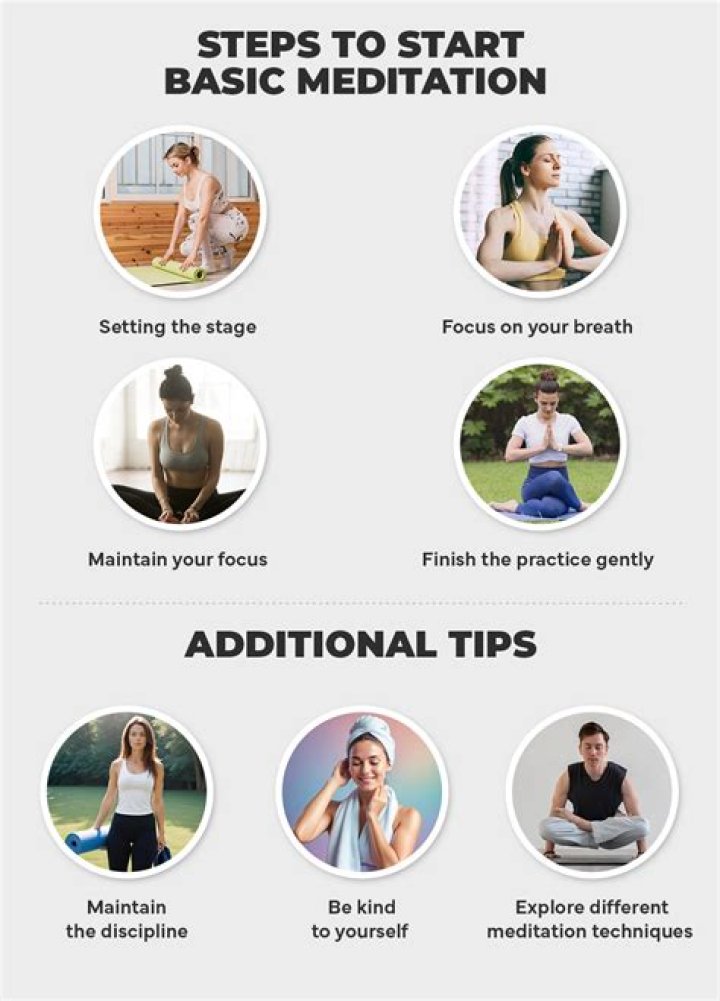
So you understand the basics of meditation, and you’re ready to give it a shot. You don’t need anything but yourself to start. Read through these steps, and then go for it!
1. Remove distractions
Put your phone on silent mode. Find somewhere quiet where you won’t be disturbed by noises or people.
2. Get comfortable
Sit upright in a chair with your feet on the floor and your hands in your lap, or cross-legged on the ground. Make yourself cozy and find a position that feels comfortable enough to stay in for the whole mediation.
3. Set a timer
Decide how long you want your meditation to be. It can be three, five, or ten minutes—whatever you have time for. Use the timer as a guide, but don’t feel obligated to wrap things up just because your timer goes off.
4. Focus inward
Close your eyes. Take three deep breaths: in through your nose, out through your mouth.
5. Note your surroundings
What does your body feel against the chair? On the floor? What sounds do you hear? Notice where your body aches or has tension, then breathe into and relax those areas.
6. Inhale, exhale
Breathe normally and observe the way your breath rises and falls. Notice where you feel the breath move in your body: chest, belly, nose…
7. Refocus your thoughts
If you notice that you’ve wandered off, simply return your focus to your breath.
8. Be gentle with yourself
Don’t force anything or judge yourself if you feel restless or can’t seem to lose yourself in the meditation. Don’t give up on it, it’ll get easier.
9. Stay until your time is up
Before jumping up to return to your day, notice how you feel. Take in all of your surroundings, and reflect on the impact your meditation made.
10. Come back again soon
Your practice will only improve the more you do it. Even if you only have two minutes for meditation, you can lower stress, increase concentration, and become more in tune with your body.
So you’re ready to try meditation and want to know how to meditate? There are many techniques for beginners. Try this easy-to-learn mindfulness technique from the Guardian, designed to help you find a bit more clarity and calm in your everyday life:
Step 1: Before you get started Before you start, you need to take care of a few practicalities. When are you going to do it each day? Where can you sit undisturbed? How will you even remember to do it? The first step is committing to a regular, daily practice. Taking 10 minutes out each day shouldn’t be difficult, but it’s easy to get caught up in everything that’s going on.Try to make it a regular part of your schedule. Create a space to sit at the same time each day. Mornings seem to work best for most people, but find a time that works for you. Where you do it doesn’t matter, just as long as you’re unlikely to be interrupted. And lastly, wear whatever you like, although you might want to loosen ties or belts, and take off your shoes.
Step 2: Get settled
Find a quiet space where you can relax. Sit comfortably in a chair with your hands resting in your lap or on your knees. Keep your back straight – sitting at the front of the seat might help. Your neck should be relaxed, with your chin slightly tucked in. Commit to practicing for the full time you’ve set aside, whether you find the session easy or difficult. A timer or a guided meditation recording might help to reach this goal.
Step 3: Breathe deeply
Defocus your eyes, gazing softly into the middle distance. Take five deep, audible breaths, breathing in through the nose and out through the mouth. On the last exhalation, allow your eyes to close.
Step 4: Check in
Take a few moments to settle into your body. Gently observe your posture, and notice the sensations where your body touches the chair and your feet meet the ground. Feel the weight of your arms and hands resting on your legs. Acknowledge your senses: notice anything you can smell, hear or taste, and sensations of heat, cold or wind.
Step 5: Scan your body
Slowly turn your mind inwards. Scan your body from head to toe, observing any tension or discomfort. Don’t try to change what you find, simply take note of it. Scan again, although this time notice which parts of the body feel relaxed. Take about 20 seconds for each scan.
Now turn your awareness to your thoughts. Notice any thoughts that arise without attempting to alter them. Gently note your underlying mood, just becoming aware of what’s there without judgment. If there’s nothing obvious, that’s fine, too.
Read steps 6-10 here.
Ending a Meditation
When you’re finished, it’s important to come out of your meditation slowly. After the deep rest you gain from your meditation, it can be jarring to suddenly get up. Keep your eyes closed for a few minutes, stretch, move around slowly, and gradually become more active. When you are ready to open your eyes, you can open them downcast at first. Take your time!
When you complete a meditation session, it is important to carry the effects into everything you do so that focus, calm and clarity can be established in your everyday life.
So you’ve read about the incredible health benefits of meditation online — from improved sleep and anti-ageing benefits to reduced stress and better brain health — and now you want to jump on the meditation bandwagon? The good news is that meditation is relatively simple, free and can be done just about anywhere — all you need is a little bit of space!
While meditation is traditionally done seated, meditation expert Mark Stephens says you can also meditate while walking, gardening or cleaning. “There are so many forms — yoga or Tai chi can be fantastic for people 60-plus,” he tells Starts at 60, adding other forms include breathing meditation or mantra meditation.
Not sure where to start? Mark has outlined how to meditate at home in five easy steps, plus two breathing tricks if you’re short on time!
Step one
Before you get started, Mark says to allocate about 10 to 15 minutes to sit back or lie down in a quiet place where you won’t be disturbed and you can get into the zone.
Step two
He says to listen to the sounds around you with your eyes closed, but don’t name the sounds. Pay attention to how you’re feeling, but don’t spend too much time gathering your thoughts.
Step three
Then, listen to and feel your breath going in and out of your body. Try not to force the breath, Mark says, explaining that: “Just watch, feel or listen to it fall in and out of your body at its own pace and rhythm.” He says to focus your energy and concentration on your breathing.
Step four
As you inhale, he recommends quietly repeating an affirmation like the word ‘peace’ and, as you exhale, repeat the word ‘release’. “Allow your body to release any tension as you exhale,” Mark says. “Repeat this for several breaths.”
Step five
Mark says as soon as you feel yourself reaching a state of deep relaxation, use your imagination to envision and feel yourself overcoming any challenges or hardships. “Mentally visualise yourself achieving goals and making positive changes in your life,” he says.
And if you’re short on time or you want to slowly ease into it, Mark has also outlined two breathing techniques that only require one step:
- Trick one: While breathing in, he says to feel the breath flow in and out of your nose and mouth. Mark adds, if you want to, you can also say an affirmation such as ‘all peace’ as you breathe in and ‘release’ when breathing out.
- Trick two: Breathe in for the count of four, hold for one, breathe out for the count of four. Mark says these holding times can be varied.
IMPORTANT LEGAL INFO This article is of a general nature and FYI only, because it doesn’t take into account your personal health requirements or existing medical conditions. That means it’s not personalised health advice and shouldn’t be relied upon as if it is. Before making a health-related decision, you should work out if the info is appropriate for your situation and get professional medical advice.
Editor’s Note: Many of our readers are regular meditators, but it never hurts to get back to basics. Below, Andy shares the tips that every meditator needs to get started.
If you’ve decided to give meditation a shot, congratulations! You’ve also decided to improve your sleep, lower your blood pressure, increase your marital harmony and reduce your stress. In fact, setting aside a little time each day to get to know your mind is a great step on the path to an altogether healthier and happier life.
The easiest way to get started is with the Headspace app (it also offers a whole range of meditations for different topics, and support throughout your meditation practice), but if you’d like to dip your toe in the water, you can use a timer and follow these simple instructions.
Watch this video to help you get comfortable before your first meditation.
1. Get settled
Find a quiet space where you can relax.
Sit comfortably in a chair with your hands resting in your lap or on your knees. Keep your back straight – sitting at the front of the seat might help. Your neck should be relaxed, with your chin slightly tucked in.
Commit to spending the full time on the meditation, whether you find it difficult or easy.
2. Breathe deeply
Defocus your eyes, gazing softly into the middle distance.
Take five deep, audible breaths: in through the nose and out through the mouth. On the last exhalation, let your eyes gently close.
3. Check-in
Take a few moments to settle into your body. Gently observe your posture, and notice the sensations where your body touches the chair and your feet meet the ground. Feel the weight of your arms and hands resting on your legs.
Acknowledge your senses: notice anything you can smell, hear or taste, sensations of heat or cold.
4. Scan your body
Slowly turn your mind inwards. Scan your body from head to toe, observing any tension or discomfort. Don’t try to change what you find, simply take note of it. Scan again, although this time notice which parts of the body feel relaxed. Take about 20 seconds for each scan.
Now turn your awareness to your thoughts. Notice any thoughts that arise without attempting to alter them. Gently note your underlying mood, just becoming aware of what’s there without judgment. If there’s nothing obvious, that’s fine, too.
5. Observe the breath
Bring your attention to your breathing. Don’t make any effort to change it, just observe the rising and falling sensation that it creates in the body. Notice where these sensations occur – be it your belly, your chest, your shoulders, or anywhere else.
For a few moments, focus on the quality of each breath, noting whether it’s deep or shallow, long or short, fast or slow.
Begin silently counting the breaths: 1 as you inhale, 2 as you exhale, 3 on the next inhalation,and so on, up to 10. Then start again at 1.
While doing this, it’s completely normal for thoughts to bubble up. You don’t need to ‘do’ anything – just guide your attention back to the breath when you realise the mind has wandered off. If you can remember the number you’d counted up to and start again from there, or simply start from 1 again.
Don’t rush the breathing and just allow it to continue at its own pace and rhythm.
Continue until the timer sounds.
6. Allow your mind to be free
Spend 20-30 seconds just sitting. You might find yourself inundated with thoughts and plans, or feel calm and focused. Whatever happens is completely fine. Enjoy the rare chance to let your mind simply be.
7. Prepare to finish
Become aware once more of the physical feelings: of the chair beneath you, where your feet make contact with the floor, your arms and your hands resting in your lap. Notice anything you can hear, smell, taste or feel.
When you’re ready, slowly open your eyes.
8. Congratulate yourself
Well done! You just meditated for a full 10 minutes. Recognize how you feel—is it different from when you first sat down to meditate? Remind yourself of this feeling the next time you feel stressed or worried, and know that with just 10 minutes of meditation, you might feel a little bit better.
If you have any questions about meditation, you can always tweet @headspace using #askandy or contact us on Facebook. It’s an exciting journey, and we’re there to support you every step of the way.
Andy Puddicombe
Andy Puddicombe is a meditation and mindfulness expert. An accomplished presenter and writer, Andy is the voice of all things Headspace. In his early twenties, midway through a university degree in Sports Science, Andy made the unexpected decision to travel to the Himalayas to study meditation instead. It was the beginning of a ten-year journey which took him around the world, culminating with ordination as a Tibetan Buddhist monk in Northern India. His transition back to lay life in 2004 was no less extraordinary. Training briefly at Moscow State Circus, he returned to London where he completed a degree in Circus Arts with the Conservatoire of Dance and Drama, whilst drawing up the early plans for what was later to become Headspace.
Related Articles
Tackling goals—whether at work, at home, or in fitness—can be challenging. But if you take care of the mind, it can help you take care of everything else.
So you’re ready to try meditation and want to know how to meditate? There are many techniques for beginners. Try this easy-to-learn mindfulness technique from the Guardian, designed to help you find a bit more clarity and calm in your everyday life:
Step 1: Before you get started Before you start, you need to take care of a few practicalities. When are you going to do it each day? Where can you sit undisturbed? How will you even remember to do it? The first step is committing to a regular, daily practice. Taking 10 minutes out each day shouldn’t be difficult, but it’s easy to get caught up in everything that’s going on.Try to make it a regular part of your schedule. Create a space to sit at the same time each day. Mornings seem to work best for most people, but find a time that works for you. Where you do it doesn’t matter, just as long as you’re unlikely to be interrupted. And lastly, wear whatever you like, although you might want to loosen ties or belts, and take off your shoes.
Step 2: Get settled
Find a quiet space where you can relax. Sit comfortably in a chair with your hands resting in your lap or on your knees. Keep your back straight – sitting at the front of the seat might help. Your neck should be relaxed, with your chin slightly tucked in. Commit to practicing for the full time you’ve set aside, whether you find the session easy or difficult. A timer or a guided meditation recording might help to reach this goal.
Step 3: Breathe deeply
Defocus your eyes, gazing softly into the middle distance. Take five deep, audible breaths, breathing in through the nose and out through the mouth. On the last exhalation, allow your eyes to close.
Step 4: Check in
Take a few moments to settle into your body. Gently observe your posture, and notice the sensations where your body touches the chair and your feet meet the ground. Feel the weight of your arms and hands resting on your legs. Acknowledge your senses: notice anything you can smell, hear or taste, and sensations of heat, cold or wind.
Step 5: Scan your body
Slowly turn your mind inwards. Scan your body from head to toe, observing any tension or discomfort. Don’t try to change what you find, simply take note of it. Scan again, although this time notice which parts of the body feel relaxed. Take about 20 seconds for each scan.
Now turn your awareness to your thoughts. Notice any thoughts that arise without attempting to alter them. Gently note your underlying mood, just becoming aware of what’s there without judgment. If there’s nothing obvious, that’s fine, too.
Read steps 6-10 here.
Ending a Meditation
When you’re finished, it’s important to come out of your meditation slowly. After the deep rest you gain from your meditation, it can be jarring to suddenly get up. Keep your eyes closed for a few minutes, stretch, move around slowly, and gradually become more active. When you are ready to open your eyes, you can open them downcast at first. Take your time!
When you complete a meditation session, it is important to carry the effects into everything you do so that focus, calm and clarity can be established in your everyday life.