While trees are a natural part of the landscape, they may sometimes require removal for whatever reason. Once removed, homeowners are often left with nothing more than an unsightly stump. However, with a little know how, you can find an easy way to remove tree stumps that will have your landscape looking as nice as it did before.
How to Kill a Tree Stump Using Chemicals
Some people choose chemical control for tree stump removal. Potassium nitrate, sulphuric acid, and nitric acid are the most commonly used but should only be used by those with experience and with great care, following label instructions.
A simpler solution may be to bore holes throughout the stump and apply salt (rock salt) and boiling water in the holes. This will help dissolve the salt so that it reaches deep into the stump, eventually killing it.
Chemicals are also commonly used for controlling sucker growth produced from the roots of tree stumps. Non-selective herbicide works well for this and should be applied at the sucker’s base on fresh cuts, or cut into the root itself and apply the herbicide. More than one application is often needed but this will eventually take care of the problem.
Remove a Tree Stump through Rotting
Rotting or decaying is another method for tree stump removal. Keeping the stump moist, not wet, and adding some nitrogen fertilizer will help encourage fungi, which will aid in its decay, especially in warmer temps (from 60 on up to 90 degrees F.).
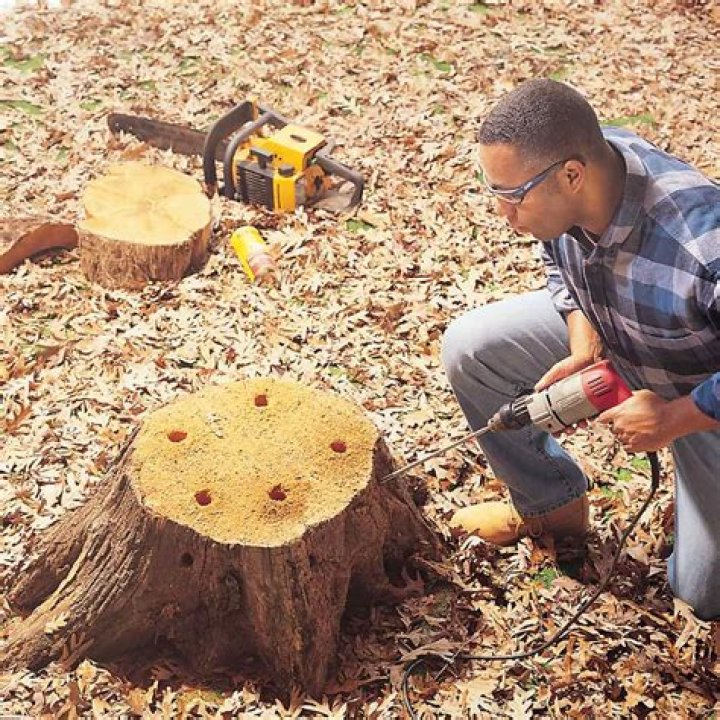
To speed up the decaying process, cut the stump as close to ground level as possible and drill 1-inch (2.5 cm.) holes throughout the stump prior to adding the fertilizer and spraying down with water. Cover this with plastic or a tarp to hold in moisture and temps.
Keep in mind that trees like cedar, mulberry, and locust will take longer to decay, as these trees have harder wood. At any rate, sufficient decay is usually evident within a year or two.
Get Rid of Trees Stumps by Burning
Burning can be used to get rid of tree stumps, but this method is rarely done except by professional landscaping and tree removers. Burning tree stumps can take up to a week or two to thoroughly burn and may not be permitted in most areas due to fire codes. This method should not be attempted nearby other dwellings or wooded areas.
Digging: The Easy Way to Remove Tree Stumps
Considered the quickest and easiest method, digging tree stumps out of the ground (by professionals) is often recommended. Though it may be somewhat expensive, it can be done within a matter of hours, or even minutes, using specialized machinery like stump grinders. Smaller stumps can be dug out with a spade shovel or pick axe.
When all else fails, you can actually turn an old tree stump into an asset. I have used them many times as pedestals for container plants, or use a hollowed out stump for the container itself.
Note: Chemical control should only be used as a last resort, as organic approaches are safer and much more environmentally friendly.
There are a lot of ways that you can do to remove a tree stump at home. All you need to do is to get the right tools for the job. If you don’t have anyone to help you, don’t worry. This is because the 3 methods on how to remove a tree stump that’s listed here can be done alone.
These methods are proven to be effective in any kind of tree stump. You can say goodbye to those stumps that destroy the view of your garden. After removing the tree stump you can actually use them as firewood. You can also use them as a decoration in your yard.
The methods that we will show you are not only exclusive to tree trumps at home. These methods can also be used in farms or forests. Removing tree stumps is easy especially if you have the right tools for the job. The only thing that you need to do is to prepare your tools and prepare yourself.
Importance of Removing Tree Stumps
Removing tree stumps are important. This is because there are some serious consequences if you don’t. You might want to remove tree stumps because they can be an eyesore to look at. But there are other reasons that you might not know that is far more important.
One of these reasons is that when tree stumps decay they become breeding grounds for insects. Insects are attracted to dead tree stumps because it’s an ideal place for them to live. And not only that, tree stumps also attract termites. These are the insects that you really want to avoid having in your backyard.
And finally, tree stumps can cause bodily injury to small children and animals. If you happen to have children then removing tree stumps are an important task. These deadweights can cause injury to your children if left unchecked. They can trip or get splinters from playing near a tree stump.
Techniques to Kill Tree Stumps
It’s easier to remove a dead tree stump than a live one. This is why killing the tree stump first before removing it is preferred. There are a lot of techniques that you can try to remove these tree stumps. Just choose the one that best suit you or the easiest that you can try.
The first technique that you can try is to use rock salt. Rock salt can kill a tree stump, not for the quickest time. Using rock salt to kill a tree stump will take you a few months. But if you’re tight on cash then this method might work for you. All you need to do is to drill holes into the tree stump and fill it with rock salt.
If you have a bit of cash on you, you can try killing a tree stomp with chemicals. There are a lot of chemicals that are being sold in the market today. These chemicals are proven to be effective when it comes to eliminating tree stumps. You can get yours in your local gardening store or you can always order online.
Scott Howfield from Which? Trusted trader Simply Stumps shares his advice on removing tree stumps.
In this article
Tree stumps in the garden can be left where they are, removed yourself or ground out by a professional. Which? Trusted trader, Simply Stumps, specialise in stump removal – Scott Howsfield shared the benefit of his experience with us.
Location of the tree stump
Apart from being unsightly, a stump can be inconveniently located too. It might stop you from easily cutting the lawn, for example, meaning that removal is the best option.
Alternatively, a stump close to a building or fence could be problematic if the tree has an extensive root system. Contact a professional for advice in these circumstances.
Type of tree stump
A tree stump left to its own devices can harbour a number of root diseases. The most notorious is called honey fungus. This fungal disease uses the tree stump as a food source and can attack other trees and woody plants nearby. It won’t attack everything and is more commonly found in trees that are already weak.
Honey fungus
Trees susceptible to honey fungus include: apple; birch; cedars; cherries (flowering); cypresses; eucalyptus; leylandii; lilac; monkey puzzle; privet; walnut; wellingtonia; willow.
Trees which show resistance to honey fungus include: ash; bamboos; box elder; beech; cherry laurel; Californian black walnut; false acacia; grand fir; hornbeam; junipers; larch; noble fir; oaks; whitebeam; yew.
‘Some tree stump removal companies will overstate the threat of honey fungus to pressurise customers into removing a stump. The truth is, if a tree has honey fungus, it will be difficult to get rid of,’ said Scott. ‘Once it’s in the ground, it’ll stay there even when the stump is removed.
Removing the stump will, however, reduce the energy or food source which the fungus is using and may slow the spread.’
Size of tree stump
Five inches or smaller in diameter
‘If you’ve only got a small tree stump, up to five inches in diameter, you can try digging it out. This is the best way to get rid of a stump – it will remove most of the root system, it shouldn’t grow back and you’re left with an area which you can replant straight away,’ says Scott.
Use a mattock. These can be bought from a DIY store for around £15. ‘It looks like a pick axe, but it has a flat blade on one side,’ says Scott.
‘The stump should be left high, around four feet, so you have some leverage. You’ll need to chop around the outside and then cut the roots out.’
Larger than five inches in diameter
Call a stump grinding professional.
‘Many customers ask me to come and help because they’ve had a go and have been unable to do it. It might only be a stump that’s a foot wide but, under the ground, the root system can be extensive making it a tough job.
‘A stump that you might spend all weekend trying to remove unsuccessfully can be ground in 10 minutes by a professional,” says Scott.
The resulting woodchips are usually left behind and can be used as mulch around the garden. If preferred, most stump grinders will take the woodchips away for an additional fee. Damage to the ground is minimal.
Tree stump removal myths
Searching online for DIY ways to remove tree stumps brings up some suggestions that are plain silly and others that are incredibly dangerous. Having seen it all, Scott dispels the myths:
1. Paint-on chemicals to make the stump rot quickly
Scott says: ‘There’s a myth about a chemical which can be painted onto a tree stump in order to speed up the rotting process. This product does not exist. I suspect it is being confused with a poison sold in garden centres to kill the stump, preventing it from re-shooting at the base.’
2. Nitrate fertiliser to make the stump rot more quickly
Scott says: ‘Drilling holes in a stump and filling them with nitrate fertiliser might shave 12 months from a process which takes many years.’
3. Burning the stump with kerosene
Scott says: ‘Another myth! Trying to burn a stump results in it becoming ‘seasoned’ (dried and hardened). A seasoned stump is more difficult for a professional to remove by grinding. Do not, as widely recommended on the internet, attempt to burn the stump using kerosene either. Apart from being dangerous, it won’t be effective.’
4. Using a chainsaw on roots
‘A number of people dig around a stump and then try to cut through the roots with a chainsaw. The chainsaw blade quickly becomes blunt, because it is not designed to cut through earth and consequently will not slice through a root. It’s also an incredibly dangerous thing to try.’
How much does professional stump grinding cost?
A tree stump grinding professional will use a chainsaw to cut a stump to the desired height and a motorised machine to grind it away.
‘I have a minimum charge of £60,’ says Scott. ‘I’ll do a tree stump in my local area of up to around 15 inches at that price.’
Hiring stump grinding equipment
It’s possible to hire a stump grinding machine for around £100 per day, but Scott does not recommend it.
‘Even though the machines you’ll find in a hire centre are less powerful than those used by professionals, they’re dangerous. The wheel will slice through anything and the machines can sometimes throw up stones which could damage a property as well as injure the operator.
‘Stump grinding machinery from a hire centre may not be well-maintained and is usually not supplied with full protective clothing or adequate training,’ adds Scott.
In addition, extra charges could be incurred for delivery of the machine and if more fuel is needed.
How to choose a stump grinding professional
‘While there is no national association for stump grinders, many are registered with the Aboricultural Association,’ says Scott.
Note that non-Arboricultural Association stump grinding professionals should not be automatically discounted as the cost of membership can be prohibitive to small, local businesses.
A good stump grinder will ask the following questions:
- What type of tree is it?
- What is the stump diameter?
- Is the stump in level ground?
- Is the stump next to a building?
- Is there space around the stump?
- What’s the reason for removing the stump?
- What’s planned for the area once the stump has been removed?
- Is there access for the machinery?
Some stump grinders may give you an estimate on the telephone, while others may prefer to visit the site and assess the stump before supplying a quote.
‘Avoid a professional who says they will just use poison or dig the stump out by hand,’ says Scott.
‘Beware anyone who says they will apply a chemical to make the stump rot away in a few months and never pay anything upfront. Also, check that the stump grinding professional is properly insured.’
Related Articles
Tree stumps are unsightly and take up valuable space. Even when they are small, stumps are incredibly resilient. Most tree stumps are capable of producing scores of new shoots, as their root systems thrive deep within the soil. By killing these eyesores, you make way for landscaping that is more attractive. Fortunately, you don’t have to dig deep into your wallet to root out a stubborn stump. Instead of hiring a professional to extirpate a tree stump, do the job yourself with items found around your home.
Epsom Salt
Epsom salt contains magnesium and sulfur, which in small doses can produce a healthy growing environment for trees. However, exposing tree stump roots to copious amounts of the minerals yields deadly results. Begin the process by combining 100 percent Epsom salt with water to create a solution that will decay the stump’s root system. Next, drill about a dozen 1-inch-wide holes into the stump. Each hole should be roughly 10 inches deep. Then, pour liberal amounts of the Epsom salt mixture into the holes. Cover the stump with a tarp and allow at least three months for the salt to kill the roots.
Rock Salt
Commonly used to melt ice from roads and walkways, rock salt has a destructive effect on tree stumps. The sodium chloride in rock salt causes soil to retain moisture so it cannot be absorbed by a tree’s roots. This intense drying effect kills stumps. The technique works by drilling a series of holes into a tree stump. Use a drill bit that is at least 3/8 inch in diameter and bore into the stump about 10 inches. Pack the holes with rock salt and top with hot water to dissolve the salt crystals. Next, pour a 2-inch layer of rock salt around the base of the stump. Add hot water to cause the salt to leach into the soil. Cover the top of the tree stump with mulch and soil and let it sit for six weeks. As the tree stump starts to decompose, begin the removal process.
Controlled Burn
Burning is a cost-effective way to kill a tree stump. However, it may not be permitted in some areas due to fire codes. If you are allowed to conduct a controlled burn on your property, drill 12-inch-deep holes into the tree stump, leaving about 1 inch between each cavity. Pour kerosene into each hole until the tree stump is thoroughly saturated. Place scrap wood on top of the stump and ignite. Carefully monitor the fire as it spreads from the scrap pieces to the stump. Continue to monitor the stump as it smolders until it turns into ash.
Forced Darkness
Robbing a tree stump of sunlight is a cheap kill technique. Cut the stump as close to the roots as possible and cover with a heavy-duty black trash bag. For smaller stumps, use a dark-colored bucket to block sunlight and moisture. Add a weight to the top of the covering to keep it in place and completely deprive the stump of light. Expect results in about eight weeks.
Breaking up is hard to do, unless you have our tips for stump removal.
Related To:
Removing Stump with Chainsaw
Removing Stump with Chainsaw
When I moved into my house five years ago, the dense stands of mature trees on the property was a huge selling point.
Of course, trees come down. Be it from age, disease or natural disasters, several stumps resided in prominent places around the yard.
Not a problem, I thought. I’ll get right on those.
Five years later, the stumps remained. One has been repurposed as the base for a birdbath. Another serves as an anchor for a bluebird feeder. Another large and poorly positioned stump reminded me that where a mighty oak once stood was now an occasional makeshift table when working in the yard.
Its time had come.
It turns out stump removal services do not come cheap. And renting a stump grinder to do the job would only make economic sense if I were taking out several stumps at the same time.
Our solution for removal may lack the convenience of hiring a service and misses the mark of speedy removal that comes with grinding. But a couple of months, thirty bucks and a bag of marshmallows later, that stump is gone and our landscaping fund remains intact.
Here’s how to remove a pesky stump when money actually is an object. Bear in mind, this involves burning, so check your local laws regarding open fires.
Lower Your Profile
I’m lucky to have a brother who is handy with a chainsaw. Cut the stump as low to the ground as possible before the process truly begins.
Soften the Stump
A commercial stump remover or plain ole saltpeter (aka potassium nitrate) will soften the wood and make it amenable to a slow and thorough burn.
Using a drill with a 1-inch bit eight to twelve inches long, drill deep holes in the top of the stump spaced three to four inches apart in all directions.
Fill each hole with stump remover/saltpeter, and top each hole off with boiling water to dissolve the saltpeter.
Stump removal can be expensive, especially on top of the cost to remove the tree. You can get a professional out to remove your stump, but there are also a few ways you can remove your stump yourself.
The top 3 methods to remove a tree stump without a grinder are:
– By hand
– Chemical
– Burn it out
Below we have detailed each option including equipment needed, a step by step guide and some safety precautions.
We have a detailed stump removal cost guide here, so you know exactly what a local professional stump removal service might cost you.
Manually by hand
If it is a smaller tree stump, you can try the good old fashion way of removing it manually with a bit of hard work.
It really is harder than you think, so I beg you, do not attempt this on medium or larger stumps, as it will take days to get it done.
The choice of tools for this job can vary depending on your personal preference, but I recommend the following as a minimum.
Tools & Supplies Required
• Mattock
• Shovel
• Heavy steel digging bar
• Axe
Safety equipment
• Steel-toed boots
• Work gloves
• eye protection
Step by Step Guide
Step 1 – Start by digging around 12 inches around the stump with the broad end of your mattock. You may need to dig deeper depending on the size of the stump.
Step 2 – The above step would help you loosen the dirt around the stump. Once done you will need to shovel it out. This is the most laborious part of the task and you need to be prepared to remove large amounts of soil and bigger the stump, more soil needs to be removed. The process should be repeated till you have access to roots that need to be cut.
Step 3 – For removing the roots you can choose either a chainsaw if you have it or an axe. You can also make use of a hand saw to sever the roots from the trunk.
Step 4 – You will need to sever all lateral roots from the stump. Make sure you sever then as close as possible to the stump itself. This will give you good access to the tap root.
Step 5 – The tap root is a root that goes straight down directly under the tree. Once the lateral roots have been severed, you will need to dig some more with your mattock to expose the tap root.
Step 6 – In the final step you will need to cut the taproot either using the large saw or your axe.
Safety Tips
• Don’t take to this job without wearing the safety gear. You need to always wear steel-toed boots and heavy duty work gloves which will help in preventing injuries.
• Avoid digging the trench close to the stump as this reduces your room for manoeuvrability and increases the chance of injuries.
• Make sure your kids and pets aren’t around and even people who aren’t involved in job. An unintentional error might lead to an injury to your loved ones.
• Aim your axe extremely carefully while swinging as hitting dirt instead of the taproot would dull the blade and require frequent sharpening.
Chemical stump removal
Using chemical removal for medium to large stumps is ideal. This process is essentially a technique of speeding up the decay of the stump through chemical reactions.
The only con with the process is that it is much slower as compared to manual removal or burning as you will have to wait for the chemicals to work their magic. While there are ways in which you can speed up the process of stump removal by increasing the moisture of the stump the process would take about 4-6 weeks to start showing results and the entire stump may take even a year to completely decay.
Tools & supplies required
• Drill and a large bit
• Plastic tarp
• Long bow saw
• Garden mulch
• Hay
• High-nitrogen garden fertilizer/Potassium-nitrate tree stump removal granules
• Chainsaw
Safety Tips
• Steel-toed boots
• Safety gloves
• Eye protection
• simple paper gas mask
Step by Step Guide
Step 1 – Cut the stump as close the ground as you can using a long bow saw or a chain saw
Step 2 – In the next step you need to drill holes few inches deep inside the stump maintaining a gap of around an inch between the holes. Use the widest drill bit available as the deeper and wider you go it is better for you.
Step 3 – Next you need to pour water into these holes and then add high nitrogen garden fertilizer or potassium-nitrate granules.
Step 4 – Once done you will need to cover the entire stump with a plastic trap. This is important as it prevents moisture from escaping. Moisture is very important for the nitrogen to work and this speeds up the entire process.
Step 5 – In the next step cover the plastic trap with organic mulch and pour lots of water over it. This will ensure that the chemicals would have adequate moisture to work their magic. You can add additional layers of hay over it and then water it thoroughly. Covering the stump also prevents a dog or cat getting access to it.
Step 6 – You need to periodically remove the hay, much and the plastic trap and pour more nitrogen over the stump and cover it back again. You will need to repeat this process weekly for a period of 4-6 weeks and you will notice that the stump starts to decay.
Step 7 – The stump turning spongy would signal the start of the decay. You can remove some of the decayed wood using an axe. The hard wood beneath should again be treated with nitrogen and water. Once you have reached ground level you can leave it and let it decay beneath the ground which can take a few months or even a year depending upon the size of the stump.
Safety Tips
• Don’t touch the chemicals with your bare hands.
• Always wear safety gloves and eye protection when working with chemicals.
• Prevent your pets and kids from touching the stump or the mulch as this can expose them to chemicals.
• Wash your hands and thoroughly after you have completed the job and disinfect the tools to avoid contaminating other trees in your yard with the harmful chemicals.
Author: Ben McInerney – Ben is a qualified arborist with 15 plus years of industry experience in Arboriculture. He ran a successful tree service before turning to writing and publishing. Ben is dedicating to providing users with the most accurate up to date information on everything trees.
Related To:
Old Tree Trunk
Removing tree stumps is no easy task. In the old days, farmers use to burn them out or they relied on horses or oxen to pull them out. Today you can buy chemicals that are designed to rot the stump, but in most cases they’re toxic and can take months and months to actually complete the process.
If you have a stump that’s relatively small, you may be able to remove it by digging it out. However, you might be surprised by how much effort and how many tools are required for the job. So when faced with a large stump, call in a professional stump grinder.
When hiring a professional, consider the cost of the services provided. How do the professionals determine their charges? “We base the price by the inch,” says arborist Adam Balogh. “Measure the widest part of the stump. Multiply that by the price for homeowners or contractors.” Also, when looking for a professional stump grinding service, request and check references.
The harder the wood, the easier it is to grind. For instance, oak is one of the easier trees to grind even though it’s one of the densest woods. This is because the chip size is very small. The softer the wood, the bigger the chip size. This also makes a big mound of chips. However, even if the stump was small in size, the mound of chips may be quite large. That’s because it’s fluffed full of air. Letting it sit for a few days will allow the air to escape and compression to occur.
However, just because the dust has settled doesn’t mean it’s time to spread the grass seed. As the chips decompose, they suck the nitrogen from the soil around them, leaving an inhospitable growing environment. Give the freshly mulched chips time to decompose. Move them to the compost pile and allow it to sit for a year. Add some blood meal to it to facilitate the decomposition process.
Once the chips have been removed from the area and you’re ready to replant, it’s important to remember that what was growing in this area before may not be suited to grow here now. For instance, the lawn underneath a large shade tree was primarily fescue. But now that the tree is gone, Bermuda grass is the better option since it’s now in full sun. Plants that were once planted underneath the shade tree may need to be relocated to another shady area in the yard and replaced with plants that tolerate more sun.
Keep in mind that even though you’ve taken the mulched load of chips from the stump to the compost pile, the tree may not necessarily be gone for good. It may come back from the roots. If the tree was located in a grassy area, a mower can take care of keeping any new growth cut back. Otherwise you can dig out certain pesky roots and cut them away with pruners. It’s possible for the stump grinding service to chase the roots. But this process can be quite labor intensive and costly, and it can make a mess of your lawn. A tree’s root line typically extends quite a few feet beyond its drip line.
Removing tough tree stumps can be harder than felling the tree itself, but it’s a task worth taking care of sooner rather than later.
Removing tough tree stumps can be harder than felling the tree itself, but it’s a task worth taking care of sooner rather than later. While a tree stump can lend your landscaping a certain rustic charm, they can cause a variety of unwanted side effects for your garden if left unchecked.
Honey fungus is among the most serious – by no means as sweet as it sounds, this viral infection can spread to other plants and remaining trees, and it can be deadly. Factor in the hassle of keeping insect infestation and suckers (new tree shoots) in check, and it’s easy to see how removing it or killing off the stump completely can save you problems in the long run.
Getting Started
Making the removal of the stump an altogether easier task starts when the tree is felled. Whether you’re doing this part yourself or employing a contractor, ensure that the trunk is cut as close to the ground as possible.
Smaller stumps can, of course, be removed by digging, roots and all, but for tougher specimens, you have two main options: using specialist machinery to grind the stump to sawdust then and there, or using a product that will kill off regrowth or help to speed up the natural process of decomposition.
While some people recommend burning as a way to quickly remove a stump, this carries a considerable risk – particularly in residential areas or dry climates – and is definitely best left to the professionals.
Whichever you opt for, you’ll also want to make sure that children and pets are kept out of the garden on the day.
Using A Stump Grinder
There are times when you’ll want a tree stump removed as quickly as possible, and this is where specialist machinery comes in handy.
Stump grinders are readily available for hire, but they are quite large and – like all motor-operated machines – potentially dangerous. If you suffer from poor mobility or poor eyesight, it’s best to give this option a miss or employ a contractor to take care of it for you.
If you do decide to hire a stump grinder and do the work yourself, make sure that you tell the company you’re renting it from the exact size of the stump you’re planning to remove – they’ll be able to advise you whether the machine you’re renting is appropriate for the task, or whether you’ll need to call a professional in.
Make sure that they run through the controls with you in detail – and do take all the recommended necessary safety precautions.
It’s worth thinking ahead about what you’ll do with the sawdust that the grinder leaves behind. If the original tree was diseased, you’ll want to arrange for this to be removed from your property, but otherwise, it can be used for mulch elsewhere in the garden.
Using A Stump Killer
While leaving a stump to decay in its own time carries risks of infestation and infection, there are steps you can take to accelerate the process without resorting to hiring contractors or heavy machinery.
Stump killers contain active ingredients that work similarly to weed killer. Absorbed by the remaining stump, they prevent regrowth and therefore give you a valuable head start on the usually lengthy process of decomposition, killing it off entirely.
It’s best to use these products on freshly cut stumps when the surface cells will be most receptive to the treatment. You also want to avoid attempting this when the stump is wet, so it’s best to avoid days following heavy rainfall.
For smaller stumps, simply dilute the product with water and, wearing gloves to protect your skin, ‘paint’ it on to the cut surface using a clean brush.
Dealing with a particularly wide trunk? You can also drill into the top of the stump in a few places, and fill the resulting holes with more the diluted solution. This will help the product to penetrate the timber more quickly, speeding up the process of decay even further. Also, opening up the tree stump and letting in the air will also help the process.
When using a stump killer, a single application will usually work completely within about four to six weeks, meaning that the decomposition process can begin in earnest – a much-accelerated timescale.
How to Remove a Tree Stump
How to Remove a Tree Stump
Tree stumps are often left in the ground for a reason — they are expensive and difficult to remove. Stumps can become unsightly, create underground issues over time and start to regrow. It is beneficial for you and your property to have them removed.
Reasons to Remove a Stump:
- Take up valuable space on your property.
- Can decrease property value.
- Safety hazard, especially when hidden by grass, weeds or plants.
- They’re unsightly.
- Old stumps attract pests.
- New stumps can start to re-grow if not taken care of correctly.
Although the stump removal process is challenging, there are a few ways to make it easier. With the right knowledge and tools it’s doable. Here are our most recommended methods for removing a tree stump:
Urban Soil Recommended Stump Removal Methods:
1. DIY – Remove by Hand: This method is best for small trees with shallow roots.
- Begin by digging around the circumference of the tree, exposing the roots as much as possible. Once the roots are exposed, using a grub hoe, cut and wench the roots from the ground, removing as much of the root system as possible. It is often easier to soak the soil as it helps loosen around the stump. Once the roots have been removed, the stump itself should be easy to take off. At this point, a shovel may be required to dig below the stump to break any additional roots. A pry bar can also be used to help leverage the stump to remove it. Remove the stump in wheel barrel or truck bed and fill the hole with topsoil.
- Tools: shovel, axe, loppers, root saw, and pry bar.
2. Stump Grinder: are by far the most effective way to get rid of stumps, especially if you need it gone ASAP.
- Using a stump grinder is the most efficient and effective way to remove a tree stump. Stump grinders have metal teeth that shred the wood into chips. As this machine suggests, this machine grinds stumps until what is left is below ground level. You can then use the ground stump material in your garden and fill the hole with topsoil.
- Tools: Stump grinders can be rented, but most homeowners choose to hire an experienced arborist or landscaper to do this work for them.
- They are generally rented by the day or half-day. Be sure to follow the safety guidelines while operating this equipment.
- Tools: Stump grinders can be rented, but most homeowners choose to hire an experienced arborist or landscaper to do this work for them.
3. Heavy Equipment: for large or multiple stumps where there is good access Urban soil uses excavators to dig out stumps and load and haul them away.
- This can be more cost effective on larger jobs where trees are being removed.
If you’re planning to remove a stump from your yard, keep in mind the time, money and resources it will require to get the job done. There’s a good possibility you will need to buy or rent tools do it correctly. If the job feels overwhelming, it’s best to leave it up to the professionals.
Committed to Sustainability.
There are other methods to removing stumps (i.e. burning and chemical removal), but here at Urban Soil, we’re committed to sustainability. We recycle tree and yard waste to reduce landfills and to eliminate burn pollution. Our process is not only good for our neighborhoods, it also helps us to manufacture high quality soils, composts and mulches for builders, homeowners and landscaping companies. We are mindful of both your property and your neighboring properties, and how our work could affect their plants and soil integrity. We take pride in each project treating it as if it were our own land.
Our experienced and ISA Certified Arborists focus on professional guidance, environmental safety and high-quality work. They have mastered the craft of tree care services and have a deep proficiency when it comes to understanding the process of stump removal.
Contact us today for your free stump removal consultation.
Trees can be fantastic garden additions, but they also cause their fair share of trouble. Even the most striking trees on your property could fall foul to disease or a particularly nasty storm. As simple as that, you’re left with a whole load of clearing up, including a still in-tact tree stump.
This can leave your garden looking scruffy, as well as posing potential problems for unsightly regrowth. If this happens, you may well find yourself asking, ‘how do you kill a tree stump?’ In reality, there are a few different options, including killing, rotting, and eventual removal, and we’re going to talk you through the main options here.
How to kill a tree stump naturally
You wouldn’t be alone in seeking natural ways to ill your tree stump. All the better for keeping your soil and outside space as healthy as possible. Top natural options include –
Killing tree stumps with rock salt
Rock salt is a naturally occurring mineral formed from sodium chloride, and it can be used to kill your stump. The main points to note when considering how to kill a tree stump with rock salt are that you’ll first need to cut that stump as close to the ground as you can, as well as drilling into the side at regular intervals. Then, killing tree stumps with rock salt is as simple as packing those holes and securing with soil. Water every 2-3 days to dissolve the salt, and watch as the process depletes the stump’s nutrients and kills it with surprising ease.
Killing tree stumps with Epsom salt
The Epsom salt tree stump trick is another popular option and involves the use of this naturally occurring compound of magnesium and sulphate. Ultimately, how to remove a tree stump with Epsom salt isn’t all that different from the rock salt method, with holes drilled into the stump and filled.
Killing tree stumps with copper nails
Killing tree stumps copper nails involves simply hammering copper nails into the stump at an angle close to the ground. Do this one inch apart around the tree, covering each nail with soil to give your copper nails tree stump the best chance of oxidizing. When that happens, the process will poison the stump, thus killing it. Simply make sure you remove nails after this process is complete for safety purposes.
Burning tree stumps
If neither of the above appeals, you always have the option of burning tree stumps in the ground. This may seem like an elusively simplistic choice, yet many of us are still at a loss as to how to remove a tree stump by burning. As much as it would be easiest, just lighting a match and hoping for the best won’t cut it. Instead, making sure this method works involves digging and drilling around the stump a few days ahead of time, then filling those holes with flammable liquid. That way, you can burn your tree stump with charcoal and watch it catch before digging out and removing those charred, and loosened, remains.
How to get rid of tree stumps unnaturally
Natural options are fantastic, but there’s no denying that they can take time and a fair amount of effort. If you’re interested in how to rot a tree stump fast, unnatural methods may turn out your best bet. Unnatural options to consider include –
Killing tree stumps with bleach
Killing tree stumps with bleach may seem extreme but approached right, there’s no reason this method can’t work. But, can bleach kill a tree stump as efficiently as you need? The simple answer is that it depends on the tree in question. Ultimately, your best way to test the theory is to try exposing the live stump, drilling holes into the outer layers, and painting bleach over the top. Within a few weeks, you should notice signs that your stump is dead. If not, try again with a stronger bleach before attempting removal.
Killing tree stumps with diesel
Killing tree stumps with diesel is another prime consideration with impressive results and doesn’t deviate all that far from the bleach method. What’s more, this option seems to offer much more reliable results. Again, you’ll need to cut that stump as far down as you can and drill for maximum exposure. Then, paint diesel onto the wood to save damaging its surroundings. Keeping the diesel localised on the stump does matter a great deal here given that trace amounts will remain in the soil in case of spillages. Still, this method has the significant benefit of allowing you to burn the stump once it’s died, making removal easier than ever.
Roundup tree stump killer
If you’re after something a little more tree-specific, Roundup tree stump killer is a fantastic option. Even better, the ingredients in this product will kill your stump from the outside in, ensuring minimal damage to its surroundings. All you need to do is mix one cup of your tree stump killer with nine cups of water. Again, it’s worth exposing and drilling your stump for maximum impact before painting Roundup killer across the stump and covering with a plastic bag. The stump should then be dead in around 2-4 weeks.
Best way to remove a tree stump
Don’t think that you can start celebrating the moment your stump dies. The hard part is yet to come where stump removal is concerned. This can be just as complex as the killing itself, and there’s no one-size-fits-all ‘best’ way to remove a tree stump. Still, we’re here with two top suggestions.
Removing a tree stump with a tree stump grinder
Tree stump removal with a tree stump grinder is the service you’ll get from contacting professionals, and it has to be the best option on the cards. That’s because this handy piece of kit includes a sharp blade that literally cuts your dead stump. Even better, tree stump grinder hire or professional services couldn’t be easier to come by. By moving the grinder side to side, you can then cut through that dead wood until you’re all the way through the stump in question. All without any backbreaking work on your part!
Pulling out a tree stump
The alternative would be to pull your stump out by hand by digging around the roots and putting your back into the process. You may assume a dead stump will be easy work, but you’re in for a shock. Those roots could still be pretty well-bonded, making this an extensive manual task, but one that is still possible if you put the work in.
Valiant Arborist are Specialists in Tree Stump Removal
As you can see from the points listed, killing and removing a tree stump isn’t always a walk in the park (or garden, as it were.) In fact, many individuals find that the easiest way to tackle this task is to turn to specialist tree stump removal services from Valiant Arborist. And, you could benefit from joining them.
As specialists in quality removals that you can trust, we offer reasonable and tailored quotes for our stump grinding processes across the Essex area. From the moment you contact us, our full-insured and experienced team will inspect your stump to determine the work necessary, and give you a reasonable quote dependent on what they find. Tree stump removal really couldn’t be simpler, and all you need to do is contact us on 01702 910 995 to make it happen today.
There are 5 basic methods for tree stump removal. Once a tree is cut down, the remainder of the trunk and the roots will eventually die and begin to decay, but that can take time you don’t want to waste. You may have several good reasons for wanting to eliminate the stump as soon as possible, but removing a tree stump is no easy task.
TIP: A popular method of stump removal involves hooking the stump up to a pickup truck and driving like crazy. Bad idea! This method has been known to seriously damage cars while leaving stumps basically intact.
1. Chemical Tree Stump Removal
There are several chemical products available at home garden centers that assist in and hasten the rotting of a dead tree stump. Most products make use of potassium nitrate to expedite the decomposition process. Chemical fertilizers high in nitrogen produce bacterial growth that will facilitate the gradual decay, which makes the stump become easier to remove. In each case, holes are drilled into the stump with a large diameter drill bit, filled with the chemical mixed with water, and left to work over time (usually weeks or months). After the chemical has taken effect and the stump has become soft and mulchy, use an axe and/or a pickaxe to break up and remove the stump.
WARNING: If using a chemical stump remover, it’s very important to keep children and pets away from the stump while the chemicals do their work.
2. Mechanical Removal With a Tree Stump Grinder
Wearing proper safety gear is very important when attempting to remove a tree stump manually or with heavy machinery. Wear long sleeves, long pants, eye protection, and steel toe boots! A mechanical tool known as a tree stump grinder can be used to remove tree stumps. It consists of a toothed circular cutting blade that grinds or chops away the stump, breaking it into small chips. Before using a tree stump grinder, remove any rocks and debris from around the stump. Then use a chain saw to remove the bulk of the stump by cutting it as close to the ground as possible. The grinder is worked from side to side, removing 3-inch sections of the stump with each pass. This method is best when you have multiple tree stumps to be rid of. You can rent the machine at a garden supply store, or pay a landscaper to take the stumps out on a price-per-stump basis. If your stump is very large, you may be forced to hire a landscaper. Rented tree stump grinders are not usually big enough to tackle huge projects.
3. Manual Removal
If the tree stump is not too big and you intend to dig it out manually, do not attempt to remove the entire stump and all of its roots intact. This is time-consuming and unnecessary. Begin by digging a trench around the perimeter of the stump and expose as many roots as possible. If you can do so without damaging the cutting blade, cut through the major roots with an axe or a circular saw. Use a pickaxe to loosen the soil around the stump, working your way around the stump and prying it loose from all sides until it comes free. Do not dig the trench too close to the stump! The wider your circle, the more room you have for maneuverability. This method is best used on trees with shallow root systems, such as maples and willows.
4. Removal With Fire
One common way to eliminate large tree stumps is to literally burn them out. Drill holes into the stump with a large diameter drill bit, fill the holes with kerosene or fuel oil (never gasoline), and wait for it to soak in thoroughly, about a week to 2 weeks. Drop one match into each hole and wait. The stump will smolder for days, and eventually you will be left with a charred hole. It is important to keep children and pets away from the smoldering stump. This method is best used for small stumps or in conjunction with another method. For example, if you have stump left behind after a chemical or manual removal.
WARNING: Be sure to check your local fire codes before using this method or you may get fined. Never leave the burning stump unattended.
5. Natural Removal
There is another alternative method for tree stump removal—doing nothing at all. Once a tree is cut down the stump will begin to decompose. It can simply be left in the ground to rot. This is a viable option if the stump is not too large in diameter. Covering the stump with fertilizer, soil or mulch will help to generate the fungus and bacteria that causes decay. In time the stump will reach the point where it can easily be extracted from the ground with minimal effort.
TIP: If you don’t like the look of your stump while you wait for it to decay, put a planter right over the top and plant something else inside. You might even forget it is there!
Over the years, I have removed several tree stumps from my garden by using this very safe and hassle-free method.
With pine needles filling up the swimming pool for several weeks of the year and most of the garden in shade, our large thirty-meter-tall pine tree had to go. I removed all the lower branches myself using a ten-meter ladder and rope to venture up as high as I dared . . . then it was a professional’s turn to go up higher to remove the remaining branches before the whole tree finally came tumbling down in the autumn.
We were left with a tree stump some forty centimeters high that was over a meter in diameter. First, we decided to put a large plant pot on top to make it a decorative feature, but over time, it became more of a hindrance when it came to cutting the lawn or playing in the garden.
So I opted for burning the stump away. I had removed two smaller tree stumps (around 30 cm in diameter) using the burn method so I was confident this method was going to be my best option.
How to Burn Out a Tree Stump
- Dig down around the stump with a shovel to expose as much of the stump as possible. On one side, I actually managed to dig under the stump and exposed three very large roots holding the stump in place.
- Drill some holes. I drilled 12 mm holes all over the top of the stump, around the bas, and into the roots, pushing the drill bit as deep as it would go (around 20 cms).
- Check the weather forecast and the calendar. Make sure it’s okay to set fires at this time and that you’ll have good weather. Here, we are only allowed to build fires outside of the summer season and after 6 p.m., so I burned my stump in late October. The weather forecast predicted four dry days followed by a lot of rain, and this was perfect, as the fire would not be dampened while it did its work and at the end, the rain would douse any underground smoldering of root systems.
- Soak with kerosene. For two days, I poured kerosene into the holes and kept topping them up over that time to make sure the fuel penetrates as deeply as possible.
- Burn it. On day three, it was time to burn that stump out. I surrounded the stump with thirty kilos of charcoal, put firewood on top of that, and set it all on fire. I prefer to use charcoal as the smaller particles can fit under the stump to help the fire reach down below the stump. I always like to ‘kill two birds with one stone,’ so I took the opportunity to dismantle a very dilapidated wooden terrace to provide more fuel for the fire as the days passed.
- Control the fire. While the fire was burning, I continually checked it and dampened the surrounding soil with a hose to avoid an underground fire.
- Give it time. By the end of the first day, the stump had been reduced by 30%, and by the end of the second day, 70% of the stump had been eaten away by the fire. I let it burn four days total.
- Add more fuel. I was able to fit my metal incinerator over the stump and re-drill holes over the remaining stump before filling the incinerator with an additional thirty kilos of charcoal, relighting the fuel again, and closing the incinerator.
- When the stump is gone, let the fire burn out. For the next two days, the charcoal burnt away slowly. Once the charcoal was gone I was left with just a large crater—the entire stump and three main roots had all gone.
Overall, it was a very easy job removing the stump and in total cost me around £50 for the charcoal and lighter fluid. The garden looks so much bigger now the stump has gone and we are looking forward to seeing the daffodils that we planted coming up this spring.
As a word of warning: Before I began, I checked the local regulations for lighting fires in my area and checked with my neighbor to make sure it was a good time for her.
Never Leave a Fire Unattended
Check with your local fire department to learn more about the specific regulations and guidelines for controlled burns in your area.
Video Tutorial
Other Ways to Remove a Stump
If you’d rather avoid fire, here are three different articles showing different methods of stump removal:
This article is accurate and true to the best of the author’s knowledge. Content is for informational or entertainment purposes only and does not substitute for personal counsel or professional advice in business, financial, legal, or technical matters.
Related
Tree Stump Removal the Lazy Way
How to Remove a Tree Stump Easily
by Eugene Brennan 6
How to Prune Fruit Trees: Pruning Made Easy!
by Zsuzsy Bee 56
5 Worst Messy Trees for the Lazy Landscaper
by Jayme Kinsey 41
Flowering Crabapple Trees: Four Seasons of Beauty
by Diane Cass 57
Popular
Why We Don’t Like Our Underground House
by Doris James MizBejabbers 437
Name Ideas for Cottages and Vacation Homes
by Virginia Allain 224
25 Ways to Annoy Your Neighbors
by Linda Bilyeu 333
Comments
leon01
It’s a very effective way – I practised on a few smaller stumps beforehand, this was a very large stump over a meter wide
leon01
I was aware of the possibility of a root fire that is why I watered the ground all the way around the stump
LaDonna
If you have many trees near each other you should avoid doing this! The fire will burn the roots out which is fine as long as they don’t make contact with other tree roots. The fire can literally spread to other trees underground and start a fire elsewhere.
Stump Removal Northwest
This looks like the most effective way to get all of the roots as well. We’ve had many clients try to burn their stumps and they still ended up call for us to grind them after because the stump did not completely burn and the roots were still in tact.
VorpalSort
Thanks for the details! Read about method in a book awhile back and have a pesky stump in my front yard I need to remove!
GreenMind Guides
3 years ago from USA
This is a good entertaining hub about your decision to get rid of that tree. A couple more photos would be welcome!
Copyright © 2020 HubPages Inc. and respective owners. Other product and company names shown may be trademarks of their respective owners. HubPages ® is a registered Service Mark of HubPages, Inc. HubPages and Hubbers (authors) may earn revenue on this page based on affiliate relationships and advertisements with partners including Amazon, Google, and others.
HubPages Inc, a part of Maven Inc.
Miscellaneous
Connect with us
About Us
Copyright © 2020 HubPages Inc. and respective owners.
HubPages Inc, a part of Maven Inc.
Don’t Let the Stump, Stump You!!
Most of the methods of removing or killing a tree do the job well, but they only concentrate on the tree! Very often, after the tree is gone, the stump remains behind. Initially, people are happy just to see the tree go, but soon the stump becomes an eyesore, and in many cases, it starts sprouting new leaves and shoots. If left unattended, it may turn into a big problem.
When we decided to kill a tree in our garden, it was mainly because it was spreading underground at a fast speed and killing off all the other plants! The grass in our lawn was withering away. The decision to kill the tree was the last resort that we could think of. Once the tree was gone, and only the stump was left behind, I was sure that my plants and lawn were going to come back to their glory!!
Soon I noticed a few new shoots and leaves sprouting out of the stump! I kept cutting them off but soon realized that the tree was thriving. Now, I had to think about killing the stump! It turned out to be a bigger problem because I had to make sure that all the roots were removed or eradicated. Read on to find information about killing the stump in the best way possible.
What Do You Need?
Just like for killing a tree, there are a number of methods for killing a stump. It depends on a number of things:
Once you are sure about these things, you can decide the method of killing the stump. There are a number of things that you may need while killing a stump.
Apart from these things, you may need a few other things which you can note when we tell you about the different methods of killing stumps. Take time to understand your needs first before you choose any method. It is not a bad idea to take advice from someone who has done it or ask an expert for tips. We will give you as much information about different methods as possible and hope that it will be useful to you.
Ways to Kill a Stump
Do you want the stump to go completely? There could be many reasons why you want to get rid of the stump!
Like there can be many reasons why you want to kill the stump, there are several methods to kill the stump. Take your time and research properly before you decide to choose one method.
1. Herbicide and Chemicals
This is an effective method and used quite extensively. You can use a potent herbicide if the nearby area is free of residences, and no water lines are passing by. Strong chemicals can easily seep into the ground and soil, which can poison the other plants and even contaminate groundwater. There are two ways you can use herbicides.
Some herbicides are specifically designed to target a particular type of tree. Use these if you can to get better and more effective results.
2. Burn the Stump
Burning the stump is also a good option to kill it. Just follow these steps.
It is essential to keep a few things in mind while choosing this method.
3. Using Salt
Using Epsom or rock salt is an easy and cheap way to kill a stump. It takes a long time, and if you are in a hurry, then this may not be a good option for you.
This method is suitable for people who don’t want to use any toxic materials or don’t want to spend too much money.
4. Cutting the Stump
Chopping the stump and removing it is also a good way to kill it. You will need a grinder and safety gear to do this effectively.
Keep these things in mind while using this method.
5. Blocking the Sun
This is a very easy method and will not cost you anything much. What you need is a lot of patience. By blocking sunlight and water, you are slowly killing the stump. Use a dark tarp or a trash bag to cover the surface.
Check it from time to time. You will notice that the stump starts to rot and decompose. It may take a few months for this to happen.
Once there are signs of breakage and rot, you can add herbicides to fasten the process. Salt is another option. You can use a drill to make holes before adding salt or herbicide. Also, be on the lookout for any sprouts. Cut them off immediately and apply herbicide to prevent any more growth. Soon you will notice that the stump is dead, and it will be easy to remove it.
Which one is the Best for You?
It does not matter which method you choose, because the keys to success are consistency, patience, and careful follow-through. Sometimes it is better to combine two or more methods to get better and faster results. Before burning a stump, you can saturate it with the salt mixture to completely dehydrate it. This will help you when you burn it. Patience is essential to do a thorough job.
If money is not a criterion; buying or renting a stump grinder is probably the best option. It will give you excellent results and that too in a short time. If it is only one or two stumps, then hiring is a better option. For a large number of stumps, it is a good idea to invest in a good stump grinder. When using herbicides, be careful and use good branded ones and, if possible, find specific tree killers.
Some Tips to Keep in Mind While Killing A Stump
While you decide to kill the stump with any of these methods, it is also essential to keep in mind some things. Some of these are safety issues, while some are tips for effective results. Please read them carefully and follow them to get better and safer results.
What Is Bleach And What Does It Do?
Bleach is the generic name for any chemical that is used for cleaning, removing stains, coloring hair, etc. It is available in different strengths, and people use it for both domestic and industrial purposes. Often bleach refers to a solution of sodium hypochlorite or liquid bleach.
When I moved to a beautiful house, everything was perfect except a large tree stump that was close to the back wall. Initially, I just let it be unless a guy who came to unclog my sewage lines told me how dangerous that tree stump was for the house! I was constantly having problems with the sewage lines and even water pipes. Every few months, there was clogging in the pipes, and I had to call a professional to clean these out.
Once I decided to get the stump out, the next question was how to do it? The number of people I asked the more ideas and suggestions I received. I did a lot of research and tried to find as much as I could about each method. Finally, I was down to the option of bleach for this operation. I will share the many reasons and ways one can use bleach for killing a tree stump.
Why Bleach?
Killing a tree is never a good thing unless necessary! However, once a tree is gone, removing the tree stump can become a big problem. Using bleach is a good option for killing tree stumps because of many reasons, and I will share some of them with you.
What Do You Need?
Once you have decided to kill the tree stump with bleach, make sure that you are fully prepared. You don’t need too many things, but still, make sure that you have the following.
Apart from these things, you may need some other things like a bowl or a bucket for the bleach, a shovel for digging the soil, and maybe a few other things.
How to Go About It?
Killing a tree with any chemical is going to affect the soil and environment. Any herbicide, chemical, or poison you use is going to have an impact on the other plants. So you must be careful with both the quantity and quality. Take a look at the steps that you need to take to achieve the results you want.
Some Important Points
Just as bleach is harmful to humans, it is also harmful to soil and the environment. The best thing is to use it in moderation.
Conclusion
Killing a tree stump with bleach is a perfect option. Remember to take into account things like the size of the stump, its location, and the most important of all safety factors. We feel that after reading all the information, you are better placed to make the right decision.
If you find the information useful, then do share it with friends and other people who are in a similar situation and are looking for a good option. We always look forward to receiving feedback from you, both good and bad. Your suggestions help us to improve. If there are any doubts, you can contact us, and we can help you. If you do it the right way, killing a tree stump with bleach can be quite an easy affair!
It seems like every time I venture into my backyard, I trip over little tree stumps everywhere. In addition to being a nuisance, they prevent me from mowing my entire yard. Not wanting to resort to using a power tool or a pick-up truck, I found that I could remove each tree stump as I found it using a simple hand tool called a cutter mattock. Now when I work outside, I bring this handy tool along with rakes and shovels to use as needed.
Thank you for supporting our family through affiliate link purchases.
Last fall our local utility company came through and cut down any trees that had grown too close to the power lines. It wasn’t until this spring, when I attempted to cut back some overgrowth, that I noticed the large stumps that had been left behind. Standing as tall as 4 inches above the ground, these stumps were catching my mower tires and stopping my mower blades dead in their tracks. Before I could safely cut through the brush with my lawnmower, I would need to remove each one of them.
Enter the cutter mattock. I personally use a Husky 5lb. Cutter Mattock with a 36-inch fiberglass handle. This beautiful piece of forged steel has a cutter head on one side and a mattock head on the other. The mattock side is used like a garden hoe to break up and remove soil, clay, sand, etc.. Used like an axe, the cutter blade is used to chop through dense undergrowth and root systems. Unlike the very sharp, broad cutting surface of an axehead, the cutter mattock’s cutting surface is narrower and less honed, making it ideal for penetrating and severing roots buried beneath the surface of the soil.
The cutter head is also excellent at damaging sewer, water, and natural gas lines buried beneath the surface of the soil, so be sure to have your local utility mark these lines if you feel they may reside around your work site. In Oklahoma, the Call Okie service will promptly mark underground lines free of charge and have always marked my lines within 72 hours of calling.
How to Properly Remove a Tree Stump (Steps With Pictures)
- To remove a tree stump completely, you will have to remove two distinct root systems:
- Lateral roots that radiate from the stump just beneath the soil
- The taproot which travels straight down from the stump.
- To get started, move any brush away from the stump with a garden rake to give yourself a clear working area. Then use the mattock head to break up the soil and pull it away from the stump. Locate the lateral roots and pull the dirt away from them as well.
- Next, use the cutter head to sever each of the lateral roots. This is where a 5 lb cutter mattock far outshines a smaller 2.5 lb version. Each root may take several swings to cut all the way though. To confirm that it is severed, I use the mattock head to pry up the section of root no longer connected to the stump. Later, I’ll cut it out as well. At this point you can simply sever the taproot if the stump is only an inch or two in diameter. I didn’t realize that this tactic wouldn’t work on larger stumps until I had spent an hour hacking on the taproot of a 6-inch diameter stump…
Two additional steps are necessary for larger taproots. First, enough soil must be removed with a shovel to expose the taproot and allow the stump enough room to rock back and forth in the hole. Secondly, and most importantly, the stump needs to be split into smaller pieces. Think of the proverbial lumberjack splitting firewood with an axe and you get the idea.
Digging around the stump provides the room necessary to split the stump vertically into 2 or 4 pieces. Once sufficiently split, the individual sections can then be stepped on and forced away from the middle of the stump. Smaller pieces will simply break off under pressure, making more room to work on larger sections with the cutter head. A 6-inch stump can be removed in around 10 minutes when not taking a picture of each step and, while working at a leisurely pace in the evenings, I expect to have all 200 feet cleared within a couple of weeks.
Shrubs and bushes can also be removed by using the cutter mattock to sever the root structure or by using a spade and landscape bar to remove all the roots at once. To remove a tree stump larger than 6-8 inches across it can be easier to burn it out or to use stump remover. If you aren’t comfortable with either of those options, you can hire a local stump grinder service or rent a stump grinder from the Home Depot.
Lessons learned while removing stumps with a cutter mattock:
- The cutter blade can embed itself surprising firmly into the dirt if you miss your target
- If either blade gets stuck, reach down and pull directly on the opposing blade to free it
- The mattock blade does not effectively cut into the taproot when swung from above
- Repeatedly slamming the mattock blade into the taproot makes your hands ache
- Attempting to pry the stump up from underneath can bend the mattock blade
- Putting a bent mattock blade back into position takes a lot of effort
- Firmly swinging a 5 lb mattock while wearing loose outdoor gloves will give you blisters
- The pictures above show the biggest stumps I’ve tackled thus far. Most smaller stumps required minimal effort; two-three swings at most.
I am really glad to have found this tool and easy way to remove stumps; it’s now one of my mandatory tools that I haul out whenever I do yardwork. Now, whenever I trip over a stump, I can quickly cut it out instead of having to make a mental note to avoid it. It’s one more tool that allows me to solve the problems and challenges I encounter, and that makes me a happy homeowner.
Livingston County’s Preferred Tree Stump Grinding Company
Tree stumps can be an eyesore and dangerous to have around the yard. To get the stump removed is the best solution, however, there are different methods of tree stump removal. Some of these methods work better for different types of stumps.
Option 1: Grinding the Stump
One of the quickest and most effective methods is grinding the stump. This will require a professional stump grinder which can be rented at various local hardware stores. This is a machine designed to grind down stumps to four to eight inches below the ground. The dirt can be placed on top and lawn can be planted. This is a very effective method and works great for multiple stumps as well. When considering this option please keep in mind that stump grinding machines are quite large and challenging to maneuver however when used properly they are very effective.
Pro Tip: When renting these machines keep in mind that many rentals have dull blades . We recommend hiring someone that has better equipment and experience just makes sense.
Option 2: UpRooting the Stump
Uprooting the stump is done by hand and it can be a huge process and should only be done with smaller trees. This process will require some sort of power to pull them on the stump such as a truck, tractor or lawn tractor. Using a pressure washer, wash away and debris the stump might have around the edges. Use an ax to cut the stump away from the former roots of the tree. Keep pulling on the tree stump with the machine and cutting as the roots are exposed.
Option 3: Kill the Tree Stump with Chemicals
Another option for removing a tree stump is to kill the tree stump with chemicals. This is a safe tactic that requires less manual labor while serving as an effective way of getting rid of the tree stump. To start, cut as much of the tree stump down to the ground and then drill holes in the stump. Then add Potassium nitrate to the holes to penetrate the wood. Let this sit for about four to six weeks until the liquid has time to saturate the stump. Once the stump has been sitting, take an ax to the soggy stump and break it up the best you can. To get even more stump out, add fuel oil or kerosene and wait another week. And, light it on fire, let it smolder until it goes out. This usually will burn below the grass line.
Option 4: Rot the Stump
Rotting the stump is similar to the above as it does not require excessive force for the removal of the stump. To begin this process first cut the stump down closest to the ground, then drill holes in the stump and fill them with a nitrogen substance. The final step of this process would be to pour water in each hole and chip off the various pieces as the stump rots.
Burn the Tree Stump
Once the tree has been removed and all the debris is gone, burning the tree stump can be a great option in getting rid of the tree stump. Drill holes in the stump and fill with Potassium nitrate and water. Then, add a small pile of wood on the top to start the fire with. All the wood to burn and chip away at it with a shovel or other tool.
Removing a stump typically can take an hour to up to several days depending on the method used. Each stump has different variables that should be considered. A large healthy stump, grinding is the best option. But, for smaller stumps or rotted older stumps, the other options are quite viable.
We hope you enjoyed this short list of tips with strategies on how to remove tree stumps. We encourage citizens across Livingston County to call a professional with any additional questions on tree and stump removal.
**Martin Tree Service provides tree stump grinding service online
With just a little patience and perseverance, you should be able to remove a tree stump with ease. Keep in mind that it is important to remove it in order to prevent fungal root and suckering rots. Despite being large and heavy, you can always remove stumps with the use of the right equipment. If you do not have the time to do so, then just give a call and hire a tree stump removal company.
But before you look for a tree surgeon near you, let’s take a look at the right way of removing tree stumps. From digging to cutting to removing, these techniques can be used regardless of the size of the stump.
Removing Tree Stumps Facts
In case you are not interested in removing tree stumps, then you need to understand why there this process is necessary. For starters, if you leave stumps in the ground after felling, they can lead to a deluge of problems. A common one is where suckering tends to introduce new shoots, most of which can rise from the roots and trunks. If you have a completely dead tree stump, it can serve as a host of many root diseases, with honey fungus being the most infamous one. Considering the consequences of not removing a tree stump, it is only imperative that you do not leave it.
When You Should Remove a Stump?
Interestingly, you have every opportunity to remove a tree stump, especially since it can always be removed physically. But if you want to the most convenient route, which is often the ideal way to go, you can always hire a tree surgeon. Basically, he will be responsible for removing a stump after it fells the tree. Sure, it can cost you a bit of money, but it is your most convenient option (not to mention the fact that the process can be quick).
If you do not see hiring a tree surgeon to be an option, you can always go with chemical stump killers. Just make sure to apply them to the freshly cut wood. Applying these killers immediately after felling will give you the best outcome. If not, there is a need for you to recut prior to applying the product.
How to Remove a Stump?
Now that you have an idea of how important removing a stump is, it is time to learn how to actually remove one. Here are some proven methods to keep in mind:
Physically Removing Stumps
This is without a doubt the most ideal solution. Your best course of action is to always remove the trump entirely. However, if doing so is not really plausible, you can go with alternative methods to get the best results. For smaller trees, a winch should be enough to pull the stump. If you are unsure of what to do, it is ideal to hire gardeners as they have the knowledge on how to use a winch properly.
You can also a mechanical mini-excavator if grubbing the stump out by hand is not possible. This machine should be more than enough to remove the stump completely. If you want to make the process much easier, make sure to cut down the tree first. That way, a significant length of the trunk is present and can even give you the leverage in removing the stump.
Using Stump Killers
Stump and/or root killers have become a popular item in the market. All of them are known for containing glyphosate or triclopyr. When applying stump killers, you should always remember to always follow the instructions the manufacturer has mentioned. This could mean drilling holes around the living edge of the stump or cutting the surface of the stump before application.
Also, you cannot just apply stump killers any time you prefer. The best times are autumn and winter. You should avoid treatment during spring or early summer because these are the times when the sap tends to rise. If you move forward with a weedkiller, remember to only apply this to a fresh stump. That is because live tissue is essential for its uptake. If the stump appears to be only a few days or weeks old, simply cut the top off in order to expose the live tissue. This is when you will finally apply the treatment to get the best outcome.
Home В» Categories В» Landscaping В» Tree Stump Removal Cost
Tree Stump Removal Cost
If you need tree stump removal, you are likely thinking about the price. Here is a breakdown to prepare you for the cost to remove a tree stump.
Use our simple two step process to tell us about the Landscaping job and what is required and well try and connect you with Landscaping companies suitable to your needs. Your contact details and privacy will be treated with the utmost discretion and privacy. Our aim is for you to be connected with the tradesperson that is 100 % suitable to your needs and circumstances.
- Use Our Service To Connect With Landscaping Professionals In Your Area
- 100% FREE No Obligation Service, Saves You Time and Money.
- Our Tradesmen Network are Pre-Screened & Certified.
How Much Does Tree Stump Removal Cost?
Tree stumps are just plain annoying, and more often than not, tree stump removal can be one big hassle. In most cases, stumps need to be professionally removed to insure that the entire root is gone and that you are not injured in the process. Knowing what prices to expect can also help you choose the right company each and every time.
How Much Does It Cost To Remove a Tree Stump?
If you are wanting to remove a tree stump, it is important that you recognize exactly what factors drive up the cost to remove a tree stump. Several factors can significantly increase or decrease the cost to remove a tree stump, including:
It is not recommended that you take on your pesky tree stump removal yourself. This project may pose some serious dangers and also requires some professional assistance with specialized equipment in order to remove the stump and roots successfully. Be sure to compare at least 3 quotes from reputable contractors in your region to get the best price possible.
Size of Tree Stump
The first thing that affects price is the size of the actual stump. Smaller stumps take less time and less manpower and, therefore, often fall into lower price range. These smaller stumps are going to take far less time and effort to remove on the part of the company that is working for you, making this a quick and easy job with a smaller price tag. Larger stumps are going to cost more and multiple stumps may end up costing into the $800 range.
Ease of Tree Stump Removal
Those stumps that pull right up out of the ground are going to cost far less than those that have to be cut or bored out of the ground. This means that the type of tree may also have an effect on price. Hard wood trees are going to cost more because hardwood trees are going to be harder to remove ultimately. On top of that, root systems and additional root removal will also affect price. Standard, straight forward tree stump removal without hard woods and extensive root systems are undoubtedly going to be cheaper to remove than others.
Season and Specials
Seasonal cost to remove a tree stump is also going to be cheaper than trees that are listed for removal during peak seasons. During summer, prices are much higher than during winter and fall, meaning that you can spend less if you have your stumps removed during an off season or while professional removal companies are running specials. Some companies offer discounts for multiple stumps and some offer discounts for those with coupons or easier jobs to complete.
Compare a Free Quote
For more information or to find a tree stump removal company near you, just enter your postcode in the space provided. You will receive a 100% FREE, no-obligation quote from professionals in your locale.
Testimonials
“Easy enough process to follow and tradesmen got in touch.Just wanted to say thanks to the team for trying their utmost to find a suitable tradesmen. I Liked that i was not bombarded with calls” – Dirk Rust from Chelmsford”.
Useful Information
Low Cost £77
Typical Cost £231
High Cost £616
Please consider prices differ greatly depending on location and specification. For an accurate price, please speak to one of our specialists in your area today.
This video is about how to remove a tree stump using a John Deere Backhoe.
The 260 backhoe we’ll be using was installed at the factory on a John Deere 1025R Compact Utility Tractor (US CA). And don’t be fooled. You can get a lot of work done with its 25 horsepower (18.6 kW). We’ve also added an H120 loader (US CA) and a Frontier AP10F Pallet Fork (US CA) for ballast on the front of our tractor.
Not long ago there was a 30-foot (9.1 m) persimmon tree standing here that the property owner was fed up with having to mow around. Now, all that’s left is this stump, which has to come out.
So the plan is to dig down and around the stump on all sides using four tools – the tractor, the backhoe, a shovel, and a chainsaw.
So let’s get started.
The 260 backhoe has a reach of 8-feet, 8-inches (2.7 m) from its pivot point. And it has a swing arc of 150-degrees. So first, Caitlin will position the tractor and backhoe so she can dig out the most material and deposit it as far away from the hole as possible, while limiting the number of times she’ll need to move the tractor.
First, she’ll lower the loader to the ground, set the tractor’s parking brake, and set the transmission into neutral. Then she’ll rotate the tractor seat into position, lower the stabilizer feet, remove the transport locking pins, and she’s ready to get started.
Using the boom and bucket control levers, Caitlin can dig on three sides of the stump from a single tractor position, and deposit the dugout material to both the left and right.
You may discover that the soil around your stump has a lot of clay in it. If so, using a shovel to loosen and remove that clay that’s in and around some of the major roots will ultimately help free the stump. And often, with a large stump like the one in this video, you’ll eventually want to cut away some of the larger, deeper roots using the chain saw so the stump will ultimately come free.
It took Caitlin about two hours of work to get the stump to come free. Now we need to get it out of the hole.
Step 2 – Remove stump from hole.
We’ll do that by using a heavy-duty ratchet winch strap to tighten it securely around the stump. We ran the strap under the freed stump, then up to and around the backhoe bucket. Then using the backhoe’s 285-pound (129.27 kg) boom lift capacity, Caitlin lifted the stump out of the hole. Now it can be disposed of according to local practice and regulations. All in, start to finish, about 2.5 hours of work.
This factory-installed John Deere backhoe, along with nearly 600 other implements, is available only from your John Deere dealer, the place to go for advice and equipment.
So remember, for implements that help turn your tractor into the workhorse it was built to be, think Frontier and your John Deere dealer.
And lastly, always read the Operator’s Manual before operating any piece of equipment and follow all operating and safety instructions.
I’ve gone on record with my opinions with palm trees. They’re useless.
Sure, they positively exemplify tropical gorgeousness in photos. Their silhouettes against fiery sunsets are striking. One should be sipping a delightful beverage out of a hollowed out pineapple as the sun goes down, while sitting next to your wife who’s wearing coconut-shell bikini-top.
Ok. Those look beautiful.
Admittedly, palm trees do complete a South Pacific circa 1943 scene when a B-17 rumbles over the house.
They still suck.
Blissfully ignorant, moments before a trip to urgent care.
This Tree Has got to Go
The issue we were having with a palm in our front yard was due to its roots. They were lifting our sidewalk, creating a trip hazard. As an added bonus, it helped by treating our vehicle to a constant stream of bird droppings to be baked into the paint by the raging southwestern sun.
It’s time for Shaggy to go.
Taking down a 20 foot palm tree was not the DIY for me. I had no chain saw, no climbing gear, and no experience. I hired a couple dudes that had left their card at our front door. I came outside when I heard the chainsaw fire up. They’d already lopped the top off.
Off with its head!
The dude worked his way down from the top, slicing the trunk like a cucumber. A heavy log thumped to the ground every couple minutes.
Dude in the truck is going to have a stiff neck. He’s got a tough job.
I DIY plenty of stuff that some might consider dangerous, but I generally know what I’m doing. Pole climbing with a hungry chainsaw, screaming inches away from my tender belly is not one of those things I’m even going to consider.
They cleaned up all the mess and left me with a short stump and a few chainsaw cuts across the face. No big deal. I would get it out of there eventually.
I’ve gone on record with my opinions with palm trees. They’re useless.
Sure, they positively exemplify tropical gorgeousness in photos. Their silhouettes against fiery sunsets are striking. One should be sipping a delightful beverage out of a hollowed out pineapple as the sun goes down, while sitting next to your wife who’s wearing coconut-shell bikini-top.
Ok. Those look beautiful.
Admittedly, palm trees do complete a South Pacific circa 1943 scene when a B-17 rumbles over the house.
They still suck.
- They only offer a little puddle of shade, strategically placed in a neighbor’s yard. The higher the tree, the further you have to range to find the shade.
- The type we have here in Arizona don’t even have the common decency to grow coconuts; how is a handy DIY dude, such as myself ever going to craft my beautiful wife a rustic, tropical island bikini top?
- They sprout creepy, inhuman tentacles that split open to spew a scattershot mess of black seeds and puffy flower things. Bonus: That’s when they attract bees!
- The palms love to prank with a never ending supply of junk destined to become flotsam in a freshly cleaned swimming pool.
- Worst of all, I’m forced to trim the never ending supply of fronds that burst skyward from their tops. They turn into a gross, brown rag-mop of dried, branch-things that must be trimmed. That’s the worst part.
- Don’t even get me started on the fact that our palm trees are man-eaters. The fronds have shark-tooth serrated edges that have tasted blood. My Blood. I don’t like going to urgent care.
Blissfully ignorant, moments before a trip to urgent care.
This Tree Has got to Go
The issue we were having with a palm in our front yard was due to its roots. They were lifting our sidewalk, creating a trip hazard. As an added bonus, it helped by treating our vehicle to a constant stream of bird droppings to be baked into the paint by the raging southwestern sun.
It’s time for Shaggy to go.
Taking down a 20 foot palm tree was not the DIY for me. I had no chain saw, no climbing gear, and no experience. I hired a couple dudes that had left their card at our front door. I came outside when I heard the chainsaw fire up. They’d already lopped the top off.
Off with its head!
The dude worked his way down from the top, slicing the trunk like a cucumber. A heavy log thumped to the ground every couple minutes.
Dude in the truck is going to have a stiff neck. He’s got a tough job.
I DIY plenty of stuff that some might consider dangerous, but I generally know what I’m doing. Pole climbing with a hungry chainsaw, screaming inches away from my tender belly is not one of those things I’m even going to consider.
They cleaned up all the mess and left me with a short stump and a few chainsaw cuts across the face. No big deal. I would get it out of there eventually.
From Our New Horizons Wiki
Since releasing on March 20th, millions of Animal Crossing: New Horizons players around the world have been hard at work on building their dream island, collecting resources and felling trees in the hopes of acquiring a pink flamingo. Unfortunately for the aesthetic-orientated among us, chopping down trees leaves behind some rather unsightly tree stumps.
While you can sit on these tree stumps (and even stave off the inevitable wasp assault by doing so), you might want to remove them to free up some space or to just make your island look tidier. It’s a rather simple process to do so, though the game never really tells you how.
All you need to do to remove tree stumps in New Horizons is to get yourself a shovel. Even a flimsy shovel, which costs just 5 hardwood to make, will be up to the job. If you don’t want to craft the shovel, Timmy will sell them at Resident Services and later in Nook’s Cranny.
New Horizons Tree Stumps
Once you have your shovel, wander up to a stump, press A, and then it will be dug out of the ground. Press A again to fill in the hole, or use this opportunity to plant some new fruit trees.
And that’s all there really is to it. You can also use your shovel to dig up and relocate flowers, something which I revelled in as I made symmetrical flower beds that no one will probably ever see or appreciate.
However, bugs seem to enjoy sitting on top of these stumps, so maybe keep a few around to attract them.
Some of the coverage you find on Cultured Vultures may contain affiliate links, which may provide us with small commissions based on purchases made from visiting our site.
Example of small rental stump grinder
If you’re thinking about removing a tree stump on your own, please read our Stump Grinding FAQs before you start.
If you’ve read our FAQs and are still determined to do it yourself, then you’ll need to rent a stump grinder. It isn’t something you have cause to use very often so purchasing is generally not cost effective.
Types of Rental Stump Grinders
Renting a stump grinder in the Danbury, CT area will get you basically two categories of machine.
Firstly, there are small push behind stump grinders (around 5 HP or so) that are effective on small stumps (8″ diameter or less) but will take a while to grind because of their lack of size and horsepower. These units generally rent for $80 to $100 a day here in Danbury and can be very handy for small jobs. Note that these types of grinders are generally not self-propelled which can really be a task to maneuver around the yard since they weigh more than a 150 pounds or so.
The second type of rental is a self-propelled 20-30 hp unit which can handle medium sized stumps but costs around $375 a day plus replacement teeth which add up quick. You will also need a good size truck with a hitch to pull this type of unit since it’s on a trailer. The one thing to consider for both rental scenarios is that these machines can be very dangerous without the skill and experience of operating them, especially as the machines get larger and more powerful.
Example of large rental stump grinder
How a Stump Grinder Works
The stump grinder has a rapidly rotating blade which bites into the tree stump and shreds it into fine mulch or sawdust. Users can control the depth and penetration of the grinder by moving it as needed, with some models being self propelled so that they will continue to chew through the tree stump until there is nothing left to shred. Once the stump has been ground, the material can be used in composting, mulching, and other tasks as desired.
Why Remove Tree Stumps?
People remove tree stumps for a variety of reasons. A large rotting stump is usually not a very desirable sight, so taking a stump out will improve the landscape. It will also make it easier to till, mow, and perform other gardening tasks, since the stump will not create an obstacle in the soil. Stump removal also discourages the growth of harmful fungi which could spread and it can prevent the tree from growing back. Some tree species, however, may sprout from the roots, so it may be necessary to grind the stump and take out the roots.
Choosing the Right Rental Stump Grinder
There are several things to consider when selecting a stump grinder to work with.
Size is an obvious concern, as a big stump will need a big grinder. Some models come with diameter recommendations, and the staff at the rental facility can also help people select the best model.
Closed vs open shroud design is another consideration. Open shroud grinders tend to work more rapidly, but closed shroud stump grinders are safer, because the blade is encased in a covering except in the area where it is actively grinding.
Safety Considerations When Using a Stump Grinder
As always when operating heavy equipment, safety precautions including the use of heavy shoes, safety goggles, ear protection, and gloves should be observed.
Additional recommendations from the manufacturer of the device should be followed as well for optimum safety, and users should always know where the on/off switch is and how to operate it.
A stump grinder should be kept out of reach of children and people who are too weak to control the device.
If you’re near anything that could be damaged by flying debris, be sure to put up a screen around the work area.
The bottom line is that we want you to be safe out there if you choose to do the tree stump grinding yourself!
If you decide that it’s something you don’t want to handle yourself, click here to check out our Stump Grinding page for information about the equipment we use and how we remove tree stumps.
How To Remove A Tree Stump Painlessly
So the tree needs to go; it’s ugly, it’s dead, it’s infested, you have a new chainsaw that you’re just dying to try out.
Whatever your reason, the bottom line it you want that tree gone. This article will give you the basics of removing trees and stumps from your property with your own two hands.
As stated earlier, you’ll need a chainsaw. Now with that chainsaw comes the obligation to use it responsibly.
You like your arms, legs, and eyes don’t you? I thought so. So to ensure your safety and anyone working with you, you’ll need the following items; a logger’s helmet.
You don’t know how sturdy those branches are, a helmet will protect you from any falling branches which cause the majority of logging injuries.
Ear muffs and a face screen are also recommended. The sound intensity of a chainsaw is roughly 109 dB depending on the brand and without proper ear protection, it would only take two minutes to cause hearing loss.
Wood chips will be flying everywhere as you are sawing, hence the face screen to protect that rugged mug of yours.
Using safety glasses with a face screen may seem like overkill, but your glasses are specifically designed to keep dust that made it through your face screen out of your eyes while sawing.
Take the extra precaution. Finally Kevlar chaps; no I don’t expect you to get into a firefight with the neighbors, but Kevlar chaps will instantly stop a chain should you accidentally drop the saw against your leg.
To actually cut down the tree, we recommend having an experienced logger teach you.
There are some things you just need to learn in person in order to learn them correctly and safely.
However, once your tree is removed, we have faith that you can get rid of the stump all on your own.
How To Cut Down A Tree Correctly:
How To Remove The Stump:
You’ve put up with the stump for a year, maybe more and you have finally had enough; enough mowing around it, enough broken trimmer lines, enough aggravation. The stump has got to go.
But who has the time and muscle to dig under the stump, pull out the roots, and yank the sucker out like an infected tooth.
You barely have an hour to yourself every day, let alone the several needed to remove this dead eyesore.
And you sure as hell don’t want to pay someone to remove it. This is your house and by God you’ll take care of it.
There’s no law saying it has to be removed in only one day. Remember patience is key, now check your garage inventory, you’ll need the following tools.
Tools Needed:
- corded drill
- extension cord
- 12 inch bit extension
- stump remover
- safety goggles
You’ll require a corded drill, an extension cord for said drill, and a 12 inch bit extension.
And please practice safe stump removal by wearing your safety goggles.
Remember little eyes are always watching. If you’re short on a corded drill, no need to buy a new one, a drill/driver will work fine.
Bit size can vary, while we recommend a 1 inch spade bit, a slightly larger or smaller bit will suffice. And last, but not least; stump remover.
The bigger the stump is, the more holes you’ll drill. Begin with your 1 inch bit, drilling at least eight inches deep and roughly three inches away from the perimeter of the stump.
Continue around the stump with three to four inches separating each hole until you’ve outlined the entire trunk.
Now that the holes are in place, pour the stump remover into them and add water. Most stump removers are made of powdered potassium nitrate.
This concoction mixed with water will speed up the rotting process, morphing the once “rock” hard stump into spongy and rotting wood in about four to six weeks.
To ensure that children and pets steer clear of the stump, surround it with chicken wire and let the potassium nitrate do the hard work.
After four to six weeks have passed, work up a sweat and chop the rotten wood out with an axe.
A partial stump will still remain. Stump remover manufacturers recommend using kerosene or fuel oil, but NEVER gasoline to burn what’s left of your stump.
Pour the oil into the holes and wait another few weeks to allow the liquid to penetrate the wood entirely.
Once the liquid has penetrated, and you’ve removed any debris that could catch fire, i.e. leaves and twigs, drop a lit match into the holes.
This will cause the stump to smolder for days, once it burns itself out, you’ll be left with a charcoal filled hole.
Surround the stump with chicken wire once more.
An ax will finish the job up nicely, giving you the peace of mind that the stump is gone and never coming back.
Note, that stump removers work best on seasoned stumps, ones that have been dead for over a year. Freshly cut stumps will require different methods of removal.
Patience isn’t everyone’s strong suit, but patience will save you money, phone calls, and headaches.
And don’t forget you also retain the bragging rights of the Do-it-Yourself man or woman.
Who needs companies with their fancy equipment and monthly payments, when you’ve got brain, brawn, and internet.
More interesting articles you may be interested in reading:
Thanks for reading and be sure to share this info with your friends using the social share buttons below. Talking about social stuff, consider liking our Facebook page to keep up to date with our articles. Check out our other articles for more mental scoops!
Tree stumps are left behind after trees are felled because the widest part is usually very hard to remove and is too low. These stumps give an ugly look to the landscape and remain there for years. It is possible to get rid of these stumps if you know the right techniques. If you have a tree stump lying around your yard since ages, it is probably high time that you remove it because we bring you all the right techniques you need to perform the task. Choose one technique that you are comfortable with and which your local environment rules approve.
Things required:
– Stump grinder
– Burning gear
– Commercial stump killer
– Spade
Others are Reading
Instructions
- font-size: 13px !important;color: #474747;text-align: justify;line-height: 21px;” >
Digging:
Use a spade to dig around the stump to a depth where the roots are exposed. You have to dig as deep and wide as two inches. Once the roots are exposed, you can cut them with an axe. This will weaken the stump as you keep removing the roots and you will be able to pull it out. This method is most effective for tree stumps with a diameter less than 14 inches. Fill the ground with the soil again after you take off the stump.
Grinding:
This is the method most tree cutting companies use. You can employ this method too. You can either hire a company to do the task or rent a grinder yourself. This is the best known method, the most expensive and works well even for very large diameters. Wear appropriate protective gear while doing it because the wooden chips will be shooting around everywhere.
Chemicals:
Bore several holes in the diameter of the stump.Pour potassium nitrate or Sulphuric acid into these holes. Commercial stump killing products are also available. These chemicals accelerate the decomposition process. It is a nature friendly way to remove tree stumps but takes its time of 2-3 months. You have to refill the chemicals on a weekly basis to make the process effective.
Burning:
Mostly people consider burning to be the most obvious solution to remove wood. Let the stump get dry over a week. Drill holes into it. Pour kerosene or fuel oil into these holes. Let the fuel penetrate the stump over a few days. Drop a match into the holes and let the stump smolder to ashes. Do take precautionary steps to prevent the fire from spreading around like a chicken wire to keep away pets and animals from it.
Tree stumps are unsightly and can cost a fortune to have removed. Or you can do it yourself. Removing a tree stump by yourself costs next to nothing but requires a bit more time than calling in a professional.
Removing the Tree Stump
All you need is a tree stump removal product and a drill. Tree stump remover is essentially just a solution or powdered mixture consisting of primarily potassium nitrate. The potassium nitrate causes the wood to rot at a much faster rate than when left naturally, allowing you to pull it out yourself after a few months. You can either buy a removal product from a hardware store or make your own by dissolving a cup of water with a half cup of potassium nitrate. Potassium nitrate should be available from your local pharmacist or chemist.
Now take a drill with a 20mm (1”) wood drill bit and drill some deep holes into the centre of the stump and the roots. Once you have drilled some holes, pour the solution into the holes. If your product is in powdered form, place a few tablespoons in each hole and fill them up with water.
–> Now you need to wait. The stump may take anything from three months to a year before it has rotted enough for you to remove it although this depends on the type and size. Large stumps and hard woods from slow growing trees will take longer to rot than softer woods and smaller stumps.
If you are in a hurry to remove it then consider calling in a professional. They have the right tools for the job and although messy, they will have it out in a day. If you really want to do it yourself quickly then you can rent a stump grinder which is a large machine with tungsten carbide teeth designed to shred it. Most machinery rental companies will offer stump grinders and will probably deliver and collect it for you.
The cover image in this article is Pin by Twentyfour Students used and adapted under CC by 2.0.
Hi, my name is Michael and I started this blog in 2016 to share my DIY journey with you. I love fixing, renovating and building – I’m always looking for new projects and exciting DIY ideas. If you do too, grab a cup of coffee and settle in, I’m happy to have you here.
Felling a tree sounds like a daunting task, but in reality, it is the easy, first step to completely removing the whole tree. There is hardly a way you can cut a tree without leaving an unsightly stump. The thing is, tree stumps are quite hardy and exceptionally resilient.
Living stumps find ways to survive. They can graft their roots to the root system of other living trees. With a new source of nutrition, saplings which emerge from the stump can grow into full trees again if not removed. They form a callous around their cross-section that prevents infection and damage from insects.
With all this information about stumps, you may be wondering how to get rid of tree stumps.
There are many ways to remove stumps, and some involve some methods which are not entirely safe. A stump grinder can be used to grind the stump entirely to the ground. It can be arduously dug up. Another stump removal method is completely burning the tree stump. A tree stump rotter can be used to kill the tree stump. However, the best way of getting rid of tree stumps yourself is by using Epsom salt.
What Is Epsom Salt?
Epsom salt or bitter salt is not just a common household item for baths and medicine. Epsom salt is an inorganic salt, which is the result of the chemical combination of magnesium and sulphur. It used as a component in bath salts and has a plethora of applications in many fields such as medicine, agriculture and food preparation. Although Epsom salt (Magnesium Sulphate) is commonly used as a laxative, it is also used for reducing inflammation and soothing muscle tension, and as an antiarrhythmic.
This salt is used in aquariums to stabilise ion concentrations. It is also applied to soil to increase its magnesium or sulphate concentrations, which in turn promotes the growth of some plants such as pepper, tomatoes potatoes and carrots which require an abundance of these nutrients to flourish.
The main quality that sets Epsom salt apart and makes it one of the best substances for removing tree stumps is its nature. Magnesium sulphate is a hygroscopic agent, that is, it absorbs moisture from its environment. This may not seem like much to you now, but you will soon find out why this trait is essential.
How Does Epsom Salt Kill A Tree Stump?
As mentioned earlier, Epsom salt is very hygroscopic, and it removes moisture from any substance it comes in contact with. When applied correctly in high enough concentrations, it kills weeds and other plants so care should be taken when using it for soil treatment.
Epsom salt kills a stump by removing the moisture from the stump, and the surrounding soil leaving the stump, and the roots to wither and dry, causing it to rot. Applying Epsom salt on stumps is safer and more comfortable compared to grinding, which may require the help of a professional arborist.
For Tree Surgeon Essex – Call: 01702 910 995
Using Epsom salt to remove a tree stump is less tasking than utilising a stump grinder or other tools like an axe. Using Epsom salt is also less costly. Now you’ll learn how to apply Epsom salt to get rid of a tree stump.
How To Get Rid Of Tree Stumps With Epsom Salt – Only A Few Steps?
There are mainly two ways you can remove tree stumps. The first method involves an inch drill bit. It is best if the stump is as close to the ground as possible (it is easier to kill tree stump and roots this way).
- Use a ½ inch drill bit or a similar size, drill holes into the stump about 1 inch apart. Make sure the outer ring of holes should be about 3 inches from the edge of the stump. The holes should be at least 7 inches deep or about halfway through the stump to improve the effectiveness of the application.
- Fill up the holes with salt and carefully add a little water to each hole to soften the salt. The moisture added is to hasten the absorption process. Be careful not to add too much water, which will cause all salt to run off and lose its potency.
- Use a tarp to cover the holes to prevent rain (if its rainy season) from flooding the holes and let the salt do its work. The time it takes for the stump to rot entirely depends on the size on the stump so multiple applications might be required. Applying the treatment once a week will suffice until you can remove the stump.
The second method is easier than the first. It involves using a strong solution of the salt to kill the stump. You will need a five-gallon bucket for this operation.
- Mix a gallon of Epsom salt with two gallons of water. Epsom salt is very soluble and should mix quite well. Pour the solution directly on the stump, the roots and its surrounding area. Use a tarpaulin to cover the stump and the surrounding area.
- Apply this treatment to the stump once a week till the stump dries out. Try chipping off all the roots as the stump dries.
When the stump eventually decomposes and dries out, you have very little work left to do. Just pull out the stump and try to remove the remaining roots.
After you have removed the stump, it is not advisable to leave the hole unattended. The ground around the hole will collapse if you fail to fill it. You can fill it sawdust or loam. As the loam or sawdust settles the ground will sink a little and so you may need to apply it for a few weeks for the ground to be flat.
There are ways to get rid of the removed stump. You can chop it up and add it to your compost pile (if you have one). Or you can also burn up the stump but make sure it is legal to have open fires in your area.
Last Word
Although getting rid of a tree stump with Epsom salt is easy, you may want to get that tree stump out of your yard as quickly as possible. If you want a clean and effective way of removing a tree stump, Valiant Arborists have got you covered. We offer professional tree stump removal and other services. Our tree surgeons are the best around. Getting rid of a tree stump has never been easier.