3. Take control of your most upsetting thoughts.
Posted Dec 13, 2016
Tough times are inevitable in life, whether you’re dealing with a serious health problem or you’re faced with a financial crisis. And it’s during those tough times that your mental strength will be tested.
Without adequate mental strength, life’s challenges can fill you with self-doubt and anxiety. Those uncomfortable feelings can then lend way to negative thinking. This will affect your behavior, which can inadvertently turn your catastrophic predictions into self-fulfilling prophecy.
Staying strong in the midst of hardship requires you to manage your thoughts, feelings, and behavior. Paying attention to all three of these areas will help you emerge from your struggles even stronger than before. To remember how to stay strong during life’s toughest challenges, follow this A-B-C formula:
1. Accept reality.
Acceptance doesn’t mean agreement. Instead, it’s about acknowledging what is happening from a realistic standpoint. For example, while you do not agree with things like racism, you can accept that they happen.
Digging in your heels and saying, “I shouldn’t have to deal with this,” only wastes your valuable time and energy. Accepting what is happening right now—regardless of whether you think it’s right—is the first step in deciding how to respond.
For example, one person stuck in a traffic jam says, “This isn’t fair! Why do these things always have to happen to me?” His thoughts cause him to feel angry, frustrated, and anxious. He starts banging his fists on the dashboard or screaming at other drivers.
Another driver stuck in the same jam reminds himself, “There are millions of cars on the road every day. Traffic jams are bound to happen.” His point of view helps him stay calm and he listens to a podcast while he waits for cars to start moving again.
Accepting reality is about recognizing what’s within your control. When you can’t control the situation, focus on controlling yourself.
2. Behave productively.
Accepting reality helps you manage your thoughts and regulate your emotions—which are key to productive behavior. The choices you make when you’re faced with problems determine how quickly you’ll find a solution.
Even when you’re faced with a problem you can’t solve—like the loss of a loved one—you make choices about how to respond.
Unproductive behavior, like complaining or throwing a pity party, will keep you stuck. Those behaviors will rob you of mental strength.
So it’s important to ask yourself, “What’s one thing I can do right now to help myself?” Whether productive behavior involves facing a fear or doing something you really don’t want to do, take action.
3. Control upsetting thoughts.
Your mind can be your best asset—or your biggest enemy. If you believe your negative thoughts, your self-limiting beliefs will prevent you from reaching your greatest potential.
Thinking, “This will never work. I’m not good enough,” or, “I can’t stand one more minute of this,” will keep you from reaching your goals. It’s important to recognize when your inner monologue becomes overly pessimistic. Remember that just because you think something, doesn’t make it true.
Talk to yourself like you’d talk to a trusted friend. When your thoughts become catastrophic or unhelpful, respond with a more realistic statement that confirms your ability to handle your struggles.
You can even create a mantra that you repeat during tough times. Doing so can help you quiet the negative chatter that threatens to drag you down.
Build Mental Strength Before Strong Is the Only Choice You Have
Building mental strength is similar to building physical strength. You may not think about your mental muscle until you need it the most, but a crisis isn’t the best time to try to build mental strength. You don’t want to wait until you have to lift a heavy object to start building your physical strength, right? Pumping iron for five minutes before you move a couch isn’t going to do you much good. But steadily building strength over time can ensure you have the muscle you need when you have more weight to carry.
Think of mental strength in the same way: There will be times when you’re going to need all the mental strength you can muster so it’s important to make mental strength training a daily habit. And then, when you find yourself going through tough times, practice the formula. These three steps can help ensure that your struggles just make you stronger.
Want to know how to give up the bad habits that rob you of mental strength? Pick up a copy of 13 Things Mentally Strong People Don’t Do.
This article first appeared on Inc.
Last Updated: September 20, 2020 References
This article was co-authored by Paul Chernyak, LPC. Paul Chernyak is a Licensed Professional Counselor in Chicago. He graduated from the American School of Professional Psychology in 2011.
There are 12 references cited in this article, which can be found at the bottom of the page.
This article has been viewed 101,601 times.
Enjoying strong mental health means understanding the meaning of well-being, functioning normally in everyday life, and having enough confidence to overcome the hurdles that confront you on a daily basis. In many ways, mental health is no different than physical health in that actions can be taken to promote a healthy mind. It is important to take care of your mental health from childhood through adulthood in order to avoid depression, anxiety, excessive stress, and addiction, conditions that can impact anybody. Having a peaceful mind should always be an important goal throughout life.
Lauren Urban, LCSW.
Licensed Psychotherapist Expert Interview. 3 September 2018.
- No need for an expensive gym membership. Instead, take a jog in the park, a swim in the ocean, lake, or river, or stretch in the living room. There are many ways to remain active outside the gym or even at work.
- Moderate exercise – breathing heavier than normal or just breaking a sweat – for thirty minutes five times a week is recommended by most physicians.
- Choose activities that fit into your daily schedule, times that work for you, and make it a lifestyle commitment.
- If you need a partner to keep you motivated, ask a colleague, friend, or family member to join you.
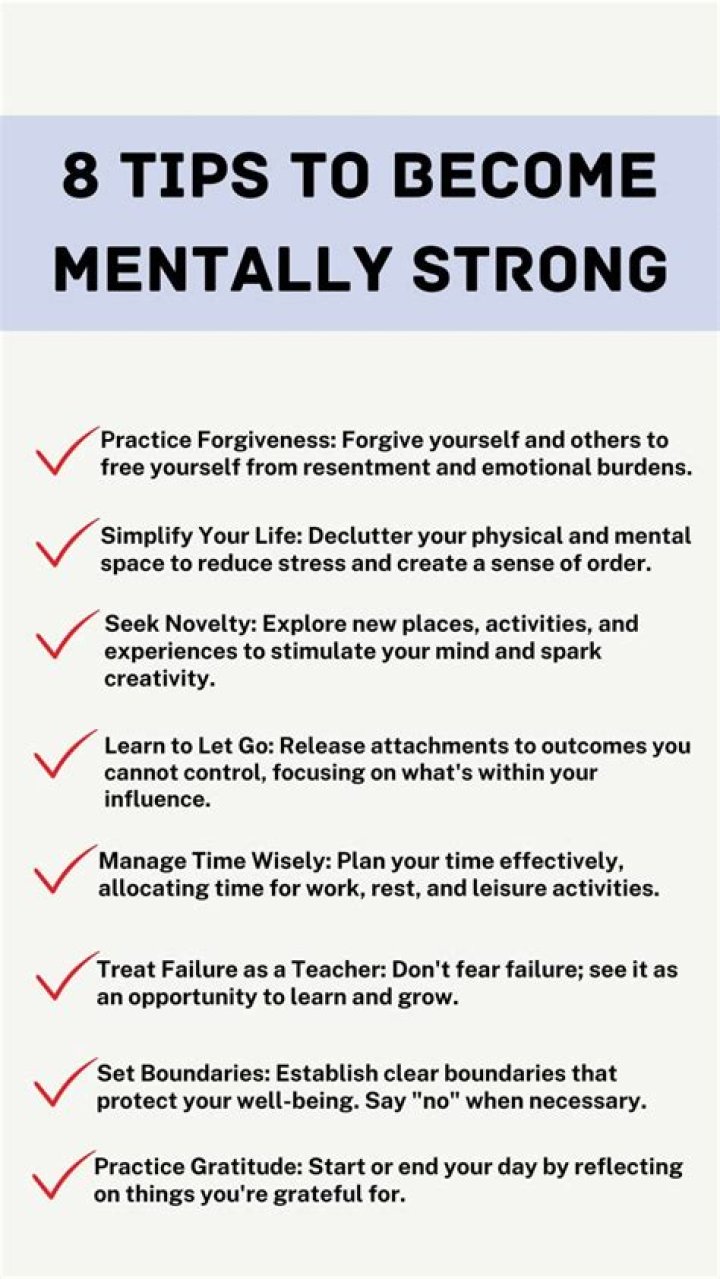
Here are 15 effective ways to become more mentally strong:
1. Focus on the moment. The challenges that come along from time to time are a test of our willingness to stretch and change. The worst thing you can do is to ignore the situation or procrastinate in developing solutions. The challenge is here and the difficulty is now. Focus your energy on the present moment; don’t lose what is right before you. When you focus on the moment you come to realize where you have the most power to make things right.
2. Embrace adversity. Mental strength gives us the ability to see the obstacles in our path as stepping stones. When we encounter struggle, and we all do, we can be inspired by the knowledge that it’s not a dead end but a path to deeper knowledge and understanding.
3. Exercise your mind. Just like your muscles, your mind needs to be exercised to gain strength. Growth and development take consistent work, and if you have not pushed yourself recently, you might not be growing as much as you can. Mental strength is built through lots of small wins, maintained through the choices we make every day. To gain stamina, take on a daily task that stretches your mental endurance.
4. Challenge yourself. Albert Einstein once said, “One should not pursue goals that are easily achieved. One must develop an instinct for what one can just barely achieve through one’s greatest efforts.” Underestimating yourself and playing it safe hold you back from success. When you believe in yourself and your abilities, you often can go beyond the imaginable.
5. Respond positively. You cannot control everything that comes your way, but you are in absolute control of how you react to everything that comes your way. What happens to you is important–but not as important as your response. Incredible progress can happen in your life and leadership when you take control of your reactions.
6. Be mindful. Mindfulness means taking control of your focus and being intentional about what you give your attention to. Whether it’s an emotion, a thought, a belief, an impulse, or something in the environment, mindfulness calls us to approaching everything with a curious, nonjudgmental, open, and accepting attitude. To be the most resilient and mentally strong, make the time to be mindful so you can focus on what you truly want.
7. Don’t be defeated by fear. To be resilient and mentally strong means knowing how to deal with fear. When you enter frightening situations with the awareness that it’s an opportunity for you to grow, trust outweighs fear.
8. Be aware of self-talk. We’re often so busy worrying about how we talk to others that we sometimes lose track of the way we talk to ourselves. Make a point of being as positive and supportive of yourself as you are of others, because when times get tough you have to be able to believe you can make it through. Replace self-doubt with positivity.
9. Rid yourself of can’t. When you feel like you can’t do something, keep your focus positive. You just have to do it. The mentally strong weed out the words like can’t, never, and should–replacing them with can, could, and when.
10. Stumble toward success. Winston Churchill once said, “Success is stumbling from failure to failure with no loss of enthusiasm.” Perseverance gives you the ability to face any difficulty, any challenge, any setback without being defeated. It’s better to have a lifetime full of small failures that you learned from rather than one filled with the regret of never having tried.
11. Find solutions. There will be always problems– every business has complications and any endeavor has hurdles, but if you can learn to focus 90 percent of your time on solutions and only 10 percent on problems, you’ll be able to respond effectively instead of spinning your wheels.
12. Be grateful. In the business of our busy lives we neglect many of the basic concept of recognition but gratitude gives us fortitude. Gratitude can transform any common day into a thanks giving day and turn routine jobs onto joy and change ordinary opportunities into something we get grateful about.
13. Brace yourself for the storms. Adversity is inevitable. Be as well-prepared as you can so you can fight them with strength and push through to blue skies.
14. Define your moments. When you find yourself doubting how far you can go, remember how far you have come. Give yourself credit for everything you have faced, for the battles you have won, for the fears you’ve overcome.
15. Make it an everyday pursuit. Most mental strength is built and demonstrated not in exceptional circumstances but in the day-to-day of life and leadership.
Positivity, preparation, willingness, discipline, focus, and a long view will all serve you well. Practice mental toughness and you’ll soon be amazed at how strong you’ve become.
As much as we want to be happy, everyday stress gets the better of us, leaving us exhausted and disconnected with our inner self. Here are some tips that will help you keep mentally fit and strong.
We live in difficult times. As much as we want to be happy, everyday stress gets the better of us, leaving us exhausted and disconnected with our inner self. Experts however say it’s important to find a meaning to your life, pamper yourself and strike a work-life balance, lest you turn victim to mental health disorders.
The mind-body connection is inevitable – a healthy body leads to a healthy mind and vice versa. Here are some tips that will help you keep mentally fit and strong.
1. Connect with others: Do you always find yourself following a routine and seldom get time to interact with people? Experts say you must break the habit, like right now. Develop and maintain strong relationships with people around you who will support and enrich your life. The quality of our personal relationships has a great effect on our wellbeing. Putting time and effort into building strong relationships can bring great rewards.
2. Set aside me time: It is important to enjoy life, rather than just finishing tasks. Set aside time for activities, hobbies and projects you enjoy. Do a crossword, take a walk in your local park, read a book, sew a quilt, draw pictures with your kids, play with your pets.
3. Pamper yourself: Keep fit and eat well to maintain a healthy body. Physical and mental health is linked and it’s easier to feel good about life if your body feels good. You don’t have to go to the gym to exercise – gardening, vacuuming, dancing and bushwalking all count. Combine physical activity with a balanced diet to nourish your body and mind and keep you feeling good, inside and out. Also don’t forget to take holidays, book spa sessions and celebrate special occasions in your life.
4. Appreciate yourself/others: It is important to count on your blessings, focus on your strengths and appreciate your positive traits. In fact, it is also true the other way round. Appreciating others also keep you in a positive state of mind and thus help you feel better about your life and yourself.
5. Increase your levels of endorphins: If you don’t feel happy enough, inject some positivity in your life by doing these simple activities – Smile as often as you can, even when you don’t feel like it, go to a comedy club or watch a funny movie, learn some jokes and begin to exchange jokes with your friends, take a class in yoga, tai chi, or qi gong.
6. Learn to deal with stress: Be aware of what triggers your stress and how you react. You may be able to avoid some of the triggers and learn to prepare for or manage others. Stress is a part of life and affects people in different ways. It only becomes a problem when it makes you feel uncomfortable or distressed. A balanced lifestyle can help you manage stress better. If you have trouble winding down, you may find that relaxation breathing, yoga or meditation can help.
7. Change your attitude: Learn Time Management: prioritise your time and your activities, let go of unnecessary tasks and learn to delegate, figure out what you can and can’t live without and focus your energy appropriately. Forget the word “perfect”.
8. Break out of the monotony: Do something different. Get a massage, make a journal diary, get an aquarium and watch turtles, fishes or slow animals, relive childhood experience especially happy moments, use the option of call forwarding in your phone, take a vacation to a new place, take a cruise, take a day trip, check out some of those activities listed in the newspaper.
9. Be in sync with sleep-wake cycle: Get plenty of sleep. Go to bed at a regular time each day and practice good habits to get better sleep. Sleep restores both your mind and body. However, feelings of fatigue can still set in if you feel constantly rushed and overwhelmed when you are awake. Allow yourself some unfocussed time each day to refresh. For example, let your mind wander, daydream or simply watch the clouds go by for a while. It’s ok to add ‘do nothing’ to your to-do list.
10. Notice the here and now: Take a moment to notice each of your senses each day. Simply ‘be’ in the moment – feel the sun and wind on your face and notice the air you are breathing. It’s easy to be caught up thinking about the past or planning for the future instead of experiencing the present. Practicing mindfulness by focusing your attention on being in the moment, is a good way to do this. Making a conscious effort to be aware of your inner and outer world is important for your mental health.
11. Ask for help: This can be as simple as asking a friend to babysit while you have some time out or speaking to your doctor (GP) about where to find a counselor or community mental health service. The perfect, worry-free life does not exist. Everyone’s life journey has bumpy bits and the people around you can help. If you don’t get the help you need, keep asking until you do.
(Picture source: Thinkstock Images)
– Inputs from Bhavna Barmi, Senior Clinical Psychologist, Fortis ESCORTS Heart Institute
(Additional inputs from Dr Nisha Khanna)
📣 The Indian Express is now on Telegram. Click here to join our channel (@indianexpress) and stay updated with the latest headlines
Taking care of your mental health is as essential as staying physically fit
White Swan Foundation
Mental and emotional health is an essential part of your overall health and wellbeing. Managing emotions and maintaining emotional balance is an important skill. When you manage your emotional health, it helps you face challenges and stress. Lack of emotional regulation skills can lead to poor mental health and difficulty in relationships.
It is as essential to care for your mental health as it is to care for your physical health. A few activities you can follow for your mental health are:
1. Take care of your physical health
You can stay healthy by eating well, getting adequate rest and exercise. Eating fresh foods rich in vitamin B-12 and Omega 3 fatty acids keep up levels of mood-regulating chemicals in the brain. Getting enough rest for your body helps to heal its daily wear and tear, while lack of sleep can make you feel tired, stressed and cranky.
2. Get fresh air and exposure to sunlight
A study has shown that exposure to sunlight increases the production of serotonin, a chemical that regulates mood in the brain.
3. Take care of yourself
Investing time in self-care contributes to your mental and emotional wellbeing. Set time aside for yourself; attend to your own emotional needs; read a book; pamper yourself. You could learn to use aspects of mindfulness to relax.
Mindfulness simply means being in the present without thinking of the past or future; choosing what you respond to, rather than getting carried away with everything that appears in your mind or your experience; to focus on one thing at a time, be non-judgmental and cultivate an attitude of impermanence towards things and situations. This helps you stay open to experiences and helps you not get overly affected by them.
Dr M Manjula, additional professor of clinical psychology, National Institute of Mental Health and Neurosciences (NIMHANS)
4. Spend time with people whose company you enjoy
Spending time with people you love and get along with gives you a sense of being valued and appreciated. Having healthy relationships with your friends, family, colleagues, and neighbors can increase your sense of emotional wellbeing and give you a feeling of connectedness. Have lunch with a colleague, or make plans to meet a friend you haven’t spent time with in a while. Spending quality time with someone in person — if this is an option — is often better than using technology to connect with them.
5. Pursue a hobby, or a new activity
Participating in activities that you enjoy helps you stay engaged and in turn, happy. Picking up a new skill challenges you, increases your concentration levels and makes you feel good about learning something new. It also increases your confidence in being able to face new situations, challenges and people.
6. Manage your stress
You, just like everyone else, will have certain triggers that cause you stress. You can try to avoid a stressful situation, but when you don’t have a choice but to face the event or person that causes you stress, you need to find a way to cope with it. “If you know you get stressed by an exam, you must learn how to put exams in perspective and not let them become life-defining events for you, because your exams are something you will just have to face. In some cases, avoiding stress-generating situations may work, but you must be able to differentiate between when you can avoid them and when you cannot. So find your strategy to manage your stress so that you can take better care of yourself. This could include talking to a friend, believing in yourself, reappraising and reinterpreting your situation, meditating, going for a walk, listening to music, and exercising, just to name a few,” says Bangalore-based counselor Maullika Sharma.
7. Identify your strengths, weaknesses, and boundaries
Acknowledge your strengths and work on your weaknesses. Accepting that you have some weaknesses just like everyone else is a key to your mental and emotional wellbeing. Set realistic goals and consciously choose to participate in activities and surround yourself with people who further your goal rather than distract you.
8. Practice gratitude
When you practice gratitude for what you have, it can take away focus from what you don’t. Studies show that being grateful for what you have helps you stay optimistic about your future and boosts your mental health.
9. Express yourself
Poorly managed or unregulated emotions can be harmful to your mental health. You may shy away from expressing emotions or feelings that you think are ‘negative.’ Being able to express what you’re feeling, what you like or don’t like, can help you de-clutter your mind. Suppressing emotions is believed to lead to depression or anxiety disorders. “Every emotion is important and essential. What makes it healthy or unhealthy is the intensity of the experience, and how it was expressed (too much or too little), the appropriateness of the expression and the frequency of the emotion occurring,” says Dr Manjula.
10. Ask for help when you feel overwhelmed
When you feel sad, challenged, frustrated, confused, angry, or just simply overwhelmed and unable to cope, speak to someone you trust – a spouse, friend, parent, sibling or relative. If you think you need even more support, reach out to a physician or counselor. The earlier you reach out, the better.
A round our office, I have a reputation for being relentlessly positive.
I’m not completely sure why, but it might have something to do with my reaction to less-than-favorable news. Whatever the reason, people always think of me as very easygoing, but I’ve had my share of negative thoughts to conquer.
When I started working at SUCCESS, I found myself participating in one of the most infuriating daily tasks known to man: long-distance commuting. I drove a tedious route from South Dallas to Plano, Texas, a minimum of 60 miles round trip, which usually meant spending up to three hours in my car each day. But instead of moving closer to work as soon as I took the job, I chose to make this journey for eight long months—and it tested everything I knew about being mentally tough.
And oh boy, did I feel the rage. I felt my heart stop cold at the same time every morning as the disappointment of a traffic jam triggered anxious thoughts. I cringed with every sudden brake that stopped my bumper inches from a wreck. I learned that Google Maps did not always have my best interest at heart, and I probably internalized everything just a little too much.
But by the time I finally reached work and swung open the front doors of SUCCESS headquarters, none of that mattered. I was no longer inching along in search of a faster lane, so technically there was nothing to be bothered about after 9 a.m. What happened on the highway was old news, and most important, I was grateful to have made it in one piece.
It isn’t easy to leave your frustrations where you found them, to simply clear your mind of the small things to make room for an entire day’s worth of events, but it’s definitely worth the effort. Looking back, I realized I was able to keep a strong mind by storing my emotions in a sort of mental filing cabinet. I packed up my thoughts, good or bad, and made sure the best ones were front-and-center when I needed them the most.
I recently moved closer to work, but I’ll never forget how light I felt after mentally letting go of my long commute. Even as I find new challenges that test my willpower, I’m always reminded that sometimes it’s best to do a little mental unpacking.
Long-distance racing drains not only the body, but also the mind. Runners can develop a negative mindset as the miles pass and the lactic acid builds up, making the race harder to finish.
“Mental toughness, or tracking cognitive thoughts during a marathon, has a large impact on the outcome of a run,” says Kate Cummins , PhD, a licensed clinical psychologist.
So, to channel your inner optimist and wash away destructive thoughts during endurance challenges, these experts provide 10 tips to help keep your mind from turning sour in a race:
“Some people think of squishing a boss’ face with each step,” says Meghan Kennihan , NASM certified personal trainer and a USATF run coach. If you want to concentrate on something more positive, she suggests imagining yourself as a “gazelle prancing gracefully through the finish line.”
Remember playing games on long car drives with the family as a kid? You can do the same thing during a race, such as occupying yourself with alphabet list games. “I would name cities to travel to starting with A, then B, then C and so on all the way to Z,” says runner Lisa Alemi . “This would keep my mind busy so I wouldn’t realize how long I was having to run.” For long races, she continues with other lists, such as foods she’s tried, people she met after graduate school and store names.
“Sometimes even writing phrases on athletic tape, silicone bracelets, etc. can help,” says Chelsi Day , PsyD, a clinical and sport psychologist for athletes at Indiana University.
Tracy Green says she writes mantras on stickers that she affixes to gels. “Each mantra corresponds to a certain part of the course, ‘Calm and Comfortable’ for the first section, and ‘Fast and Fierce’ for the final section.” She focuses on each mantra and repeats it to herself as often as she needs until she opens the next gel.
Heidi McBain , MA, a licensed professional counselor says to simply visualize yourself crossing the finish line at any point during the race when you’re feeling discouraged.
“I break up the remaining race into minuscule parts and tell myself, ‘I only have to get to the next one,’” says James Goodwillie, founder of onetomulti.com . Doing this helps Goodwillie remind himself that he could hang on longer in training, so he can make it in the race.
“Most people are struggling to get through the race just like you are,” says David Bennett, certified counselor, relationship expert and co-author of seven self-help books. He suggests intermingling with others could be a simple as running past crowds and giving high fives to spectators or providing positive affirmations to other runners.
“Consider creating multiple playlists based on how you will feel throughout the race,” says Ashley B. Hampton, PhD, a business coach for women entrepreneurs. She says that calm, classical music at the beginning of a long-distance race could help create a smooth start, and upbeat music near the end might help you forget the burn in your muscles.
“Crafting my own posts in my head while I’m exercising or racing is great motivation for finishing what I started,” says Carolee Belkin Walker , a wellness blogger and podcaster.
During races, Cody Higgs , a licensed professional counselor and endurance runner thinks of his son, wife and friends, giving him an overall feeling of positivity. “There was an obstacle race when I had to remember a group of random numbers for about 2.5 hours, and I was able to relate all the numbers to people close to me, causing me to think about those people the whole race. It was a huge help,” he says.
About the Author
Jennifer is a Southern California-based freelance writer who covers topics such as health, fitness, lifestyle and travel for both national and regional publications. She runs marathons across the world and is an Ironman finisher. She is also a certified personal trainer through the National Academy of Sports Medicine. You can follow her on Twitter @jenpurdie.
This year has been utter chaos. These mindset tweaks can help.
These tips will help your family stay sane amidst the chaos of working and homeschooling in the same space.
Well, it’s official. With less than nine weeks left until 2021, 2020 has been and still is a distinctively unique year—a year hopefully never to be repeated. A year, hopefully, that leads to only positivity and an amazing future.
As we push through the blur of repetitive days (What’s today’s date?) and unbelievable conversations (What’s hybrid learning?), working moms all over the country are redefining and reimagining ways to keep themselves, their families and their kids productive, positive and focused on succeeding—despite the chaos that is 2020. Here are some of the tips that help me keep my kiddos (and myself!) on the right track:
I believe in the power of positive affirmation. I model it for my daughter.
Every morning, I spend a little quiet time alone, I journal a bit and I speak positivity into the day. I also have parts of my affirmation posted around the house and office. It’s a great reminder throughout the day to pause, check in with myself and stay focused on things that move me towards progress. Now, my daughter has her own affirmation that she says during breakfast, and I’ve watched her carry that confidence when she is in the virtual classroom and things become a bit too hard on the computer. She pauses, closes her eyes, takes a deep breath and says a few positive phrases to maintain her calmness. While it doesn’t work like magic—Tada, computer fixed!—it is a magical scene to observe. And, while she’s been practicing her affirmation since she was 3 years old, this season of unpredictability has allowed her to really lean into that foundation to center herself whenever she needs to. I find it reassuring that she has a tool that, hopefully, she’ll carry with her into her teenage years and adulthood.
A great schedule, organization and transparency are essential.
Since my daughter is in a virtual classroom most of the day, she must remain on a structured schedule. Thankfully, we’ve retained some sense of “new” normalcy, which I believe is the key to providing comfort for kiddos, by re-imagining how she’ll attend her weekly extracurriculars and enrichment programs. She still has her piano, chess and Mandarin lessons in person (everyone is screened before arrival), but now she has soccer and theatre, both virtually. Those extra opportunities to connect with classmates and friends around a more physical activity provide a respite from the academic rigors of the day. And, just so she doesn’t panic, we have a white board with the schedule (for easy updating when things change) and I leverage technology (Alexa!) to set reminders so that she can practice a little independence rather than asking me when she needs to go to certain activities. A structured day and healthy routines (like a consistent bedtime) help create a sense of order to the day that also offers reassurance.
Joy Altimare is a mom and the chief engagement and brand officer at the industry-leader in health and prevention for over 100 years, EHE Health.
Although most of us are still spending most (if not all) of our time in the same home, it’s really important to spend individual, one-on-one time with your children.
I call it “special time-in,” and it’s a great way to be present with each child to reinforce how special they are. It could be as simple as making cookies together, while you ask some questions to check in on their schoolwork and mental stamina; or maybe 15 minutes in the morning for a cup of tea (and maybe juice for the kiddo). This works for kids of all ages; individual, uninterrupted (no cell phones!) time with each of them helps everyone feel special and ready to be their best selves.
While being productive is important, it’s also key to decide, today, where you want your family to be when we get on the other side of this pandemic. When this school year is over and we’ve figured out a way for all kiddos to be in class and we no longer have the benefit of time together, where do you want your family unit to be? Stronger together? Happy and positive? Loving and supportive? That’s the focus—to emerge better than how we entered. And part of that is listening to yourself and carving out time to listen to your kiddos to create a sense of support and peace in your home.
Joy Altimare is the chief engagement and brand officer at the industry leader in health and prevention for over 100 years, EHE Health. With over 16 years of experience in the marketing field, Joy has become an expert adviser to organizations looking to tackle growth, innovation and technology challenges. Prior to joining the healthcare world, Joy worked on brands such as L’Oreal, Verizon and Colgate-Palmolive at such agencies as Ogilvy+Mather, GREY and Publicis.
Whenever I used to read books about the subject of self-esteem, I got frustrated with the psycho-babble about being “mentally strong”. Or worse still, in some books I had to plough through pages and pages of the author’s anecdotal reminiscences about how many millions of dollars worth of real estate he had sold because he had something called a “positive mental attitude.”
Nobody explained how to become mentally strong or how to obtain that elusive PMA. Nobody seemed to understand that I urgently needed concise and practical step-by-step help to put out the fires. I was searching for effective armour to protect me against the searing emotional pain caused by rejections and disappointments, usually from thoughtless and uncaring people.
Although my wife used to tell me that it was no use crying over spilt milk, I found that I was unable to bring myself to the stoic intellectual acceptance of the reality that these failures had taken place. Well, here is an attempt to help those of you who find themselves in a similar predicament.
1) This may sound stupid, but if you find yourself in a hole, the first thing to do is to quit digging. In other words: discontinue whatever you were doing and reassess your situation. Diagnose what went wrong and how it came about.
2) Resolve that you will deliberately and stubbornly refuse to be harmed by rejections and disappointments. The law of averages says that there will be many of them if you are active. Accept that this is the price you may have to pay for being successful. Look at failures as valuable learning
lessons, which will serve you in the future to avoid making similar mistakes again.
3) Never miss a good chance to shut up: quit broadcasting (and lamenting about) your misfortunes. Feeling sorry for yourself is not only counter-productive, but there is the dangerous possibility that you will brainwash yourself into becoming habitually negative.
4) If you need the healing outlet of “venting” your emotions, do it in a non-destructive manner. Let off steam by whacking a few golf balls at the driving range. A positive byproduct of this exercise is that your golf game will improve. Then there is the gentle pleasure of gardening or taking the old hound for a walk. I am sure that you can find something constructive that will work for you. The objective is to wipe up the mess by putting it out of your mind and to go on with living – hopefully wiser.
5) Whatever you decide to do, always remember that there is no valid reason for prolonging “the mourning.” Somewhere along the line you must be done with it.
6) There is no point in passively wishing for something to happen, like a client magically materializing out of thin air. Acknowledge to yourself that you are the one and only person who can make something positive and worthwhile happen. Tape a note onto your bathroom mirror saying: “tuum est” (It is up to you).
7) If you are paralyzed into inaction by any sort of imaginary pain, then your action is similar to you sitting on a bed of sharp nails: a painful experience that should be avoided, discontinued and definitely not repeated. To get out of this predicament you must make an all-out effort to “get going today” with some sort of self-designed program to suit your needs and your personality. You know what you have to do. You have to get organized and concentrate on real estate activities that have a 50/50 chance of making you some money in the next 60 days. If you are stuck, ask your manager for help. He knows your strengths and weaknesses and will be able to assist you.
8) Part of this program should be that you must become better informed in order to stay competitive. This is a long-range project and cannot happen overnight. For example, by going on the MLS tour, you will learn what is currently for sale. But you must do it week after week. Persistence is the key word. To get a listing or to make a sale you must talk to many people. This endeavour is called prospecting.
9) Decide to make an enormous investment in yourself! Feed your mind by beginning a comprehensive do-it-yourself project of personal development. The objective is to give yourself the
training you require to become the very best salesperson you can be. Upgrade your mind with knowledge of the business. Descriptive language and communication skills will help you to overcome objections and will improve your closing techniques.
10) Difficult real estate markets are a universal level playing field. This is because all of your associates in the office as well as all of your competitors are in the same boat as you are. If nothing else, this should be a comforting thought because misery likes company. Psst! Don’t tell anybody, but there is a positive side even to this; in fact it could be a golden opportunity for you. If your competitors get to be discouraged, chances are that they will either stop working or leave the business altogether. In either case, there will be less competition.
11) Take heart that progress is possible and that you can change the future by gaining experience in the School of Hard Knocks. Good judgment comes from experience. Unfortunately, a lot of experience comes from previous bad judgments. By accumulating experience, you will gain increased confidence in your abilities. Clients will like dealing with you because you will be able to deal with them on a higher and more professional level. All of this will result in increased sales, which in turn will translate into peace of mind.
12) If you stick with your program, one fine day you may notice that not only you are you too busy to cry the blues, but also that there are fewer failures. As the commission money starts rolling in with ever-increasing frequency, people will admiringly say that your success is due to you having a Positive Mental Attitude. As a byproduct, you will also have become mentally strong.
Millions of us are struggling to find normalcy in the age of COVID-19. The uncertainty over our health, jobs, finances and when we’ll be able to see our loved ones again has taken its toll. In fact, according to a recent Kaiser Family Foundation poll, nearly half of Americans — 45 percent — say their mental health has been negatively affected as a result of the pandemic.
I recently chatted with Amanda White, a licensed therapist and the creator of the popular Instagram account @therapyforwomen. We discussed the roller coaster of emotions many of us are suddenly experiencing and how we can cope.
“When an initial event is happening, we have that fight or flight response and then the event is over and we’re able to process is,” White explained during my weekly Instagram Live series for Know Your Value.
White noted this time period is especially challenging because it’s “so extended that we are consistently going through fight, flight, freeze, and our brain doesn’t know when this is going to end. So, it continues to happen over and over, because it doesn’t know which fight, flight, or freeze is going to be most effective in dealing with this.”
‘Happiness Lab’ professor Laurie Santos shares 5 ways to feel better
In addition to White, I spoke to holistic coach and wellness teacher Lily Silverton and clinical psychologist Christie Ferrari. Here are a few tips and strategies they suggested to help lower stress and anxiety during this uncertain time:
1. Get rid of the shame associated with grieving
The reality is that we are all grieving in one way or another.
The best thing to do as we continue to heal, is to “try and normalize it” White said. “Now is the time to share what you are feeling with others — family, friends, on social media, or wherever you feel safe doing so. We are collectively grieving, and the shared experience in knowing you are not alone will help the healing process.”
And don’t feel ashamed of your emotions. “Shame often acts as this binding agent over the deeper emotions that are going on, and it stops ourselves from feeling the deeper emotions that are going on,” said White.
2. Implement mindfulness in your everyday routine
Yoga and meditation has helped me during this time stressful time, and has resulted in me being more mindful throughout the day. But don’t just take it from me; Science also says the benefits of yoga and meditation to our mental and physical health are significant.
If you’re new to meditation, or like to be guided through one, check out this mediation by holistic coach and wellness teacher Lily Silverton. According to Silverton, meditation “increases grey matter in the pre-frontal cortex, which is responsible for reasoning and thinking – both tools we need to combat anxiety.”
White added that it’s also important to practice noticing our emotions , and not judging them. “When we engage in judgement about our thoughts and emotions we get stuck in an anxiety loop,” she said.
3. Remember that your breath is the gateway to the present
If you feel yourself getting anxious, focus on your body cues, said clinical psychologist and blogger Christie Ferrari. “Is your heart racing? Are you breathing quickly and chest-breathing mostly? Are you tense? Are your hands clammy?”
If the answer is yes, certain breathing techniques can help calm down your nervous system. Ferrari advised to practice deep belly breathing. “An easy way to get good at this is to lay down for five minutes with a plastic cup or light book on your stomach and practice having this item rise when you take a deep breath in, holding it for four seconds, and then releasing and exhaling and watching this item go down as your belly goes down for three to four seconds.”
Silverton recommended this breathwork tool, which incorporates deep belly breathing. “You can do this anytime of day or night, when you feel that swell of anxiety starting to rise up.”
4. Create routines
Having a consistent routine even for just five minutes will help ground you. “A routine can do a lot of good. It keeps a sense of normalcy, can boost productivity and provide structure” said Ferrari. She suggested getting out of your pajamas as part of your routine, and sticking to clothing that is casual and comfortable but still looks polished “A loose dress and a cardigan, for example, or linen pants with a blouse,” she said. Getting dressed, even while we’re home, will help you get into the right mindset for the day ahead.
A toxic coworker is like an energy vampire.
No matter where you work, you’re bound to come across a difficult coworker. And if you’re not careful, one individual could ruin your entire work experience—and perhaps even damage your career.
It might be the teammate who takes credit for your work. Or, maybe your colleague’s negativity drags everyone down.
Toxic coworkers can drain you of the mental strength you need to do your best—if you let them. Here are five strategies for staying strong even when you work with the most difficult people:
1. Resist the temptation to complain.
It can be tempting to turn to another coworker and say, “Can you believe he said that at the meeting?” But venting to other people—and trying to get them to confirm your beliefs—isn’t healthy.
Whether you send emails to your other coworkers to complain about the toxic individual, or you vent to your partner when you get home, complaining keeps you stuck in a negative state.
The more time and energy you spend complaining, the more space you allow a toxic person to take up in your life. Commit to filling your life with positive people and productive experiences and give toxic people less air time.
How Narcissists Affect The Culture Of Their Organizations
Buckle Up—Post-Election Unrest Could Be A Wild Ride: Here’s What To Expect
How To Answer New, Hard Interview Questions Employers Now Ask
2. Retain your personal power.
Saying that your coworker makes you feel bad about yourself or claiming that your boss ruined your day, implies you aren’t in control.
You’re in control of how you think, feel, and behave. Decide that someone else’s bad behavior, poor attitude, or toxic choices won’t drag you down.
3. Focus on controlling yourself, not anyone else.
It’s easy to invest energy into wishing your coworker would become a team player or hoping that your colleague will change departments. But, wishful thinking wastes your valuable resources—time and mental energy.
You can’t control your coworkers. You can only control how you respond to them.
So put that same energy into taking positive action. Whether you decide your best option is to confront your coworker, or you think your best choice is to put your energy into biting your tongue, use your resources wisely.
4. Have a direct conversation.
When it comes to dealing with a toxic person, you don’t have to stay passive. Instead, establish boundaries that make your expectations clear. Just keep in mind, you can’t change the other person’s personality but you can call them out on specific behaviors.
That may mean confronting someone head-on and saying, “I understand you’ve been telling people that I don’t know what I’m doing.” Or, it may mean saying, “I was talking and you interrupted. I’m going to finish what I had to say.”
You may also need to set limits by saying something like, “This sounds like gossip and I don’t want to hear it.” People who aren’t used to having boundaries set with them—and many toxic people aren’t—often get upset when someone draws a line in the sand.
But holding a direct conversation and setting firm boundaries can save you from feeling more stress in the long-term. Just be prepared for how you’ll respond if the problem continues to happen.
5. Practice healthy coping skills.
Dealing with a toxic coworker can take a serious toll on you. It’s important to practice healthy coping skills to help you stay strong in the midst of a stressful situation.
Take care of your mind and your body. It’s impossible to stay mentally strong if you’re eating a poor diet or you’re not getting adequate sleep. Get plenty of exercise to help you combat the negative effects of stress.
Experiment with a variety of coping skills, like gratitude and meditation. Incorporate plenty of social and leisure activities into your life so that your world doesn’t revolve around your toxic coworker.
Seek Help When Necessary
If your work environment is taking a toll on you, elevate the issue to the next level. If you’re being bullied, ostracized or harassed, it’s especially important to talk to your human resources department.
If your stress levels are impairing your ability to perform well or you’re feeling anxious or depressed, get professional help. Talk to your physician about what you’re experiencing to see if you might benefit from a referral to a therapist.