Slide seamlessly from one PC to the next, cut and paste between PCs and more. And it’s free!
Senior Editor, PCWorld |
Today’s Best Tech Deals
Picked by PCWorld’s Editors
Top Deals On Great Products
Picked by Techconnect’s Editors
Microsoft’s Mouse without Borders app is an unsung productivity tool whose ability to let a mouse and keyboard hop from one Windows device to the next is worth checking out. It unlocks a versatility similar to that of Logitech’s Flow, but for far, far cheaper—because it’s free to use with any Windows device.
Mouse without Borders originally launched in 2011, long before Logitech debuted Flow. The app resurfaced Wednesday as part of Microsoft’s inaugural Microsoft Garage Wall of Fame, a celebration of smaller apps developed within Microsoft. You should try it out.
Like Flow, Microsoft’s Mouse without Borders allows you to use the same mouse and keyboard (yes, keyboards too) across multiple PCs. Once you move the mouse cursor to the edge of one screen, it hops over to the next connected computer—exactly as if it were a passive monitor, allowing you to bring in additional PCs into your workspace.
Both Flow and Mouse without Borders also allow you to cut and paste files across PCs, and type on multiple PCs using the same single keyboard. But while Flow is locked to a small coterie of Logitech-equipped peripherals, Mouse without Borders promises to work with just about anything.
To be honest, Logitech’s Flow also factored into our endorsement of Logitech’s Craft keyboard and MX Master 2S mouse. While we still stand behind those reviews, Mouse without Borders serves to highlight that Flow isn’t as exclusive as you might think.
Mark Hachman / iDG
You’ll see this screen more than once, as you need to download Mouse without Borders on multiple PCs. But how you answer this question will differ.
Setup: Still rough around the edges
Even several years after its debut, the 1.3MB Mouse without Borders app feels like a throwback to Win32 utilities of old, rather than the more polished UWP apps Microsoft is promoting within Windows 10. You’ll need to enter encryption keys manually, tweak options, and so on. But it’s a live app, whose most recent update was released in January.
First, you’ll need the Windows without Borders app itself, which runs on everything from Windows 7 and above. Up to four PCs on the same network can share the same mouse and keyboard. The author, Truong Do, recommends that both PCs be connected via ethernet, though wireless worked acceptably in some cases. Obviously, you’ll need to download and install the app on more than one PC. This is where it gets a bit confusing.
When Mouse without Borders first loads, the app will ask you if you’ve downloaded it on any other machine. Even though you’ve probably downloaded the utility to two PCs at about the same time, you’ll need to pick one of these PCs and select No. Doing so reveals the name of the PC you’re working on, as well as an encryption code. (Though it’s not essential, you may want to change the PC name within Settings > System > About to rename it something intuitive, rather than just a collection of letters.)
Mouse without Borders will generate an encryption code to enter manually on the other connected PCs. (You can also ask it to generate a new code later, if you’d like).
On the second PC, you’ll need to respond Yes to the question of whether the app appears on any other PC. It’s here that you’ll enter the name of the first PC, as well as the complex encryption code/password that the first installation of the app generated. Clicking Link will then connect the second PC to the master PC.
Like Flow or the Smart Switch technology Microsoft tied to its Surface Precision Mouse, the PC layouts can be organized either vertically or next to one another, as on a desk.
Your firewall may negatively affect how well Mouse without Borders works. I found that turning off Windows Defender, enabling Mouse without Borders, then re-enabling Defender worked well. (ZoneAlarm, another popular firewall, allowed Mouse with Borders to work, though the mouse moved very slowly.) To be fair, I had the same wireless troubles with Logitech’s Flow, too.
Mark Hachman / IDG
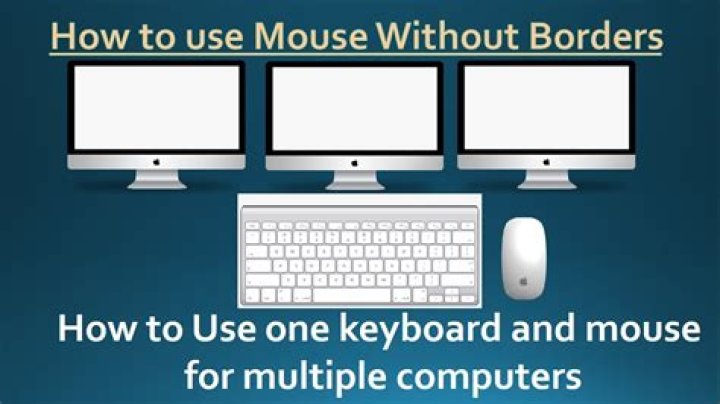
We used this image to illustrate Logitech’s Flow software, but it applies here as well: Mouse without Borders allows you to bring in multiple PCs into one shared workspace.
How it works: Quick and slick
Once connected, I found that my mouse cursor zipped from one PC to the other, with surprisingly little lag. It was easy to cut and paste text from one PC to the other, and copy files up to 100MB in size—right now, 100MB is a hard limit, unfortunately. You can even do tricks like lock all of the PCs at once, simultaneously, or virtualize a keyboard-video-mouse setup, so that your mouse and keyboard input are duplicated exactly across multiple PCs. Again, to be clear—Mouse without Borders works with mice and keyboards.
The main screen of Mouse without Borders. Here, you can generate a new passkey, align your PCs, and more. Note that you can also re-initiate the setup experience. Connecting and disconnecting PCs with Mouse without Borders installed is as easy as clicking the checkbox.
Certain situations, like Remote Desktop windows or other virtual machines, may confuse the app, the developer notes. And you unfortunately can’t copy and paste multiple files, unless they’re compressed into a single file that’s less than 100MB.
When set up properly, though, Mouse without Borders is fast, faster than Flow. I used it on the same machines by disabling Mouse without Borders and turning on Flow. Granted, Flow was using a wireless Logitech MX Master 2S mouse, rather than a wired connection. But Flow can also copy multiple files without apparent issue. Any file above 100MB is copied with a progress bar visually indicating how quickly it will transfer.
Mark Hachman / IDG
Mouse without Borders offers tons of options. For more details, you can hover your mouse over each one.
The one key advantage that Mouse without Borders offers is the freedom from dedicated hardware. There’s no guarantee that it will work with everything, but I used a wired Razer mouse and keyboard to test it, and it seemed to work flawlessly. If it works just as well for the generic corded USB mice and keyboards that populate our desks, Microsoft’s Mouse without Borders sounds like a utility worth owning. (A Logitech spokeswoman points out that Mouse without Borders is restricted to Windows, while Flow migrates across Macs and PCs — a fair point.)
Will Mouse without Borders eventually migrate into Windows? Certain features that allow cross-PC collaboration, such as upcoming Timeline and Near Share features within Windows 10’s Redstone 4 feature update, signal that Microsoft is thinking about tying Windows devices closer together. For now, though, there’s Mouse without Borders—and it looks like a handy app to add to your PC’s bag of tricks.
Updated at 10:01 AM on March 2 with a comment from Logitech.
Taylor Gibb is a professional software developer with nearly a decade of experience. He served as Microsoft Regional Director in South Africa for two years and has received multiple Microsoft MVP (Most Valued Professional) awards. He currently works in R&D at Derivco International. Read more.
If you’ve got multiple computers at your desk, you probably know that it’s a pain to use more than one keyboard and mouse. Here’s how to use a single keyboard and mouse on more than one PC using a tool from Microsoft.
Most geeks will be familiar with Input Director and Synergy, which do the same thing, but now Microsoft has released an application called Mouse Without Borders, which has some great features—like dragging files from one PC to another.
Using Mouse Without Borders
Once you’ve downloaded and installed the application, there’s a quick wizard that helps you setup the application for use on your network. On the first PC, you’ll want to click No to do the initial setup.
This will generate a security code that you can use on the next PC to connect to the first one.
Over on the second PC, you will want to enter the code that you generated on the first PC, and the computer name.
That’s all there is to it – now you can start using the application.
If you’re still puzzled about how it works, here’s a video that explains it in more detail.
Want to control multiple computers simultaneously with the same keyboard and mouse? These software and hardware options can help.
If you have more than one computer in your house—say, a personal and work machine, or a laptop alongside a home theater PC—it can be a pain to control them. Instead of stacking your keyboards on top of each other, you can use specialized software or hardware to use one mouse and one keyboard with two computers simultaneously.
No program works perfectly and does everything. Each option has its own pros and cons, but there are two methods that stand out from the pack: Mouse Without Borders and Synergy.
Mouse Without Borders: Free and Easy for Windows
An experimental project from Microsoft developer Truong Do, Mouse Without Borders is a free program that shares your mouse and keyboard between Windows machines only. It’s also very easy to set up, which makes it a good first step if you’re just starting out with these programs.
Download and install Mouse Without Borders on your main PC—the one whose keyboard and mouse you want to use across all machines. Click No when asked if you’ve installed it on other PCs. You’ll be given a code—take that code and install Mouse Without Borders on your other PC(s), entering the code when prompted. They should automatically connect to each other, no extra hassle required.
From the main Mouse Without Borders window, you can click and drag the icons to rearrange your PCs to match how they appear in your physical space. For example, my desktop is to the left of my laptop, so I made sure the icons matched that layout. That way, your mouse should easily “hop” over to the other PC when you drag it to the correct edge. There are some other options you can play with in this window, if you so choose.
Mouse Without Borders works well for free, but I find it’s a bit stuttery at times. On the second computer, my cursor would often be slow to respond or get stuck for a second as I moved it around the screen, which can cause you to lose some precision when clicking on things.
Still, clipboard sharing worked well between my two PCs, and I could drag and drop files from one machine to another with no issues. Try it out for yourself and see if it works well enough for your use case; if not, check out Synergy below.
Synergy & Barrier: Smooth and Cross-Platform
Synergy is the more well-known program in this space, but it costs $30, is a bit difficult to set up, and is currently going through a transition. The program used to be open source, and a fork of an older version called Barrier is available for free.
Synergy is working on a new version that should leap ahead of Barrier in terms of features, but for right now, the two are extremely similar, so I recommend trying Barrier first. If you can’t get it to work, or want the support that comes from a paid app, you can then fork over the cash for a Synergy license.
Despite the complexities, Synergy (and Barrier) works smoothly once everything is set up. Install the program on all the computers you want to use with your mouse and keyboard. (You may be asked to reboot your computer during the process.) The program will then ask you to designate the current computer as a Server (the computer with the mouse and keyboard) or a Client (the computer you need to control).
If you’re using the paid version of Synergy, it will then ask you to activate your account—copy the license key from your Symless account page and paste it into the Synergy application. Once activated, repeat this process on any other computers, choosing one Server and as many Client computers as you will need.
Once both computers have the program installed and running, you’ll need to get them talking to each other. On the server machine, click the Configure Server button. In the upper left-hand corner, you should see an icon that looks like a PC monitor—drag that onto the grid and line it up with your server PC’s icon.
For example, my client, a Mac mini, sits to the right of the server, a desktop named Jotunn, on my desk—so I dragged the icon one square to the right of my server PC’s icon.
Next, double-click on the Unnamed icon you just added. Under Screen Name, type in the name of the client PC—you’ll see it in the client’s Synergy window, where it says Client Name. Click OK. Then click the Apply button to apply your settings and start the server.
At the top of the window on your server PC, you’ll see an IP address in bold—in my case, it’s 192.168.1.11. That series of numbers denotes a PC’s location on the network, and your client PC will need to know the server’s IP address to connect. Copy that address into the Server box on the client PC’s window, as shown above. (Barrier also has an “Auto Config” checkbox you can try, or you can turn that off and type in the IP address yourself.)
Once you’ve done so, click the Start button. The two PCs should then connect, and you should be able to use the server PC’s keyboard and mouse on both machines. Just drag it to the edge of your main computer’s screen and it will hop over to your other PC, as if they were the same machine. If you have problems, check the log—Barrier requires you to set up the log in its settings, where it will log to a file. Synergy outputs the log at the bottom of its window, which gives you more quick access to any errors that may arise.
While you can copy and paste text between both your machines, dragging and dropping files can be a bit finicky, and your mileage may vary. Overall, though, I found Synergy and Barrier to be much smoother than Mouse Without Borders, which made it a bit more compelling (despite the lack of reliable drag and drop). There are more ways you can configure Synergy, so check out the server settings for additional hotkey customizations and other tweaks.
Want to control multiple computers simultaneously with the same keyboard and mouse? These software and hardware options can help.
If you have more than one computer in your house—say, a personal and work machine, or a laptop alongside a home theater PC—it can be a pain to control them. Instead of stacking your keyboards on top of each other, you can use specialized software or hardware to use one mouse and one keyboard with two computers simultaneously.
No program works perfectly and does everything. Each option has its own pros and cons, but there are two methods that stand out from the pack: Mouse Without Borders and Synergy.
Mouse Without Borders: Free and Easy for Windows
An experimental project from Microsoft developer Truong Do, Mouse Without Borders is a free program that shares your mouse and keyboard between Windows machines only. It’s also very easy to set up, which makes it a good first step if you’re just starting out with these programs.
Download and install Mouse Without Borders on your main PC—the one whose keyboard and mouse you want to use across all machines. Click No when asked if you’ve installed it on other PCs. You’ll be given a code—take that code and install Mouse Without Borders on your other PC(s), entering the code when prompted. They should automatically connect to each other, no extra hassle required.
From the main Mouse Without Borders window, you can click and drag the icons to rearrange your PCs to match how they appear in your physical space. For example, my desktop is to the left of my laptop, so I made sure the icons matched that layout. That way, your mouse should easily “hop” over to the other PC when you drag it to the correct edge. There are some other options you can play with in this window, if you so choose.
Mouse Without Borders works well for free, but I find it’s a bit stuttery at times. On the second computer, my cursor would often be slow to respond or get stuck for a second as I moved it around the screen, which can cause you to lose some precision when clicking on things.
Still, clipboard sharing worked well between my two PCs, and I could drag and drop files from one machine to another with no issues. Try it out for yourself and see if it works well enough for your use case; if not, check out Synergy below.
Synergy & Barrier: Smooth and Cross-Platform
Synergy is the more well-known program in this space, but it costs $30, is a bit difficult to set up, and is currently going through a transition. The program used to be open source, and a fork of an older version called Barrier is available for free.
Synergy is working on a new version that should leap ahead of Barrier in terms of features, but for right now, the two are extremely similar, so I recommend trying Barrier first. If you can’t get it to work, or want the support that comes from a paid app, you can then fork over the cash for a Synergy license.
Despite the complexities, Synergy (and Barrier) works smoothly once everything is set up. Install the program on all the computers you want to use with your mouse and keyboard. (You may be asked to reboot your computer during the process.) The program will then ask you to designate the current computer as a Server (the computer with the mouse and keyboard) or a Client (the computer you need to control).
If you’re using the paid version of Synergy, it will then ask you to activate your account—copy the license key from your Symless account page and paste it into the Synergy application. Once activated, repeat this process on any other computers, choosing one Server and as many Client computers as you will need.
Once both computers have the program installed and running, you’ll need to get them talking to each other. On the server machine, click the Configure Server button. In the upper left-hand corner, you should see an icon that looks like a PC monitor—drag that onto the grid and line it up with your server PC’s icon.
For example, my client, a Mac mini, sits to the right of the server, a desktop named Jotunn, on my desk—so I dragged the icon one square to the right of my server PC’s icon.
Next, double-click on the Unnamed icon you just added. Under Screen Name, type in the name of the client PC—you’ll see it in the client’s Synergy window, where it says Client Name. Click OK. Then click the Apply button to apply your settings and start the server.
At the top of the window on your server PC, you’ll see an IP address in bold—in my case, it’s 192.168.1.11. That series of numbers denotes a PC’s location on the network, and your client PC will need to know the server’s IP address to connect. Copy that address into the Server box on the client PC’s window, as shown above. (Barrier also has an “Auto Config” checkbox you can try, or you can turn that off and type in the IP address yourself.)
Once you’ve done so, click the Start button. The two PCs should then connect, and you should be able to use the server PC’s keyboard and mouse on both machines. Just drag it to the edge of your main computer’s screen and it will hop over to your other PC, as if they were the same machine. If you have problems, check the log—Barrier requires you to set up the log in its settings, where it will log to a file. Synergy outputs the log at the bottom of its window, which gives you more quick access to any errors that may arise.
While you can copy and paste text between both your machines, dragging and dropping files can be a bit finicky, and your mileage may vary. Overall, though, I found Synergy and Barrier to be much smoother than Mouse Without Borders, which made it a bit more compelling (despite the lack of reliable drag and drop). There are more ways you can configure Synergy, so check out the server settings for additional hotkey customizations and other tweaks.
Control multiple computers using only one keyboard and mouse.
Focus on developing software, designing, gaming and remove time switching between operating systems.
Leading technical teams use Synergy
Our two million users include
Why choose us?
Increase your productivity
With Synergy, you can finally build software across all your computers using only one keyboard and mouse. Staying on top of tight deadlines and ever-changing project requirements has never been easier.
Develop better software
Synergy gives you the ability to efficiently review your code and find errors across different production environments. The result is a higher quality software product for your end-users.
Secure your data
Whether you’re working on a weekly sprint or a large-scale software launch, you can rest assured that your data will be kept secure. SSL/TLS enterprise-grade security comes standard with Synergy’s business license.
Reduce frustration
Throw away the extra keyboards and spend time where it really matters.
Make life easier
Simplify your workspace by combining multiple computers into one.
Effortless experience
Easily copy and paste between computers with no effort at all.
Confident and reassuring
Keep your passwords and sensitive data secure with TLS encryption.
Satisfying efficiency
Key, mouse and data all sent fast and securely, directly over your local network.
Power and control
Advanced customization settings give you complete control of your setup.
Software developers love Synergy
Millions of software developers across the globe are using Synergy to redefine the way they work.
Gamers love Synergy
Thousands of gamers across the globe are using Synergy to redefine the way they stream.
Designers love Synergy
Thousands of designers across the globe are using Synergy to redefine the way they work.
What people say about Synergy
Been using Synergy for several years now, and had the occasional problem – usually related to adding new computers with different operating systems – and everytime the Symless support has been exemplary – quick – polite – and solutions found.
Colin Baguley
Amazing product. I’ve used it for several years on my Linux/Windows machines, and would highly recommend it to anyone who needs to use multiple computers at once.
‍
Alan Guinan
This is the best keyboard / mouse sharing software out there. I have used others and while all of them are less than perfect, I have to rate this one the best.
Scott
I have several development PC’s running various OS’s and am tired of using KVM’s. Synergy is a fantastic solution. I had it working within minutes of purchasing. This is a great tool.
I have a basic license and run synergy server on my MacBook Pro. I run synergy client on an nvidia tx2 dev board and also on a laptop with mint on ubuntu. Synergy works great. Exactly what I want. The mouse and keyboard work fine, copy-n-paste works fine. It’s great.
Peter Leiser
Great software, works a treat across my 6pc’s. When I had a problem (it was a Windows error) the support team were very quick to reply to my email and the advice given was second to none. Highly recommended
‍
Ken Hutton
We are hiring!
Symless is on the hunt for talented software developers to build the next major version of Synergy.
The next version is being built from the ground up by combining the latest technologies, Node.js and React, with the rock-solid stability of C++.
The Synergy team are investing in a UX Design first approach, so we can build a great product that will delight our customers.
Get started with Synergy
If you have any further questions, please contact us.
The software “ShareMouse” lets you control multiple computers from a single mouse and keyboard:
Move the mouse to the monitor of the computer you wish to control and the pointer magically jumps to that computer. Any mouse and keyboard input is transmitted to the corresponding computer.
Similar to a network KVM, ShareMouse transmits mouse movements and clicks through the local LAN. All traffic can be password-protected and AES encrypted.
To switch between computers, there is no additional hardware or press of a button required.
Similar to a keyboard switch, you can seamlessly operate multiple computers on your desk from any mouse and keyboard.
. but never trust the marketing blurb – Let actual users speak:
If you’re tired of cluttering up your desk with multiple keyboards and mice, this is the app you’ve been waiting for.
Drag & Drop Files between Mac & Windows
Simply drag & drop files between computers. No need to set up file shares or configure cross-platform network protocols.
Clipboard Sharing
ShareMouse can share the clipboard between multiple computers.
Copy any formatted text or files into the clipboard and paste it any other computer with a single key press.
Windows and Mac Cross-Platform Solution
ShareMouse allows you to control a Mac from a PC.
It also works the other way round and you can control a PC from a Mac.
A whole new Synergy
ShareMouse can sync several events and actions between computers:
- Lock/unlock multiple computers simultaneously.
- Synchronize screen savers on multiple computers.
- Remote log-in on a Windows PC after cold start.
Software KVM
A software KVM solution has many benefits compared to a hardware PC switch.
There is no extra hardware required. ShareMouse uses your existing network connection.
Share your keyboard with multiple computers
ShareMouse offers you keyboard sharing with multiple computers. The software works like a Network KVM but without the monitor sharing.
Two Computers and one Keyboard
ShareMouse allows you to operate two computers with one keyboard and saves you from buying a USB switch or keyboard switch. Any keyboard input on any computer is processed by the computer with mouse focus.
Two Computers and one Mouse
ShareMouse also includes mouse sharing, allowing you to operate two computers with one mouse. Unlike a physical mouse switch, ShareMouse doesn’t require you to press any button. Instead, just move the mouse to the computer you wish to operate.
Freeware for Personal Use
The ShareMouse freeware edition is free for personal users.
Michael Crider is a veteran technology journalist with a decade of experience. He spent five years writing for Android Police and his work has appeared on Digital Trends and Lifehacker. He’s covered industry events like the Consumer Electronics Show (CES) and Mobile World Congress in person. Read more.
Logitech’s newest mice and keyboards have an interesting additional feature called Flow. Flow lets you use a mouse and keyboard across multiple PCs, very much like Synergy or Mouse Without Borders, but with a much simpler setup process.
Logitech Flow isn’t a separate program—you’ll have to dive into the configuration application in order to set everything up.
What You’ll Need
For this process, you’ll need:
- Two or more PCs, running either Windows or macOS. They need to be on the same local network.
- A compatible Logitech mouse. At the time of writing, the compatible models are the MX Master 2S, MX Anywhere 2S, M585, and M720 Triathlon mice. For seamless keyboard switching, you’ll also need a compatible Logitech keyboard, which includes the K780, K380, K375s, and MK 850 keyboards. (You do not need a compatible Logitech keyboard though, just a mouse—see the last section of this guide for more info.)
- Logitech Unifying USB dongles for all your devices, or Bluetooth in the connected PCs. Mixing and matching is fine.
If your devices aren’t compatible, you’ll need to use something like Synergy instead—otherwise, read on.
Step One: Install Logitech Options
If you haven’t already, download and install Logitech Options from this link on all the computers you wish to connect via Flow. It’s pretty handy software even without this feature, allowing for gesture control and custom key bindings. Just download the installer and follow the on-screen instructions—in Windows double-click the install file, in macOS drag it into the Applications folder.
Once the program is installed, it should detect any compatible Logitech products automatically. (Note that just because a mouse or keyboard appears in Logitech Options doesn’t mean it’s compatible with Flow.) You’ll need to use your mouse or keyboard’s multi-device functionality to pair it with all the computers, one at a time.
Step Two: Pair Your Mice and Keyboards
To add a device to Logitech Options manually, use the multi-device button to switch to a secondary channel, pressing and holding it until the light flashes quickly, indicating it’s ready to pair via Bluetooth or a Logitech Unifying Receiver. Click “Add devices” in Logitech Options, then click either “Add Unifying Device” if you’re using the USB dongle or “Add Bluetooth Device” if you’re using Bluetooth.
For a Unifying device, follow the on-screen instructions; for a Bluetooth device, pair it in the usual way with either Windows’ or macOS’s Bluetooth dialog—it should be detected automatically by Logitech Options.
Repeat this process with all your PCs and input devices, switching to the alternate connections as needed. Once finished, you should see a new “Flow” tab at the top of Logitech Options. If Flow doesn’t appear on all your PCs, try reinstalling the program and rebooting your machine.
Step Three: Establish Flow Connection
On each machine, click the Flow tab in Logitech Options. (You might need to switch channels on your mouse if you only have one.) If all your machines are connected to the same network, you should see them appear on the screen below:
The white or teal squares represent the screens of each machine and their relative positions: where they intersect with a grey line, the mouse cursor will be able to pass between them seamlessly. Click and drag to arrange the squares in the same configuration as your real-world setup—if your laptop is to the left of your desktop monitor, place the corresponding square to the left, and so on. If you’re not sure which square represents which machine, click the “…” menu item to see the PC name.
The options on the left are fairly self-explanatory. The toggle switch for Logitech Flow turns the entire feature on and off, which can be useful if you’re focusing on a single task. It’s also available in the notification area. For a more intentional switch, there’s an option to only move the cursor to another machine when the Ctrl button on the keyboard is being held down.
Enabling copy and paste will allow you to move items on the operating system clipboard between connected PCs. Linking keyboards shouldn’t be required if you’re using a Flow-compatible model, but a manual addition is available if you need it.
Can I Use Non-Logitech Keyboards With Flow?
No. The Flow connection is set up over your local network for the hand-off of the cursor and other elements like copy-and-paste, but the actual computer inputs rely on specific USB or Bluetooth connections to all of computers. So you can use a Logitech mouse on multiple computers at once with Flow, but without a Flow-compatible Logitech keyboard, you won’t be able to type remotely.
For a more universal solution (which unfortunately takes more work to set up), try Synergy KVM or Microsoft’s Mouse Without Borders. These programs work with any conventional mouse or keyboard.
Control up to four computers from a single mouse and keyboard
About Mouse Without Borders
Would you want to have an incredible mouse that can seamlessly move from one machine to another?
Would you want to get rid of the KVM and be more productive working with multiple machines?
Mouse without Borders is a product that makes you the captain of your computer fleet by allowing you to control up to four computers from a single mouse and keyboard. This means that with Mouse without Borders you can copy text or drag and drop files across computers.
Mouse without Borders is for Windows operating systems.
Video
Journey
The Garage was created in 2009 by a small group of employees to work together on side projects. By 2011, what started as a mini-rebellion had grown into over 3,000 employees around the world, all hacking, building, and tinkering. Truong Do, Microsoft Dynamics AX developer and creator of Mouse without Borders, was part of the early movement, and Mouse without Borders is his side project.
Originally released in September 2011 to accolades from top press outlets, Mouse without Borders has achieved millions of downloads and continues to be hugely popular in the developer community at large. Mouse without Borders is one of the first Garage projects to be released to the public, and almost seven years later is still a top search term for the Garage.
Truong continues to work as a Microsoft employee and remains dedicated to keeping Mouse without Borders ready to go on the latest Windows operating systems.
From its humble roots as side project in the early days of the Garage, Mouse without Borders has stood the test of time and proven that a small project can have big impact.
Truong Do, developer for Microsoft Dynamics and creator of Mouse without Borders.
Special thanks to the Garage for helping bringing the app to the world, and to all other the contributors who have been giving feedback/ideas to improve the app:
Adrian Garside, Alan Myrvold, Aleks Gershaft, Bao Nguyen, Bruce Dawson, Chinh Huynh, Chris Ransom, David Andrews, Ed Essey, Gwyneth Marshall, Joe Coplen, Justin White, Karthick Mahalingam, Karen Luecking, Long Nguyen, Luke Schoe, Mario Madden, Mike Rick, Nino Yuniardi, Peter Haug, Pooja Kamra, Quinn Hawkins, Ross Nichol, Ryan Baltazar, Scott Bradne, Triet Le – and the many people who use the product.
By Bryan Clark 10 November 2019
Switch between computers while using the same input devices.
Controlling multiple PCs at once is a lot more functional when using Mouse without Borders. Created as a free utility software for the masses, this program allows you to control up to four PCs with a single keyboard and mouse, simplifying the process of typing with no physical hassle. It’s also great at copying text and sharing small files between your PCs.
1. Download Microsoft Garage from here and begin the software installation on your computer.
2. Click the Privacy button on the “Welcome To Mouse Without Borders” pop-up.
3. Read Microsoft’s Privacy Statement.
4. Click Next on the “Welcome To Mouse Without Borders” pop-up if you are ok with Microsoft’s Privacy Statement.
5. Read Microsoft’s License Terms. If you are ok with these terms, select the checkbox “I accept the terms of this agreement”.
6. Click the Install button.
7. Click Yes to verify you want to allow this app to make changes to your device.
8. Click the Finish button when prompted.
9. If you’re ok with this app making changes to your device, click the Yes button.
10. Click No on the pop-up, “Let’s get started”.
11. Write down the “SECURITY CODE” and “THIS COMPUTER’S NAME”.
12. Repeat these steps on your second PC until asked: “Have you already installed Mouse without Borders on another computer?”.
13. Click Yes.
14. Input the security code and computer’s name you wrote down earlier.
15. Click the Link button.
16. Click Next.
17. Click Done.
18. Install Mouse without Borders on the third PC using the steps from above. When asked “Have you already installed Mouse without Borders on another computer?”, click Yes.
19. On the PC with the Machine Setup window, click the third checkbox.
20. Input the name of the third PC.