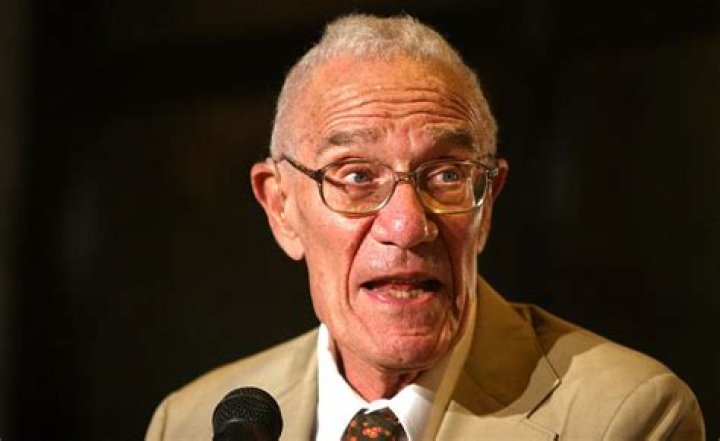
Robert Solow, a famous professor of economics at the Massachusetts Institute of Technology (MIT) who was known for his innovative research on the relationship between economic growth and technology, passed away at the age of 99.
The Royal Swedish Academy of Sciences granted Solow the 1987 Nobel Prize in Economics in recognition of his achievements. The academy recognized Solow for creating a mathematical model that deepened our understanding of production and served as the basis for contemporary macroeconomic theory.
The New York Times reported that Solow’s son verified his death on Thursday at his Lexington home. Solow criticized the prevalent growth models in a number of publications published between 1956 and 1960, arguing that their limited emphasis on labor and capital made them insufficient. He emphasized that technical advancement plays a crucial role in economic growth and that it has contributed to at least half of the expansion of the economy.
Even though Solow recognized that measuring technical progress was difficult, his work advanced economic theory.
Like his colleague Paul Samuelson, Solow advocated for an active role for the government in directing the economy, which led to his appointment as a senior economist in President John F. Kennedy’s Council of Economic Advisers. Industrialized nations were persuaded to increase funding for scientific research and education by Solow’s study. During Ronald Reagan’s presidency, he was awarded the Nobel Prize despite opposing Reaganomics’ resistance to tax increases.
During the press conference for the awards, Solow said, “The best thing you can say about Reaganomics is that it probably happened in a fit of inattention.”
Solow’s 2017 addition to the book demonstrates his continuing influence. “After Piketty: The Agenda for Economics and Inequality,” where he endorsed Thomas Piketty’s call for an annual progressive tax on wealth, deeming the wealth gap an “ominous anti-democratic trend.”
Solow, who was born in Brooklyn in 1924, attended Harvard University on a scholarship and studied economics there after serving in the military during World War II. He graduated from Harvard with a bachelor’s degree in 1947, a master’s degree in 1949, and a doctorate in 1951.
Solow joined the faculty at MIT in 1950 with the intention of specializing in statistics and econometrics, but his close relationship with Paul Samuelson led to a four-decade involvement in “straight” economics. 1995 saw Solow’s retirement from MIT.
Mario Draghi, one of Solow’s several students who would go on to become prime minister of Italy and the head of the European Central Bank, is particularly noteworthy.
In recognition of his noteworthy accomplishments, Solow was awarded the John Bates Clark Medal in 1961. He also served on the board of the Federal Reserve Bank of Boston from 1975 to 1980.
Solow’s influence was also felt at the Manpower Demonstration Research Corp., where he was chairman and founding director and oversaw the testing of policies intended to assist the underprivileged.